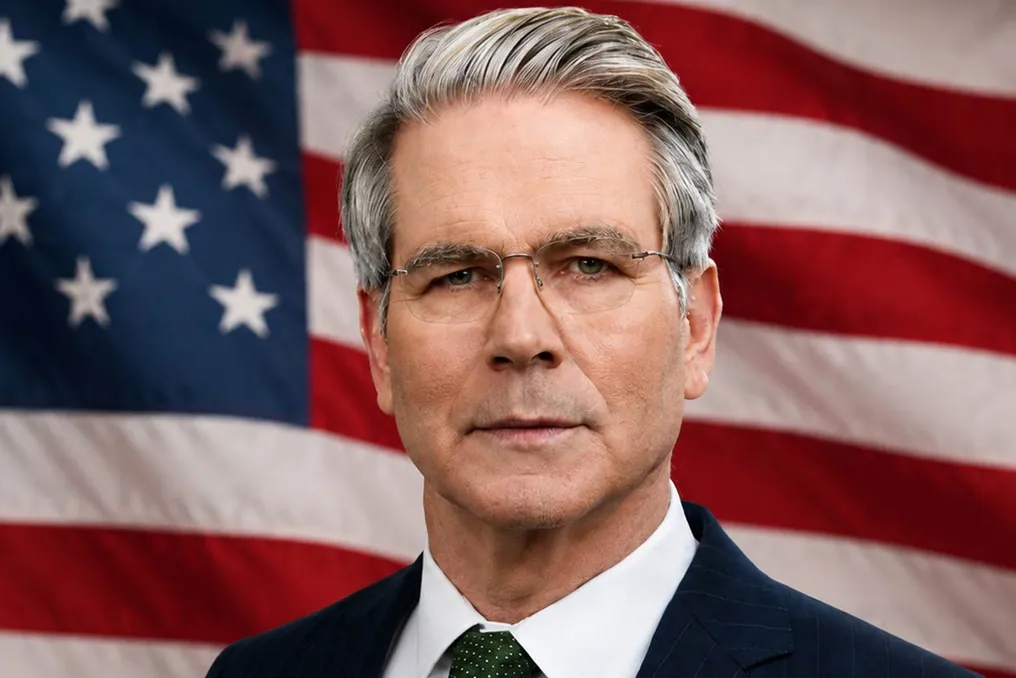
MTN Group reduced its investment in Iran by R3.9 billion in the first six months of the current year, but the company continues to hold net assets of Irancell amounting to R10.5 billion on its balance sheet. Both figures are under direct threat due to promises by U.S. Treasury Secretary Scott Bessent to impose 'the harshest sanctions in history' against Iran.
Last week, U.S. President Donald Trump stated on Truth Social that any country whose financial institutions, enterprises, airports, or state structures provide any support to Iran would face serious economic consequences. He listed potential channels that must be stopped, including oil smuggling, swap lines, money transfers, exchange bureaus, ship registries, and shell companies.
The following day, Bessent confirmed on CNBC that a 'double attack' would be applied: blockade and the strictest sanctions in history. He revisited this topic in an editorial for the Financial Times on Sunday, with details expected on Monday, the same day MTN published its interim results.
Ownership Structure and Restrictions
MTN owns 49% of Irancell, which was licensed in 2005 as Iran's second mobile network. The remaining 51% belongs to shareholders linked to the Iranian state. This stake is non-controlling and accounted for at fair value, and MTN has been trying to divest it for many years without success.
Group CEO Ralph Mupita told journalists on Monday that under existing sanctions, it is impossible to deposit or withdraw funds. This situation has persisted since May 2018, when the first Trump administration abandoned the nuclear deal with Iran. The subsequent rollback led to certain Iranian banks being disconnected from the Swift messaging network in November of that same year. Mupita noted that 'Iran has been an investment trap since May 2018... we neither invested nor withdrew funds.'
Stuck Funds
The volume of stuck funds has decreased, but this is due to currency depreciation. MTN disclosed that at the end of the reporting period, Irancell had accounts receivable of approximately R886 million, with fund repatriation 'restricted by the current sanctions regime.' Mupita explained it more simply: 'After devaluation, the total amount is just over R880 million equivalent in stuck dividends.'
This is not Irancell's only outstanding debt. A separate note indicates unpaid loans and receivables from Irancell totaling R2.01 billion. This debt is classified as non-current because its repayment is 'not planned and unlikely in the foreseeable future' and is included in investments in affiliates and joint ventures. Previously, this amount was R2.31 billion in December and R2.55 billion a year earlier. The results do not clarify the relationship between these two figures.
This is not the first such case. Under a previous round of sanctions, MTN had approximately $1 billion stuck in Iran, which the company managed to recover only in 2017, shortly before the doors closed again.
From the beginning, Irancell's operations were legally complex. Turkcell, initially selected for the license, has claimed for over ten years that MTN obtained the concession through bribery and political influence in South Africa and Iran. Its lawsuit for $4.2 billion reached the constitutional court and names former group CEO Futumu Nhleko and former director Irene Charnley, both of whom deny these allegations. Separately, MTN reported last August that a U.S. district court was investigating its former operations in Afghanistan and current operations in Iran; the company stated it was cooperating.
Meanwhile, the rest of its Middle East portfolio was liquidated. MTN exited Syria and Yemen in 2021, and Afghanistan last year. This year, the company agreed to a settlement with the Syrian telecommunications regulator worth $43.9 million, which was recorded as a profit of R716 million.
Mupita concluded: 'Only the investment in Iran remains.' He added: 'Under conditions where sanctions were lifted, we would continue to perform and exit the market in the best way possible. But obviously, that is not the case now.'
MTN has also lost some of the visibility it once had. As TechCentral reported in March, its position deteriorated to a 'cannot stay, cannot leave' state after the state shareholder of Irancell appointed a new CEO without consulting MTN, leaving MTN without local management or a seat on the board of directors.
Impact of Military Actions
The write-down was noted two weeks before the release of the results. In a trading statement dated August 11, the reason for the impairment was cited as 'geopolitical and economic conditions, as well as the war in Iran' following a U.S. and Israeli air campaign targeting sites across the country.
The latest impairment amounted to 213 cents per share, compared to 104 cents the previous year. This affected the basic earnings per share figure, which stood at 404 cents, while the total EPS excluding impairments was higher at 615 cents. The difference of 211 cents is almost entirely due to the write-down.
The adjusted total earnings per share, MTN's preferred operating metric, increased by 21.3% to 793 cents, falling within the forecasted range of 775–808 cents. If Irancell is excluded, this figure is lower in Rand terms, at 767 cents, but the growth rate is higher at 23.7%, as Irancell increases adjusted profit by approximately 26 cents per share this half-year, and its contribution was greater than the previous year.
One detail might confuse anyone comparing these percentages with the August 11 trading statement. MTN revised its comparative figures for the first half of 2025 upwards by 8 cents, to 547 cents basic EPS and 653 cents total EPS, due to changes in MTN Ghana accounting. Based on the revised figures, the declines are 26.1% and 5.8%; based on the initial ones, they are closer to 25% and 5%.
During the call, Mupita explained the write-down was for accounting reasons, not political ones: constant hyperinflation in Iran and the sharp drop in the rial exchange rate over the last six months. This leaves R10.5 billion on the balance sheet. He added: 'Throughout the year, we will revalue the level of these investments and apply all necessary accounting adjustments, up or down.'
Exposure Risks
MTN's practical protection against secondary sanctions is that Irancell is useless to it: there are no financial flows. No capital comes in, and no dividends are withdrawn, and MTN does not manage the business or sit on its board of directors.
However, the nature of the asset has changed. The 49% stake in an operator that MTN no longer manages in the country under heightened blockade differs significantly from a company that is already answering questions from a U.S. district court regarding the same country. Washington's message last week stated that any channel, no matter how passive, could become a target.
The stricter regime makes easing MTN's exit less likely, pushing back the recovery of stuck receivables to a later date and increasing the probability of another write-down by year-end. Furthermore, it keeps the Iranian line on the group's balance sheet, which requires constant dollar inflows, as the maturity date for Eurobonds approaches, and Washington urges banks worldwide to cease any ties resembling vital support to Tehran.
Otherwise, MTN's balance sheet is in good shape: the group's net debt to EBITDA is stable at 0.3x, there is a liquidity reserve of R39.1 billion, and a share buyback of R6 billion is soon to begin. Iran represents a minor deviation against these figures. It is also the only exposure for which the company has no leverage.