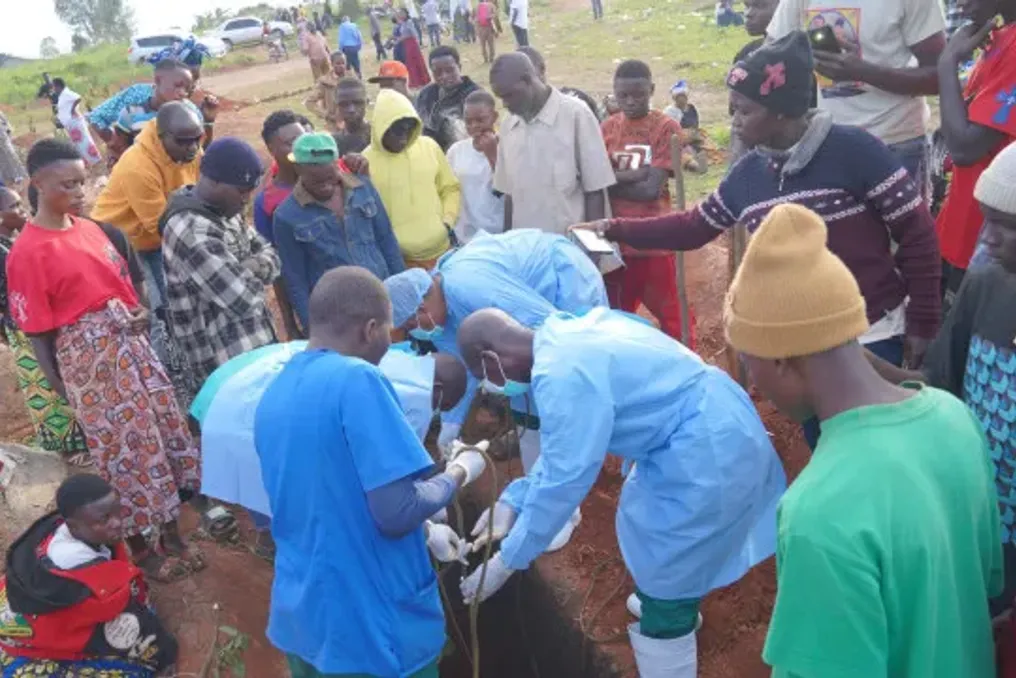
In a statement, the organization Médecins Sans Frontières (MSF) warned that the Ebola epidemic in the Democratic Republic of Congo (DRCongo) has become the deadliest and largest in the country's history, continuing to spread at a worrying rate in communities already dealing with conflict, violence, hunger, and other daily health emergencies.
To control the disease in this African country, MSF emphasized the urgent need to intensify the training of health professionals and community leaders regarding case detection, preventive measures, and control in areas affected by the epidemic.
One hundred days after the announcement of the Ebola epidemic in DRCongo, Congolese authorities reported 5,514 confirmed cases and 2,642 deaths, resulting in a fatality rate of 47.9%. The international president of MSF, Javid Abdelmoneim, observed that the epidemic continues to progress faster than the response capacity allows, stressing the importance of better identification, safe isolation of patients and their contacts, as well as support for health professionals.
In the displaced area of Rho, in the province of Ituri—where 83.6% of cases are concentrated, according to Congolese authorities' data—community leaders and MSF collaborated to contain Ebola among about fifty thousand people, focusing their efforts on prevention and promoting early diagnosis.
The local community leader, Ezrome Kiza Lumani, reported that when cases arose, they acted immediately, talking to families, listening to their fears, and encouraging those with symptoms to seek medical assistance.
Despite these local efforts, more than sixty percent of deaths in the country occur outside treatment centers, indicating rapid dissemination of the virus to new regions.
Given this situation, Trish Newport, manager of the MSF emergency program in Ituri, requested an increase in the number of health professionals specialized in the disease within the impacted communities, and not just in established treatment centers.
Currently, more than 1,400 staff members of the organization are dedicated to supporting the response in DRCongo, operating six treatment centers and managing more than 430 beds. The organization has also pressured the World Health Organization (WHO) and the Congolese Ministry of Health to expand local training to strengthen immediate reaction.
This epidemic is already the second worst in history and the largest in DRCongo, surpassing the outbreak that occurred in the same region between 2018 and 2020, although it is still below the most severe record, which caused 11,000 deaths and 28,000 infections in West Africa between 2014 and 2016.
However, the current epidemic shows the fastest growth since its beginning compared to any previous outbreak, leading the WHO Director-General, Tedros Adhanom Ghebreyesus, to warn about the potential to reach the numbers of the West African epidemic.
Recent WHO information indicates that the Ebola virus began circulating in eastern DRCongo in February, but a study published in the journal Science at the end of July suggested that the first infections might have occurred as early as January.
After the announcement of the epidemic in Ituri, the virus spread to neighboring Uganda, which declared itself Ebola-free on July 28, after registering 20 confirmed cases, including 15 cases brought from DRCongo, two of which resulted in fatalities.
The epidemic is linked to the Bundibugyo strain, whose fatality rate varies between 30% and 50%, and for which the WHO has neither an authorized vaccine nor a specific treatment. The virus is transmitted through direct contact with the body fluids of infected people or animals, causing severe hemorrhagic fever, vomiting, diarrhea, and internal bleeding.