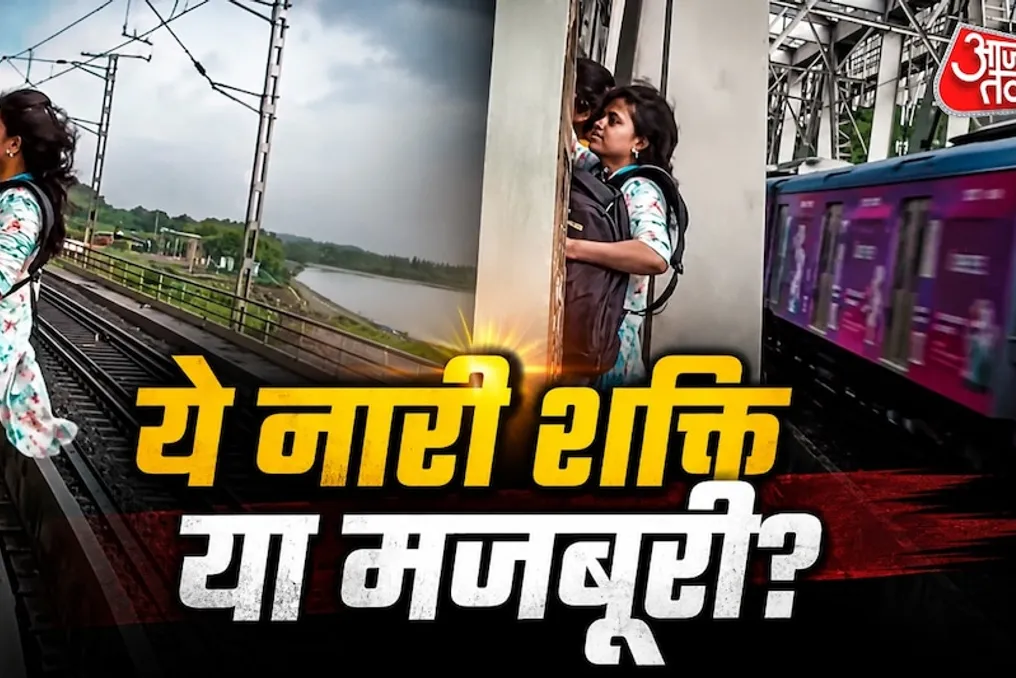
Mumbai's local train, often referred to as the city's lifeline, suffers from severe overcrowding. A video has circulated on social media showing women traveling by clinging to the carriage doors in the packed local train. While the train is moving, with the women's hair blowing in the wind, they are visible standing outside the door on the platform.
On August 23, a user on X with the handle @pallvika_ shared this video, labeling it an expression of 'female strength.' However, after the video went viral, the public objected, arguing that it was not bravery but a forced necessity. It was noted that calling it 'female strength' would obscure systemic flaws.
This incident is not isolated. Statistics on deaths in the Mumbai local train due to overcrowding raise serious concerns. According to a petition filed with the Bombay High Court by the Central Railway, 8,273 passengers have died on Central Railway tracks over the past eight years. The main causes of death include crossing tracks, negligence, and traveling while clinging to the doors of a moving train.
In the first five months of 2025 alone, 443 people died as a result of trespassing on tracks or falling from local trains. If one considers the statistics for all Mumbai suburban rail services, the picture is even bleaker. In 2025, 4,841 incidents were recorded on suburban trains, resulting in the deaths of 1,588 passengers. One user commented on this, stating that this cannot be called a system flaw, otherwise everything will be hidden under the guise of 'female strength.'
Approximately 80 percent of the population in the Mumbai-MMR region relies on local trains for commuting, yet the number of seats in the trains does not match the number of passengers. This is why thousands of people are forced to travel by clinging to the doors daily.
Commenting on the video, Dr. Gaurav J. Sontake noted that the ability to cope with difficult circumstances is commendable, but true respect will only be achieved when the system is fixed so that no one has to hang outside the train. Many users pointed to the problem with railway infrastructure and demanded an increase in the number of carriages and train frequency. Another user stated: 'Madam, at least do not call it female strength. Sometimes we are afraid to question the system, so we link this forced situation to a sense of pride.'