
DHL Stadium in Cape Town Sold Out for Springboks vs All Blacks Match
Read more
IOL
iol.co.za

DHL Stadium in Cape Town Sold Out for Springboks vs All Blacks Match

The match between the Springboks and All Blacks teams at the DHL Stadium is completely sold out, with an expected attendance of 62,000 fans on Saturday. The appetite of Cape Town residents for this rivalry remains high, despite ticket prices reaching 4000 rand.

When tickets went on sale earlier this year, their price ranged from 850 to 4000 rand, with cheaper tickets selling out first. Now, with only a few days left until the match, the question is not about buying a ticket, but whether one can be found at all.

The complete sell-out underscores the strong support for both competing teams in Cape Town. The match will start at 17:10, and the city is preparing for thousands of people to travel through the Central Business District (CBD) and Green Point starting Saturday morning. Fans who secured seats will need to carefully plan their route to the stadium.

Buses and Parking

The stadium gates will open at noon, and MyCiTi shuttles will begin running from 11:30 AM from locations such as Civic Centre, Thibault Square, CTICC, UCT, and Bellville Velodrome. JP Smith, a member of the municipal safety and security committee, warned of possible significant traffic congestion.

Smith stated: 'With the stadium fully occupied and thousands of people expected in the CBD and Green Point area, we predict serious road traffic jams on match day.' Shuttles will use a dedicated bus lane, and the last return shuttle from the stadium will depart at 22:30.

The city will provide 475 free parking spaces in the Civic Centre from 11:00 for ticket-holding fans on a 'first come, first served' basis. Free street parking will also be available in the CBD from 13:00, subject to existing restrictions. Fans can park on the UCT Upper Campus and take a shuttle from the UCT Shuttle North Stop on Madiba Circle.

Paid parking will be available at CTICC, Ryk Tulbagh Square, Picbel Parkade, Plein Park, Parkalot on Jack Craig Street, and Harbour Arch. Those using ride-hailing services can use a special zone in P14 on Green Point Main Road, between York Road and Wigtown Road.

All roads lead to the DHL Stadium on Saturday. Road restrictions will be in effect from 6:00 AM to 22:30 around the Green Point area and the stadium itself. These restrictions include Granger Boulevard between Green Point Circle and Beach Road; Beach Road in Granger Bay; Fritz Sonnenberg Road between Granger Boulevard and Beach Road; Stephan Way between Fritz Sonnenberg Road and Hamilton’s Rugby Club; Vlei Road between Helen Suzman Boulevard and Fritz Sonnenberg Road; Fort Wynyard Street between Portswood Road and Granger Bay Boulevard; and Granger Bay Boulevard between Helen Suzman Boulevard and Beach Road.

City security services will work jointly with SAPS and SA Rugby on match day. Smith strongly urged fans to plan their journeys in advance, to use shuttles where possible, and to arrive with plenty of time.

Similar stories

Springboks vs. All Blacks rivalry remains the greatest in rugby after 105 years
Read more
iol.co.za

Springboks vs. All Blacks rivalry remains the greatest in rugby after 105 years

After 105 years, the rivalry between the Springboks and the All Blacks continues to be considered the most significant in world rugby. When the 'Greatest Rugby Rivalry' tour between New Zealand and South Africa was first announced, some critics dismissed the title as arrogant. However, it is difficult to surpass the unending drama that has existed between these two teams for over a century.

Although there are long-standing and exciting confrontations, such as England versus France or New Zealand versus Australia, the uniqueness of the All Blacks and Springboks matches lies in the fact that since their first meeting in 1921, both teams have regularly competed for the title of world champion—first unofficially, and then officially.

History of the Rivalry

When the Springboks first visited New Zealand in 1921, the series of three matches ended with one win and one draw. Since then, both teams have consistently been among the world's best, often occupying the No. 1 or No. 2 positions in world rankings. As early as 1928, series in South Africa were positioned as a contest to determine the best team in the world. This was true in subsequent series in 1937, 1949, 1956, 1960, 1965, 1970, 1976, and 1981. Even the Cavaliers sporting tour from New Zealand to South Africa in 1986 pitted the two strongest teams in the world against each other.

After South Africa emerged from international isolation in 1992, the countries played 37 matches since 1921. The Springboks won 20, the All Blacks won 15, with two draws. Then came the era of the World Cup, which began in 1987 and was created to determine the best rugby team on the planet.

The All Blacks won the first World Cup, but the Springboks did not participate due to South Africa's sporting isolation. When the Boks finally entered the tournament in 1995, they won the Webb Ellis Cup in their first appearance. Over the past 10 World Cups since 1987, Australia has won twice, England once, and the remaining titles have been shared by the Springboks (four) and the All Blacks (three).

Recent Dynamics of the Rivalry

There were only one or two periods when the balance of power in this rivalry could be reasonably questioned. Between 2001 and 2006, New Zealand defeated South Africa eight times in a row. Later, in 2016 and 2017, the All Blacks scored 57 points against the Boks twice. However, after Rassie Erasmus started working with the Springboks, the balance of power changed drastically. South Africa won five of the last six encounters, including the epic 2023 World Cup final in Paris. And in the latest match in 2025, the rugby world was stunned by how the Springboks defeated the All Blacks 43–10 on home soil in Wellington.

Interestingly, throughout the entire 105-year history of this confrontation, New Zealand traditionally held an advantage when visiting South Africa. However, the situation is changing this year. For the first time, the Springboks are playing a series against the All Blacks at home as clear favorites, expecting four matches as part of the 'Greatest Rugby Rivalry' tour.

Preparation for the first match at Ellis Park next Saturday, August 22nd, promises to be thrilling. Questions arise: can the tight five of the All Blacks withstand the fierce physical power of the Springboks? Does New Zealand possess sufficient squad depth to remain competitive over four matches, especially considering expected injuries? Can the All Blacks find a way to overcome the suffocating defensive system of the Boks? And can South Africa cope with the high-tempo attack presented by New Zealand's athletic backline?

These questions will soon receive answers. The opening chapter of a new era is set to be written into the folklore of a rivalry that has defined the highest standards of international rugby for over a century. Calling it arrogance is your right. But the history of 105 years proves that the title of 'Greatest Rugby Rivalry' between the Springboks and All Blacks is deserved.

All Blacks demonstrated their readiness for any conditions to the Springboks during the great rivalry
Read more
iol.co.za

All Blacks demonstrated their readiness for any conditions to the Springboks during the great rivalry

After two matches on South African soil, the All Blacks showed the Springboks that they are ready to adapt to any challenges posed by the great rugby rivalry.

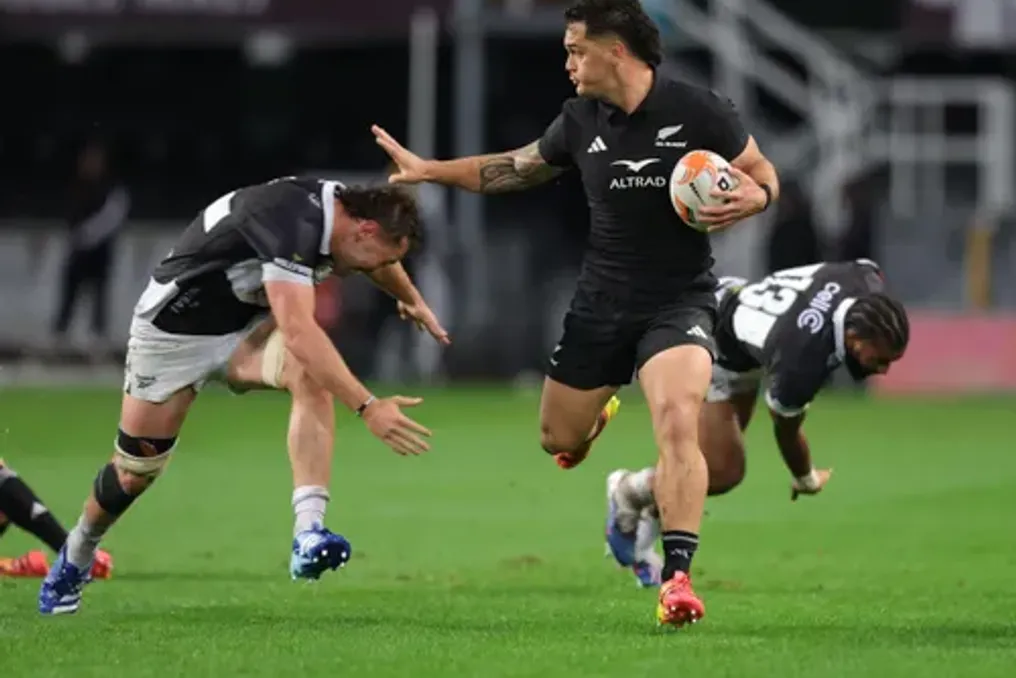
In the first match, the teams secured a tight victory over the Stormers in Cape Town. However, on Tuesday, they displayed a completely different level of play, achieving a convincing 54-0 victory over the Sharks in Durban, despite extremely difficult weather conditions.

This result highlighted the team's ability, under the guidance of Dave Rennie, to adapt to circumstances. Despite the rain and slippery surface, the team maintained its attacking potential and also demonstrated an ability to win using a more pragmatic approach.

These actions did not go unnoticed by the Springboks' head coach, Rassie Erasmus, and his coaching staff, who closely studied the All Blacks' game ahead of the first test match next Saturday at Ellis Park stadium.

In the wet conditions, New Zealand's attacking power was not suppressed; their passing game was particularly impressive, as they repeatedly found space behind the Sharks' defense. The team's ability to recognize opportunities and change tactics in difficult situations will be another warning for the world champions.

The third and final match against the United Rugby Championship team will take place on Saturday when the All Blacks face the Bulls at Loftus Versfeld in Pretoria. This match presents a different challenge, as the altitude will test the visitors after they have faced contrasting conditions in Cape Town and Durban.

Loftus, located at an altitude of approximately 1,350 meters above sea level, will provide the All Blacks with a final test before traveling to Johannesburg for the first test match. If they can overcome the effects of altitude and show another convincing performance, the New Zealanders will conclude an impressive three-match cycle against top South African teams in the URC.

More importantly for the Springboks, the All Blacks demonstrated across three very different environments that they are not preparing for the great rivalry using only one style of play. Although they intend to dominate the Bokke through their polished technique and high-tempo style, they can easily switch to a more measured approach when the situation demands it.

Regardless of the conditions awaiting them at Ellis Park, Erasmus will know that they will likely be prepared after these three encounters.

Popular