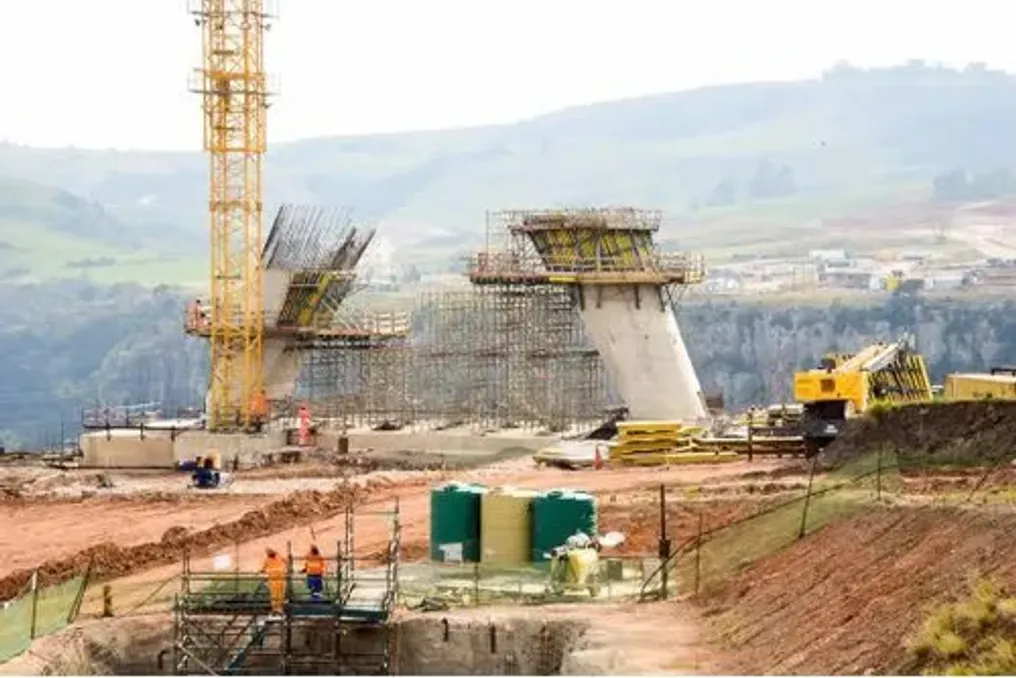
As South Africa prepares to invest over one trillion rand in infrastructure, the question arises of how these expenditures can change the future of millions of young people. It must be determined whether this funding is solely aimed at creating physical assets, or if it can simultaneously instill hope, opportunities, and skills into the social fabric of society.
Against the backdrop of South Africa planning to spend over one trillion rand on infrastructure, millions of young citizens remain outside the formal economy. This contrast requires society to answer a more complex question: is the infrastructure being built for societal transformation, or has the procurement process become so dominant that the contract holds more weight than the final outcome?
In this context, the intervention of KwaZulu-Natal Deputy Commander of Police, Lieutenant General Nlanhla Mkhwanazi, deserves greater attention. Speaking at the Parliamentary Summit on Gangs and Violence, Mkhwanazi, as head of the Organized Crime Task Team, stated that the government should reconsider its approach to public works tenders. He proposed using infrastructure financing itself as a tool for job creation, including more direct state involvement instead of automatic outsourcing to contractors.
He provided a simple example: a gravel road can be prepared, engineering graduates can supervise the construction, and people without formal education can be trained to perform practical work such as mixing cement and laying bricks. Thus, what initially seemed like a police argument about tender corruption is actually a much larger economic and managerial issue: if the state spends billions on building roads, schools, hospitals, water supply and energy infrastructure, why shouldn't these expenditures simultaneously create jobs, develop skills, strengthen local businesses, and reduce the economic vacuum exploited by organized crime networks?
This approach is not radical; what is radical is the minimal impact he has had on the architecture of public infrastructure. The unemployment crisis in South Africa cannot be viewed as an issue belonging only to the Department of Employment and Labour, because infrastructure, economic development, and policing operate across different departments, and municipal procurement follows its own institutional logic. These issues are interconnected and are symptoms of a condition that has failed to transform public spending into broad economic opportunities.
Unemployment statistics demonstrate the severity of the situation: in the first quarter of 2026, the unemployment rate was 32.7%, among youth aged 15–24 it was 60.9%, and among those aged 25–34 it was 40.6%, with the situation worsening in the second quarter. This means that South Africa is facing not just an infrastructure deficit, but an opportunity deficit.
It is necessary to acknowledge that the needs for roads, water, schools, and energy infrastructure cannot exist separately from the inability to find work or the economic isolation of communities. The state has a unique political opportunity to use its largest spending commitments to solve one of the most serious social and economic problems.
However, infrastructure is too often viewed through the lens of procurement: the project is defined, specifications are prepared, a tender is announced, a contractor is appointed, funds are disbursed, construction begins, and the opening takes place, after which the government declares the completion of another project. In this process, the fate of the young person living near this project is ignored: what skills did they gain? Did they enter an apprenticeship, become a master, start a business, or find stable employment thanks to the built infrastructure? Has the surrounding community become economically stronger, or has it merely received different coverage?
When Procurement Becomes a Measure of Effectiveness
Here, the concept of 'Governance Theatre' is useful. It arises when the demonstration of governance becomes more visible than its actual results: the tender serves as proof of government action, the contract as proof of development, the launch as proof of execution, and the opening ceremony as proof of success, while the real social and economic consequences remain unnoticed.
A tender can meet all requirements yet be economically inefficient. A contract can be legally awarded but provide insufficient developmental value. A project can be completed on time but fail to contribute to strengthening the local economy. The procurement administration checks compliance with the process, whereas development management assesses whether the process led to the necessary societal outcome. These are different questions.
The state has become very adept at demonstrating that money has been spent, but less convincing when it comes to whether that money has changed anything.
Infrastructure Must Become an Economic Platform
Imagine if every major infrastructure project initially had a measurable architecture of employment and development, rather than just a vague obligation in the tender documentation. A R500 million road project should report not only on kilometers but also on the number of young people employed, apprentices trained, skilled artisans, the volume of spending within the local economy, and the number of workers remaining economically active after the project ends.
A water project should measure not only the number of connected households but also the number of trained plumbers, electricians, and technicians, as well as local businesses integrated into the supply chain. A renewable energy project should measure not only the megawatts generated but also the human competence created for installing, operating, and maintaining that infrastructure.
This is not a criticism of contractors. South Africa needs competent construction firms, engineering companies, and specialized contractors, and the private sector plays a vital role in implementing complex infrastructure projects. The problem is not the existence of contractors, but that the contractor becomes the final point in the development discussion when the government signs the contract and assumes that development will arise automatically from that transaction. It will not.
The state must intentionally define the expected development outcomes from its spending and then measure the achievement of those outcomes.
Criminal Economy Understands Opportunities
The situation becomes even more acute as infrastructure spending has become a target for organized crime networks. Since the signing of the Durban Declaration at the National Construction Summit in November 2024, over 770 cases of extortion and intimidation related to construction have been registered, with infrastructure projects worth approximately R63 billion halted by criminal syndicates.
The link between unemployment and organized crime must be viewed more subtly. It would be intellectually lazy to claim that unemployed youth inevitably become criminals; many remain law-abiding despite severe economic hardship. However, it would be equally naive to pretend that constant economic isolation does not create vulnerabilities that organized crime networks can exploit.
Criminal networks understand that people need income, belonging, and a path to economic independence, and where legitimate institutions cannot provide this, illegal economies fill that vacuum. This is why the fight against organized crime cannot be solved by the police alone. The police can arrest, prosecutors can prosecute, and courts can sentence, but if the economic ecosystem that makes recruitment and exploitation possible persists, another network will eventually occupy that space.
Thus, infrastructure can become not only an economic intervention but also an intervention in employment, skills, public safety, and governance simultaneously.
Measuring What Remains After the Opening Ceremony
The simplest test of South Africa's seriousness of intent lies in changing the definition of a successful infrastructure project. The question should no longer be whether the project is finished. The question should be: what did it leave behind? Did it leave behind trained youth, stronger local businesses, skilled artisans, sustainable businesses, and communities with greater economic power? If the answer is no, perhaps we should question whether we achieved development or merely completed construction.
The government has committed to investing over one trillion rand in infrastructure over the next three years, according to current discussions. This is not just a budgetary figure; it is potentially one of the largest platforms for job creation and skills development available to the South African state. The choice, therefore, is enormous: we can spend a trillion rand on building physical assets, treating employment, skills, and business participation as secondary considerations, or we can deliberately use these expenditures to build both physical and human capital. The difference is colossal: a road deteriorates over time, a pipeline fails, a building requires maintenance, but a skilled worker carries potential into the future.
From Governance Theatre to Development
South Africa does not just need more infrastructure announcements; it needs a different philosophy of public spending, where infrastructure is not just concrete, steel, and contracts, but a deliberate mechanism through which the state builds human potential alongside physical assets. We can continue to judge the government by the number of tenders awarded, the volume of expenditure, and the number of projects launched, or we can start judging the government by what remains after the spending: how many young people entered the economy, how many businesses became sustainable, how many artisans were created, what volume of legitimate economic opportunities displaced criminal opportunities, and how much public trust was restored.
These questions are harder to answer than the question of awarding a tender. That is why they must become the questions that matter. Mkhwanazi may have asked the wrong question, but he asked it absolutely correctly. The question is not whether the government should hold tenders, but what the government expects from that tender. If a rand spent on infrastructure can build both a road and a skill, why should it only build a road? If it can create jobs while simultaneously reducing the space available to organized crime networks, why shouldn't that outcome be intentionally embedded in the project? South Africa does not just need infrastructure; it needs infrastructure that produces opportunities, procurement that produces potential, and public spending that produces...