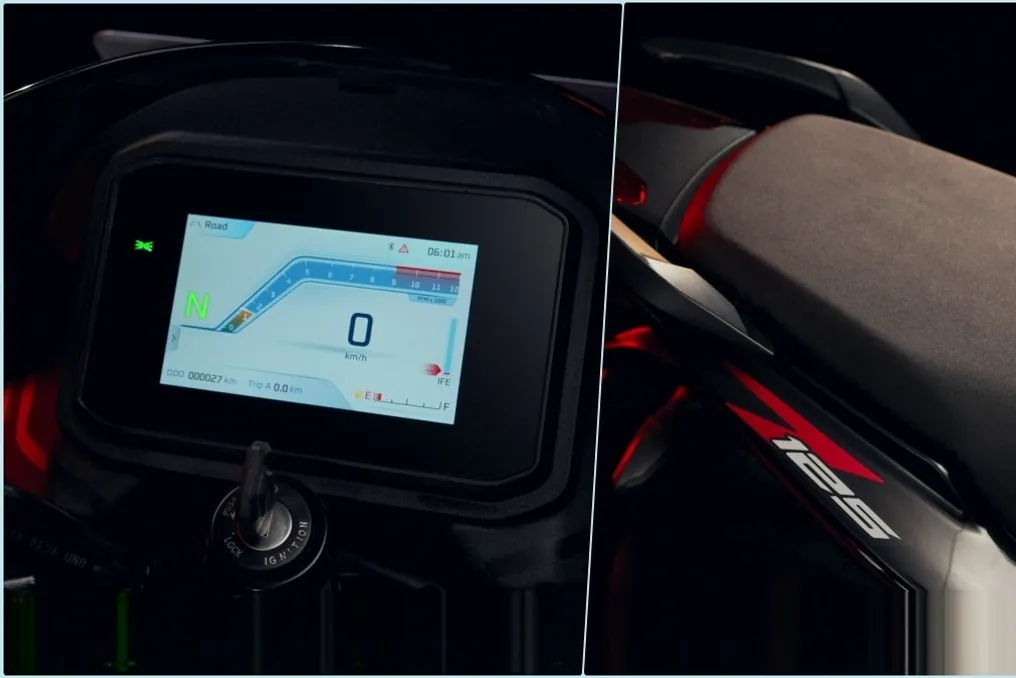
Bajaj Auto has introduced the new generation of the Bajaj Pulsar 125 motorcycle for the Indian market. Instead of just a cosmetic update, the manufacturer has made significant changes to the engine, suspension, braking system, and digital functions.
Special attention has been paid to adding a TFT display, as well as Bluetooth connectivity and integration with Google Maps. The starting price for the new Pulsar 125 ranges from 92,900 to 1.04 lakh rupees.
The new model is equipped with a 124.58 cc single-cylinder engine that generates 12.1 hp of power and 11.4 Nm of torque. This is a slight increase compared to the previous version, which used a 124.38 cc engine producing 11.8 hp and 10.8 Nm of torque. The transmission remains five-speed, and the company has not provided information on changes to the gearbox design.
The most noticeable change is in the instrument panel. Depending on the configuration, the motorcycle can have a fully digital LCD display of 4.8 inches or a larger 5-inch TFT display. Variants with the TFT display support Bluetooth connection. The most expensive versions also include Wi-Fi, Google Maps integration, and screen mirroring functionality. Previous models had an analog-digital instrument cluster, making the new motorcycle significantly more technologically advanced.
Furthermore, the Pulsar 125 is fitted with a USB Type-C charging port; however, this feature is available as an optional extra on the LCD variants, simplifying mobile device charging for daily users.
The manufacturer has also updated the suspension system. The front is now equipped with telescopic forks measuring 31 mm high with a travel of 125 mm, whereas the old model used 30 mm forks with a travel of 135 mm. The biggest change concerns the rear: instead of twin shock absorbers, a mono-shock suspension with a travel of 110 mm has been installed, while the old dual shock absorber configuration provided a travel of 102 mm.
The braking system has been improved: the size of the front disc has been increased from 240 mm to 260 mm. The rear brake remains a 130 mm drum. The motorcycle is equipped with a Combined Braking System (CBS), which ensures balanced braking even at high speeds.
The new Pulsar 125 features LED headlights, along with additional LED indicators and taillights. Depending on the configuration, features such as hazard lights and side indicators are available. More expensive versions are equipped with a double horn, while the base variant has a single horn. The motorcycle supports both electric start and kick-start capability.
The Bajaj Pulsar 125 is offered in various configurations, differing by the presence of a seat (single or split).
The base variant with a single seat and LCD display costs 92,900 rupees. The variant with a split seat and LCD display will cost 94,518 rupees. The model with a single seat and TFT display is priced at 99,291 rupees. The most expensive option, including a split seat, TFT, and connected features, is priced at 104,318 rupees.
It should be noted that the starting price of the new Pulsar 125 is higher than that of the old model, whose single-seat options started from 81,556 rupees. However, Bajaj compensates for this increase by offering customers significant improvements, including increased power, a mono-shock absorber, a larger front disc, and an integrated TFT instrument cluster.