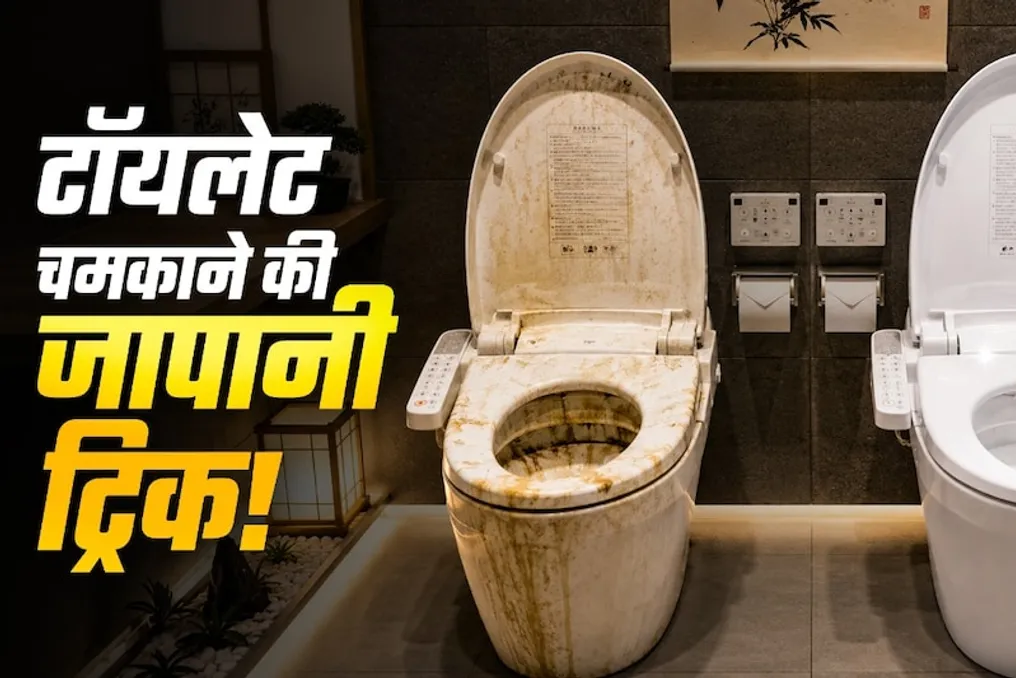
When cleaning the house, people often pay close attention to the floor, kitchen, and furniture, but cleaning the toilet is often postponed. Even after thorough cleaning, yellowish-brown limescale can appear on the toilet seat after a few days, and black dirt can accumulate under the rim. Many try to remove these contaminants using aggressive chemical agents or bleach, but the problem returns again and again.
Toilet contaminants come in different types, so using the same cleaning agent for all types of dirt is not the right approach. If you are tired of your toilet constantly getting dirty and being difficult to clean, you no longer need to worry. We present a simple Japanese method for cleaning toilets. Toilets in Japan always look like a mirror thanks to a simple care habit that includes daily light cleaning and periodic use of vinegar, which prevents dirt from accumulating for long periods.
The yellow or brown film forming around the water surface is often mistakenly taken for dirt or bacteria. However, this is not the case. If hard water containing calcium and magnesium is used in your home, these minerals can form a layer on the surface upon prolonged contact with water. Gradually, this layer becomes denser and harder; it is called limescale or mineral deposits.
This is why simply adding bleach or scrubbing intensely with a brush does not completely eliminate this yellow layer.
The situation with black scale under the toilet rim is different. There is little light and water in this area. Here, in addition to mineral deposits, moisture, bacteria, mold, and cleaning residue accumulate. Over time, this layer becomes thicker and darker, so the same method cannot be applied to remove dirt along the waterline and under the rim.
For removing mineral layers, such as limescale, an acidic agent is best suited. White vinegar contains acetic acid, which reacts with calcium carbonate, helping to loosen this mineral deposit. In Japan, white vinegar is predominantly used for toilet cleaning.
How to use vinegar to clean the waterline
If a light scale has formed on the toilet that persists for several weeks or months, you can pour about a cup of white vinegar into the bowl. Then, wet a cloth or paper towel with vinegar and apply it to the area where the scale has accumulated under the rim. Leave it for 30 minutes. After this, gently clean the toilet with a brush and rinse. It is more important to give the vinegar time to work on the scale than to scrub intensely.
If there is thick scale on the toilet that has accumulated over many months or years, a single 30-minute treatment will not be enough. In this case, this process can be repeated over the next two or three days. With each repetition, the stubborn yellow scale will become slightly softer, and the toilet surface will begin to clean gradually.
Never mix vinegar and bleach
It is important to remember: never mix vinegar with bleach. Vinegar is an acidic substance, while bleaches contain chlorine-based chemicals. Mixing them can lead to the release of toxic chlorine gas, which can cause serious irritation to the eyes and respiratory tract. Therefore, if you plan to use both products at different times, first thoroughly rinse the previous cleaning agent and ensure good ventilation in the bathroom. The safest option is never to mix them.
A characteristic of the Japanese approach to cleaning is the emphasis on small daily cleaning rather than powerful deep cleaning. Daily or every-other-day light cleaning of the toilet with a brush for about 30 seconds helps prevent new scale from hardening. It is also useful to leave a small amount of white vinegar once a week to control the formation of mineral deposits.
The main mistake in toilet cleaning is perceiving every spot simply as 'dirt'. It is necessary to distinguish between mineral scale on the waterline, dirt under the rim, and ordinary stains. Applying the correct method will eliminate the need for large amounts of chemicals, intensive scrubbing, and great effort. Especially if you have hard water issues, regular attention to hygiene will help prevent the growth of stubborn limescale.