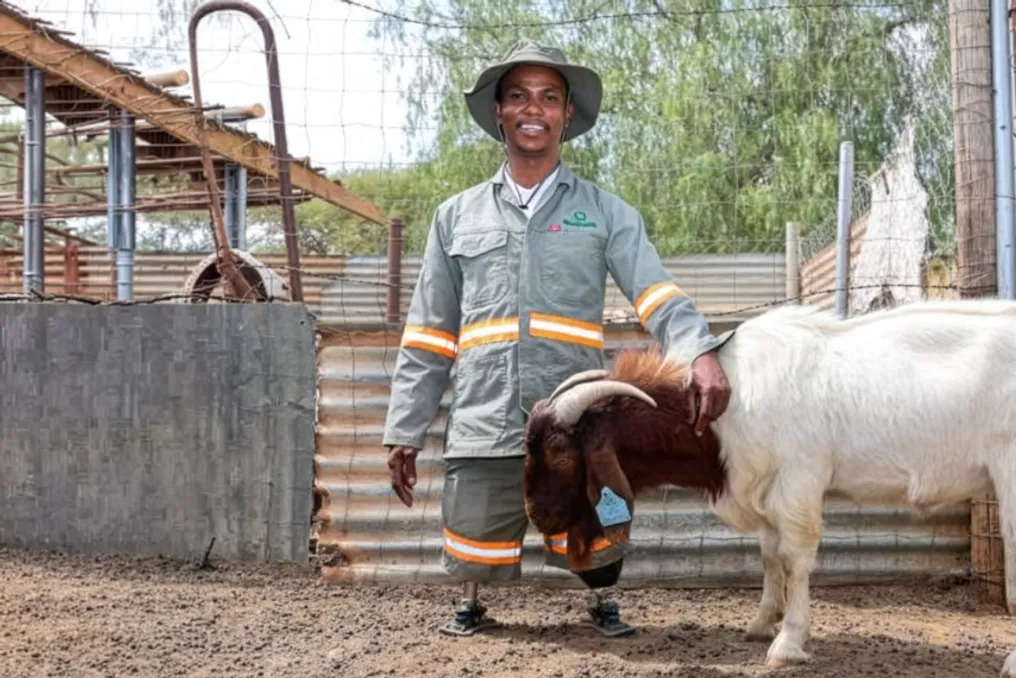
Before the tragic accident that cost him both legs, Realeboga Marlon Mangwegape had already proven his willingness to sacrifice for agriculture, even dropping out of school in his youth to engage in livestock farming.
Today, this unwavering determination fuels his home enterprise, Temo Leruo Botshelo, transforming a life-altering disability into an unstoppable story of resilience and growth.
Mangwegape's roots run deep into the soil of Chiefscort, a small village in the North-West province. His initial education began at Maranata Primary School, but his real classroom was nature among the livestock.
His grandfather, Gobusamang Mangwegape, and uncle Tebogo were involved in animal husbandry from an early age. By nine years old, young Mangwegape was fascinated by animals, especially the excitement of horseback riding.
Mangwegape recalls: 'I started loving farming as a child... because I liked it and enjoyed riding horses.' He continues: 'Most older people in my community kept various livestock, including horses, so I helped them with their herds just for the ride on the horse, and that's where I learned about animal husbandry.'
Driven by a desire to work alongside local herders, he skipped four years of schooling to work as a full-time herder. Only after mastering the rhythm of herding did he return to his studies, eventually graduating from Mankuroan Technical and Commercial School in 2010, and later pursuing IT at PC Training.
Despite completing formal education, Mangwegape waited over ten years before securing a nine-month internship in 2018 with the South African Social Security Agency (Sassa) as a disability benefits administrator.
While processing support for the community of people with disabilities, he used his modest salary to lay the foundation for his true calling—commercial farming.
In 2019, he officially registered his business under the name Temo Leruo Botshelo, a Setswana phrase meaning 'farming is life'. Using his savings, he launched a small livestock farm and strategically chose Boer goats and Dorper sheep to build his base.
He explains the choice: 'I decided to farm with Boer goats because they are meat goats and adapt well to harsh conditions.' He adds: 'The probability of twins is high, and they are good mothers, just like Dorper sheep. They are good for business, plus they give birth twice a year. So, one goat can give you four goats by the end of the year; demand is also high.'
To supplement the flock, he added local chickens to clean the enclosure of parasites and ensure household consumption, along with four working dogs.
By 2021, he acquired two Boer crossbred does and received a Support and Contribution Programme (Pesi) voucher from the Department of Agriculture, which he used to purchase a quality Boer ram.
Then came an important opportunity: the Department of Agriculture and Rural Development in Mahikeng invited him for an interview for a messenger position. Completing the application required his fingerprints and a police clearance certificate on short notice.
Mangwegape needed to travel to Pretoria, where the head office could quickly issue the necessary document so he could make the interview.
Initially, he traveled to Johannesburg with the boyfriend of his younger sister, Oratile Motlabaane, who offered him lodging. The plan was to travel to Pretoria the next morning, obtain the certificate, and immediately return to Mahikeng for the interview.
However, he never made it to the interview venue.
While in Johannesburg, Mangwegape was hit by a truck. The impact was catastrophic. He was evacuated to Milpark Hospital, where surgeons performed above-the-knee amputations on both his legs.
In an instant, the young farmer who chased livestock on horseback as a child became a member of the very community of people with disabilities he once served.
Refusing to let the loss of limbs halt his agricultural ambitions, he returned home to Chiefscort and adapted. Continuing operations on his grandmother's backyard, he managed the animals with relentless determination, hiring one permanent herder and one part-time assistant for heavy physical labor.
His strategic breeding approach has paid off. Starting with just two does in 2021, Mangwegape has expanded his home farm to 72 goats, while also increasing his stock of Dorper sheep, local chickens, and guard dogs.
He regularly sells his livestock directly within his local community and at official livestock auctions.
Despite his remarkable recovery and growth, Mangwegape's ambitions are seriously constrained by spatial limitations. Operating from a backyard prevents him from scaling up to the full commercial enterprise he envisions.