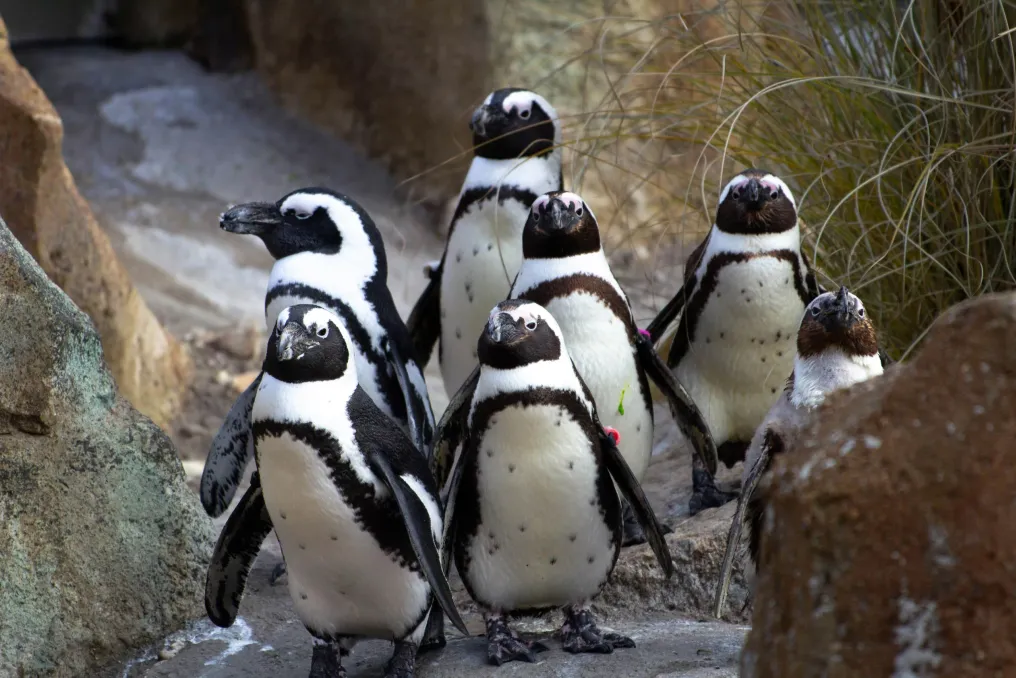
In the Stony Point area, located in Betties Bay, African penguins and small fishermen share a stretch of coastline. Both groups depend on the state of the ocean; however, as fish stocks decline and the penguin population approaches extinction, local fishing communities are finding new ways to protect the sea they have considered home for generations.
Miriam Smith, seventy-four years old, has lived in Kleinmond since she was nine, when she moved there with her family from a farm in Overberg. They lived in a tight-knit community near the harbour. She recalls: 'Life there was wonderful. Fishermen would go out at 4 am, and if we woke up, my father would say, 'Let's go help them launch the boats into the sea.' '
When Miriam was fourteen, the community was destroyed by forced removals during apartheid. One summer, the municipality arrived with tractors, bulldozers, and trucks, ordering residents to pack up and leave the harbour before their homes were turned into ruins.
Many residents of the Koggelberg area are descendants of the fishing community established in the mid-1800s. Traditionally, they fish from the shore or on small boats, using methods passed down through generations.
Marceline Barry, twenty-eight years old, grew up in Kleinmond and remembers standing at the harbour with women from her family, waiting for the men to return from the sea. She recounts: 'They gave us small fish they caught, and we carried it to our grandmother, and she baked Kep-brem, which we call Hottentot. There were so many fish, especially during the snoek season.'
Today, there are significantly fewer species of cod-like fish around Stony Point. Snoek has not been seen there for seven years, forcing fishermen to travel to the West Coast in search of this fish.
Local fisherman Morn Jon, 47, emphasizes that the knowledge of these fishermen about the ocean cannot be learned from books, describing the sea as 'a living force that must be respected, never taken for granted.'
A major attraction in Koggelberg is Stony Point in Betties Bay, home to a unique colony of African penguins and four species of gulls. Hartlaub's gulls and seaweed terns also feed around the colony, and giraffes and southern stone iguanas can often be seen on the rocks.
The colony is managed by CapeNature with support from SANCCOB, BirdLife South Africa, and WWF South Africa. The area features wooden walkways for visitors, and plans include improving wheelchair access and expanding coastal access for penguins, as well as installing shelters to protect against summer heat.
However, the African penguins themselves are in serious danger. In 2024, the IUCN classified African penguins as critically endangered, predicting their extinction in the wild by 2035. Only 676 pairs were counted in Stony Point, almost half as many as the previous year.
Historical threats include egg collection, predation, climate change, oil and noise pollution, and habitat loss. But one of the biggest problems is food. African penguins are specialized consumers, heavily reliant on sardines and anchovies. When these small pelagic fish become scarce, penguins cannot simply switch to another food source. Studies have shown that competition from large-scale trawling fishing can reduce the amount of fish available to penguin colonies.
Conservation groups SANCCOB and BirdLife South Africa, represented by the Centre for Biodiversity Law, filed a lawsuit against the South African government, arguing that existing fishing bans are insufficient to prevent the extinction of the African penguin. In March, the government, environmental groups, and the fishing industry agreed on new no-take zones around penguin nesting sites. Stony Point became one of five colonies benefiting from this, with the exclusion of small pelagic trawling covering over 90% of the colony's main feeding zone.
Research continues. Weight bridges at four colonies, including Stony Point, record the weight of penguins before and after feeding, helping researchers assess the effectiveness of new restrictions. Nevertheless, conservationists argue that more needs to be done during the off-season, when young penguins leave protected areas and require sufficient food at different life stages.
Saving the African penguin is more than just nature conservation. For small fishermen, the decline of these birds is also a warning sign about the health of the broader marine ecosystem. Penguins feed on sardines and anchovies, which are also an important food source for valuable cod-like fish such as hake. Thus, protecting the penguins' food base can benefit the entire marine ecosystem—and the fishing communities that depend on it.
However, coastal communities are among the most marginalized groups in South Africa, notes Craig Smith, senior marine specialist at WWF. They often have little voice in government and science. In 2013, WWF opened an office in Kleinmond to pilot its Fisheries Conservation Project with local fishermen and the wider community. Instead of pushing fishermen toward entirely different professions, the project sought ocean-related livelihoods, including marine ecotourism.
The Muisi Witstig community, for example, holds commercial rights to manage the restaurant On the Edge, whose success is closely linked to the penguin colony and the attracted tourism. Another success story is Relebokhile Mbele, who manages guides at Sisonke Enviro Tours. After moving to Kleinmond in 2018, she joined a training program supported by WWF, which helped five members of the Koggelberg community gain qualifications as ecotourism guides. These guides now conduct nature-based tours, sharing the natural and cultural heritage of Koggelberg and earning income.
WWF has also assisted local fishermen in monitoring catches and accessing markets. Applications like ABALOBI Fisher and ABALOBI Marketplace allow fishermen to register their catch and sell species listed on the WWF-SASSI Green list to restaurants. In 2023, two small-scale fishing cooperatives in Koggelberg received fishing rights for the first time.
There are also community members working directly in nature conservation. Marceline was one of 19 local residents hired by WWF as a marine and coastal community monitor. Two positions in Stony Point are funded by WWF. Monitors record environmental issues, count seabirds and mammals, check for pollution and entangled animals, and collect plastic waste from the shoreline.
Today, Marceline works as a nature conservation monitor for WWF in Stony Point. He has been trained in handling birds affected by predators or pollution, as well as artificial feeding of chicks. He has also contributed to research on small endemic shark species of South Africa. Together with other local fishermen and community members, he has helped scientists collect data using baited remote underwater video (BRUVs) systems to study marine species and their habitats along the coast between Betties Bay, Pringle Bay, Kleinmond, and Hermanus. The project recorded 70 marine species, and the results showed that small endemic sharks, including pajama and puffadder sharks, thrive in seaweed and reef habitats. The importance of protecting sandy and muddy habitats used by other sharks and rays was also highlighted.
For Marceline, this work has changed his attitude towards the sea. During the project, he finally went out on a fishing boat himself, instead of watching the boats from the shore. It takes scientists years to understand how the environment behaves. Fishermen often absorb these patterns over decades—when fish gather, where they feed, and how seasons affect the sea.
The current task is to merge these two bodies of knowledge. WWF conducts quarterly stakeholder meetings between public fishermen, the Koggelberg Marine Biosphere Working Group, and CapeNature to discuss everything: from ocean management and poaching to governance and compliance.
This makes sense. Scientists, conservationists, and fishermen may have very different experiences, but they share a common hope: a healthy ocean that can continue to support both people and wildlife. And perhaps, ultimately, everyone wants the same thing—not to read about the extinction of the African penguin in 2035.
_