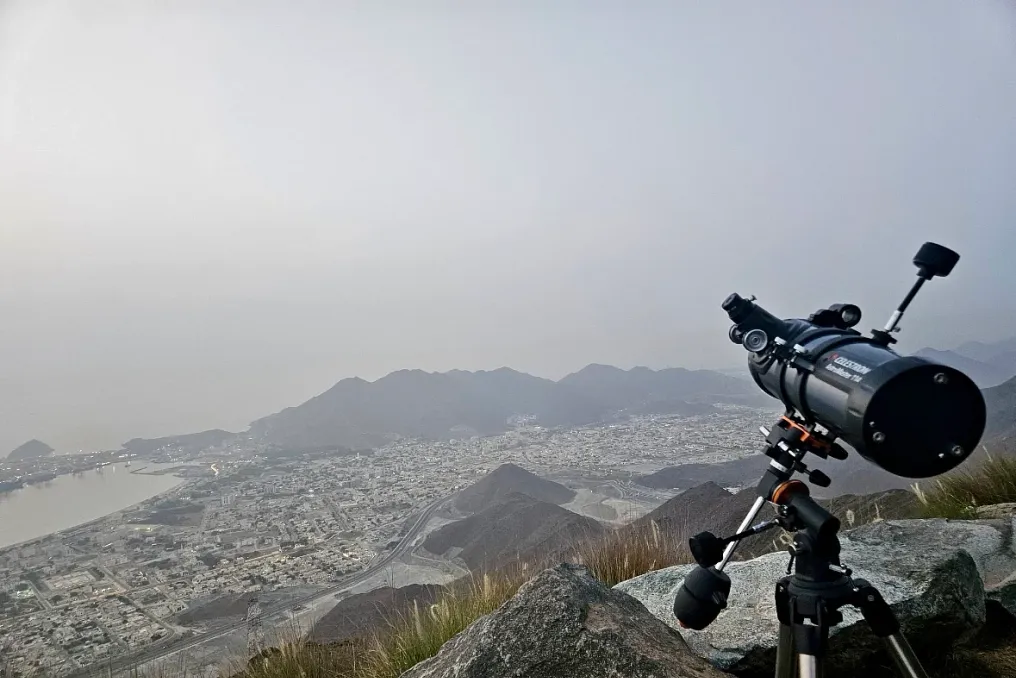
The rising of the star Suhail in the United Arab Emirates began on Monday, August 24th, but due to high humidity and fog, it could not be clearly observed in the early morning hours, reported Ibrahim Al Jarwan, chairman of the Emirates Astronomy Society.
Al Jarwan was in Khor Fakkan to observe Suhail, also known as the 'Star of Yemen,' and shared an update on X after attempting to locate the star. He noted that the star was observed on August 24th of last year, but the conditions this year were less favorable.
'The humidity was high, 80 percent or more, and fog formed, so we could not observe it,' he stated. Al Jarwan emphasized that stars maintain their annual rising times, but suitable observation conditions are not always available.
He added that the general public will be able to see Suhail more easily in clear weather in about a week. The appearance of Suhail is traditionally associated with the gradual decrease in summer heat, but residents should not expect a sharp drop in temperature immediately after the star appears.
The star marks the beginning of a transitional period lasting about 40 days, known as Sufriya, during which weather conditions gradually change from intense summer to cooler. This change is usually first felt at night, while daytime temperatures may remain high until September. Al Jarwan compared this process to a pot that remains hot after the fire beneath it is turned off: the intensity of heating may begin to decrease, but the accumulated heat requires time to dissipate. A traditional saying associated with Suhail similarly indicates cooler nights, not the immediate end of summer.
Weather conditions are expected to fluctuate during the Sufriya period before stabilizing around mid-October with the onset of the traditional season Wasm. The winter season in the UAE begins significantly later. Suhail also holds an important place in the traditional Emirati astronomical calendar, known as Al Durur. This ancient system divides the year into 36 periods of 10 days each, each linked to astronomical and climatic conditions.
Historically, this calendar was used by communities to determine suitable times for planting and harvesting, forecasting wind and rainfall, identifying fishing and aquaculture seasons, and tracking the migration of wild and marine birds. Calculations based on Al Durur are closely related to the rising of Suhail.
The Sheikh Zayed Mosque Center has also established a special committee to monitor and document this star, reflecting its significance to the traditional Emirati calendar, as well as to astronomy and meteorology. This initiative includes organizations such as the National Metrology Centre, Sharjah Academy of Astronomy, Space Science and Technology, the Emirates Astronomy Society, and the International Astronomical Center.