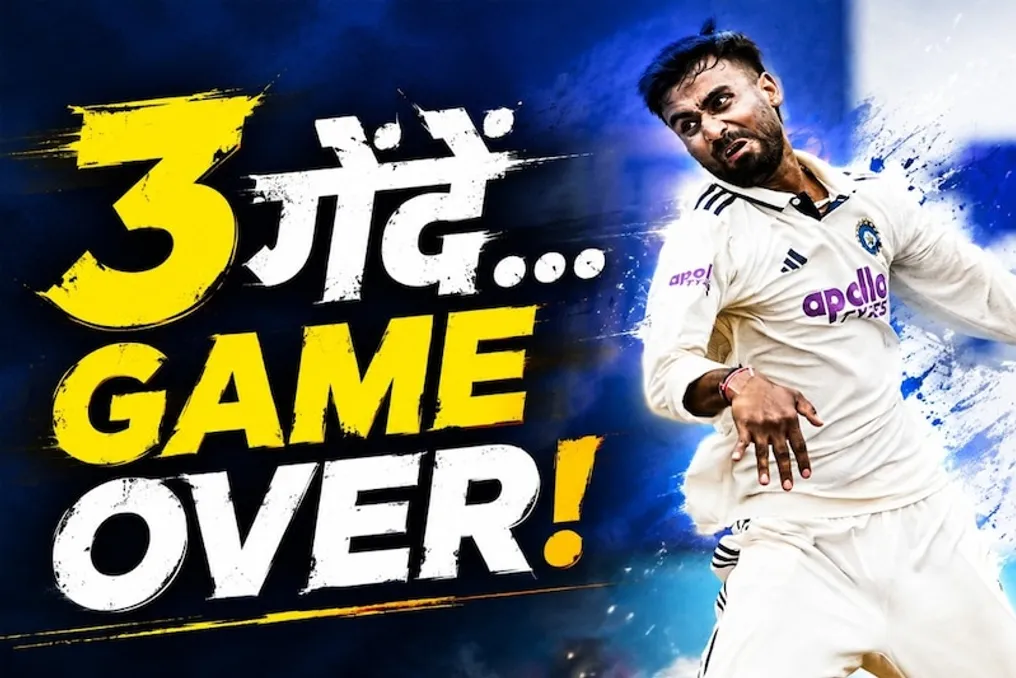
Yujwendra Chahal replicates viral celebration gesture after taking wicket in England
Read more
Aaj Tak
www.aajtak.in

Yujwendra Chahal replicates viral celebration gesture after taking wicket in England

Indian leg-spinner Yujwendra Chahal has attracted public attention not only for his playing skill but also for his unique way of celebrating while playing club cricket in England.

Playing for Northamptonshire, Chahal replicated the famous '6-7' celebration during a match against Lancashire, which had previously gone viral thanks to Delhi female cricketer Medhavi Bidhu. This match was part of the County Championship between Northamptonshire and Lancashire at Old Trafford stadium in Manchester.

After dismissing Lancashire batsman Joe Murse, Chahal performed the very '6-7' gesture with his hands that recently became popular on social media following Medhavi Bidhu's celebration. Chahal then shared a video of this moment and the celebration on his Instagram account, accompanying it with the witty caption: 'Outspinning the algorithm.'

In addition to the celebration, Chahal demonstrated outstanding bowling in this match. He took 3 wickets, conceding 39 runs in 18.4 overs. His team, Northamptonshire, won by 316 runs. This victory marked Northamptonshire's first red-ball victory at Old Trafford since 1999.

The discussion about the '6-7' celebration began during the WDPL 2026 Women's Delhi Premier League tournament. The Delhi cricketer, Medhavi Bidhu, used this unusual hand gesture after taking a wicket, which quickly went viral on social media. Subsequently, the gesture was integrated into the '6-7' trend popular among Generation Z. Now, thanks to Chahal's actions, this trend has spread from Indian cricket to English club cricket.

Similar stories

Cricketer Medhavi Bidhuri goes viral for her 'Gen-Z' celebration after taking a wicket
Read more
www.aajtak.in

Cricketer Medhavi Bidhuri goes viral for her 'Gen-Z' celebration after taking a wicket

On the cricket field, players attract attention not only with their sporting achievements but also with their unique style. During the first match of the Women's Premier League Delhi 2026 (WDPL), held on August 20 (Thursday) between Central Delhi Queens and South Delhi Superstars, a video was circulated widely on social media.

This video generated significant interest among fans because it showcased a distinctive celebration style displayed by all-rounder Medhavi Bidhuri of Central Delhi Queens after she took a wicket.

Medhavi Bidhuri plays for Central Delhi Queens as an all-rounder. She bats right-handed and bowls using leg-break. Although Central Delhi Queens lost the match by a margin of 29 runs, her Gen-Z style celebration quickly went viral on social media. In this match, Medhavi took 2 wickets, conceding 24 runs in 4 overs, and herself was dismissed for only 5 runs while batting.

According to social media reports, the idea for such a celebration came from Medhavi's sister. Her sister was impressed by the Gen-Z style and advised Medhavi to wear jersey number 67 and perform a special celebration after taking a wicket. This video of her celebration quickly went viral, and fans are praising her for both her cricketing talent and her cute and confident style.

The '6-7' trend is a viral meme or an inside joke currently used among Gen-Z and in social media language. It does not have deep meaning. On platforms like TikTok and Instagram, it has become popular to use it in a playful manner, especially saying 'Six-Seven' with specific hand gestures. This has turned into a kind of internet slang that young people often use without any particular reason. This is why Medhavi Bidhuri's jersey number 67 also attracted public attention. One wicket, a special celebration, and jersey number 67 brought Medhavi Bidhuri into social media discussions, and her Gen-Z style is now very popular among cricket fans.

Manav Sutar demonstrated why his cricket style of play is dangerous
Read more
www.aajtak.in

Manav Sutar demonstrated why his cricket style of play is dangerous

In cricket, a bowler's true value is determined not only by the number of wickets he takes but also by how many different questions he can pose to the batsman. When a bowler constantly changes tactics while using the same motion, it starts tipping the scales in his favor, as the batsman is forced to find answers to new challenges with every delivery.

In the Galle Test match, the Indian team saw exactly this kind of bowler in Manav Sutar. Although two Test matches are not enough for a final judgment on a player's career, the signals given by 24-year-old Sutar in these two games are strong enough to warrant close attention.

It was particularly telling that he used three different approaches against three different batsmen. This convincingly demonstrates that India might gain not just one bowler, but a player capable of posing a new question to the batsman with every ball.

On the fourth day of the Galle Test, Sutar bowled a ball to Pasindu Sobarandera, forcing him to drift in the middle and leg area. The ball did not have much spin and continued its path roughly in the same direction it came from. Sobarandera tried to defend, expecting the ball on the inside edge, but the ball was not there. It hit the player's back leg. India utilized the review option, and ball tracking showed three red flags—LBW.

Sutar defeated the batsman not through spin, but through a straight delivery.

The situation changed when Sonal Dinusha came onto the field, who was only 16 runs away from a century in his second innings. Sutar bowled the ball outside off stump this time, giving it flight, thereby inviting the left-handed batsman to attack. Dinusha attempted to clip the ball, but it struck the inside edge of the bat, went into the pad, and rebounded into the leg-side. The ball was caught. Here, Sutar did not attack the wicket directly; he forced the batsman to play and waited for a mistake, creating the conditions for it himself.

Next up was Prabhat Jayasuriya. This time, Sutar increased the pace and used drift. The ball speed was 92.7 km/h. This drifting ball looked like it could be easily defended with the back foot for a left-handed batsman. However, the ball landed on the pitch, gripped it, and deviated slightly. This was enough: the ball hit the outside edge of the batsman and struck the off-stump.

Three balls. Three different speeds and lengths. Three different questions... and the answer to all three—wicket. This might be the most interesting part of Sutar's story.

Indian batsman K.L. Rahul very accurately grasped this characteristic of Sutar. In his opinion, Sutar's true strength lies in the 'subtle variations' achieved by using the same motion and angle. He can slow down or speed up the ball without making large changes to his arm speed. In conditions like Galle, he also brilliantly utilized the drift provided by the air.

This difference is hugely significant. For an orthodox slow left-arm spinner, it is rare to be able to make the ball move in for an LBW and also move out to touch the bat's edge, using the same motion.

Usually, when talking about such spinners, the first thing that comes to mind is bowling to one spot, letting the pitch do the work, and waiting for the batsman's error under pressure. However, Sutar's initial story is different. He can create the impression that there is nothing special about the ball, but at the next moment, by changing the speed, drift, length, or spin of the ball, he completely changes the entire question.

In two Tests, Sutar took 17 wickets, including two five-wicket hauls, 10 wickets in one match, and an average speed of 27.2. His economy rate is only 2.49 runs per over. The statistics are impressive, but even more important is the way he secures these wickets. Sutar does not dismiss batsmen in the same way; he finds different paths using the same bowling action.

K.L. Rahul also pointed this out. He believes that Sutar's consistency gradually puts the batsman in a difficult mental situation. If the ball doesn't spin, the batsman thinks he needs to do something... and as soon as the batsman gets into such a state, the bowler is in a position to win the match. Thus, Sutar's greatest strength is not just the ball's spin; his strength is that he does not allow the batsman to be confident about the next ball.

Sutar's appearance in Test cricket was not sudden. His experience playing first-class cricket, in India A tours, as well as in various conditions such as Australia, Sri Lanka, and England, prepared him for international cricket.


Yashwish Jaiswal provoked Niroshan Dickwell, who lost an important wicket under the influence of an IPL contract promise
Read more
www.aajtak.in

Yashwish Jaiswal provoked Niroshan Dickwell, who lost an important wicket under the influence of an IPL contract promise

The Indian team won by 165 runs in the first Test match against Sri Lanka on the last day of the second session. Several exciting moments occurred during the game, in which the young Indian left-handed batsman Yashwish Jaiswal played a key role, achieving significant success by using psychological pressure on the opponents.

Under the influence of Jaiswal's provocations, the experienced Sri Lankan batsman Niroshan Dickwell lost his composure and carelessly hit the ball, thereby losing his position. This video featuring Jaiswal is actively circulating on social media.

When the Sri Lankan team set a large target of 372 runs, they showed impressive batting in the morning session of the fifth day. Danjaya D. Silva and Sonal Dinusha scored half-centuries, neutralizing the Indian spin attack. However, Ravindra Jadeja broke this partnership by catching Danjaya D. Silva on the short leg side, allowing the Indian team to get back into the game.

After this, the experienced Niroshan Dickwell came onto the field, from whom the Sri Lankan team expected him to bat patiently and help achieve either a draw or a win. As soon as Dickwell took his place on the field, Yashwish Jaiswal, who was in a slip position, began putting pressure on him. Jaiswal constantly goaded Dickwell, urging him to hit several sixes on the left side of the field.

Dickwell could not resist this remark and replied that, of course, he would do it. Jaiswal eventually lured Dickwell into his trap by hinting at an IPL contract. He stated that if Dickwell had the courage, he should hit sixes; if he did, Jaiswal would talk to his team and secure him an IPL contract.

Jaiswal's psychological game immediately bore fruit. In the next over, fast bowler Prasidh Krishna unleashed a series of bouncers on Dickwell. Under the pressure of Jaiswal's challenge, instead of playing defensively, Dickwell tried to hit Prasidh's strong delivery. The ball touched the outer edge of the bat and went straight into the hands of the backfielder. Dickwell returned to the pavilion, scoring only 10 runs.

The young team, led by captain Shubman Gill, set a huge target of 372 runs against Sri Lanka. The home team's counter-attack was completely dismantled by spinner Manav Sutara, who took 6 wickets. The second innings of Sri Lanka finished on only 206 runs, allowing India to secure a comfortable victory by 165 runs. Sutara, who took six wickets in the second innings, accumulated a total of 10 wickets in this match.

Popular