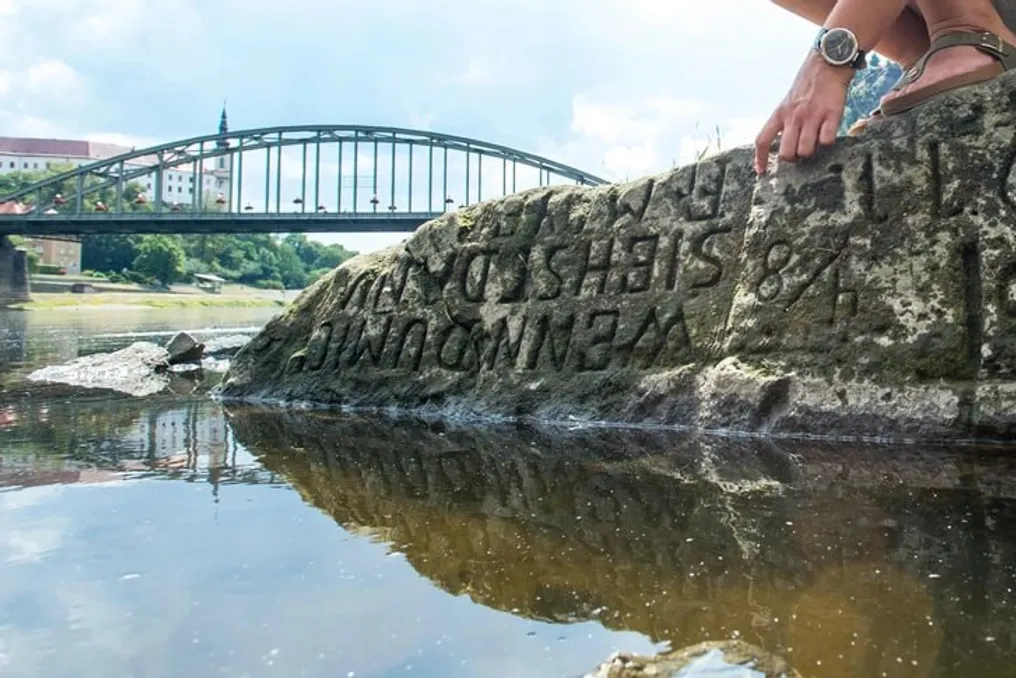
Due to prolonged drought and intense heat, water levels in European rivers have significantly dropped, leading to the appearance of so-called 'famine stones.' These boulders, etched with markings and inscriptions, served for centuries to record periods when rivers became severely shallow, causing food shortages.
The Deчин Stone on the Elbe
One of the best-known examples is a stone located on the Elbe River near the Czech city of Děčín, close to the German border. This stone bears an inscription in German: 'If you see me, cry.' Although this phrase gained widespread fame only in the early 20th century, the stone itself contains traces of drought periods dating back to at least the 16th century.
The boulders, known as 'famine stones,' are usually hidden by water in riverbeds and become visible when water levels drop sharply. Similar markers can be found not only on the Elbe but also on the Danube and Rhine; some of them indicate specific years, such as 1616, 1746, and 1842.
Historians and climatologists note that these markings were not merely warnings of famine. Many of them correspond precisely to documented periods of extremely low water levels and were presumably used to monitor the river's condition.
Consequences of River Low Water
River shallowness created a number of difficulties: the movement of barges transporting grain, timber, and other cargo was hindered, negatively affecting trade. Furthermore, fishing declined and the harvest situation worsened, leading to food shortages and rising grain prices.
History of the Deчин Stone
The Deчин Stone holds special historical significance. According to one version, the famous phrase on it was carved in 1904 by a local boatman and innkeeper named Franz Maier during another period of drought. Soon, the stone became a local attraction, about which newspapers began writing and postcards were made.
The fate of the stone was threatened: in 1904, local authorities planned to remove obstacles from the Elbe channel. However, thanks to the intervention of the boating community, the stone was preserved. Later, in 1911, the famous inscription was re-carved below the original spot, and in 1938, an additional inscription in Czech was added to the stone.
The reappearance of these 'famine stones' above the surface in recent years has once again attracted public attention amid droughts in Europe. They are viewed as a kind of historical indicator of changes in river levels, reminding us of the serious risks to food security, agriculture, and trade in the past.
In the context of the current situation, it should be noted that due to heat and drought, about 550,000 residents of France have faced water supply problems, and over 40,000 people are experiencing interruptions or have completely lost access to drinking water. In several settlements, water is delivered by tankers, and water restrictions have already spread to more than two-thirds of the country's territory.