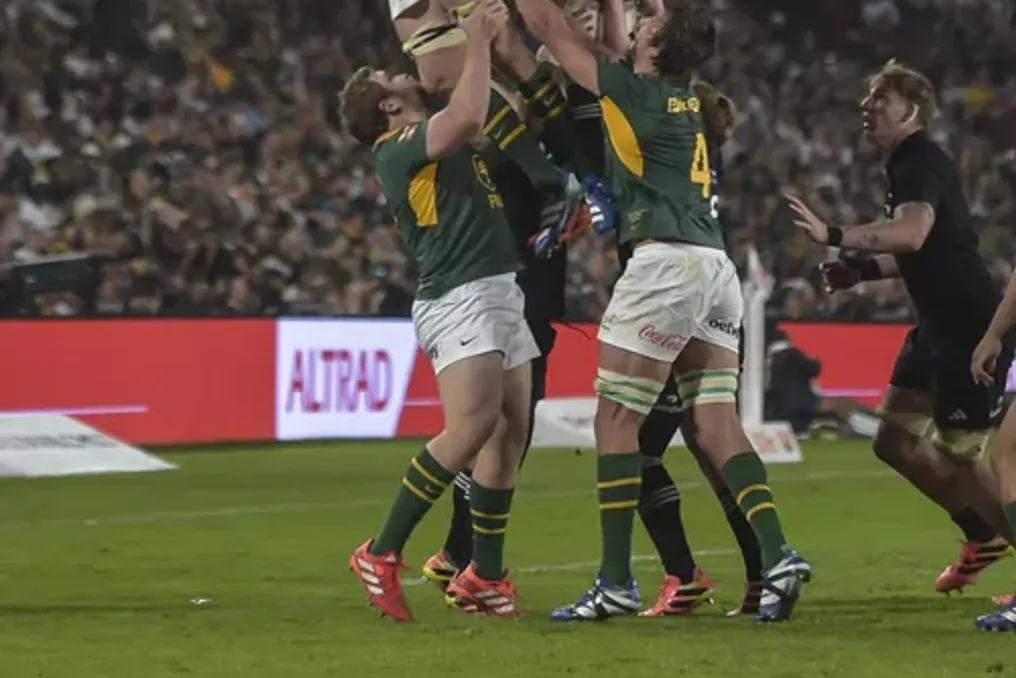
Rassie Erasmus acknowledged that the Springboks suffered a 'defeat' against the New Zealand team at Ellis Park stadium on Saturday, but emphasized that his team would remain calm, ignore criticism, and work to restore their previous level of play.
The All Blacks won the intense match with a score of 31:16 as part of the 'Rugby's Greatest Rivalry' tour in Johannesburg. Erasmus showed little interest in exaggerating the results, calling his own performance 'terrible' based on the scoreline.
The coach noted that defeats happen to most teams from time to time, and the fans' reaction to failure is natural. He added: 'We understand that it was a terrible performance by the score, but the score is what matters. We can talk about many different things, but we know that we need to be better.'
About Rugby's Greatest Rivalry
For an experienced coach, such a defeat was nothing new. 'I have been working with the Springboks for 106 games, and we have been in a similar situation before,' he stated. 'Now we need to find a way to come back against a very good team from New Zealand.' He continued: 'Today we lost, so naturally there will be critics, and we will stay aside, not read newspapers, and work hard to return.'
The Springboks' task was complicated by a series of injuries that forced Erasmus to abandon a significant part of his carefully planned substitute strategy. Both wings were affected: Kurt-Lee Arendse left the field after a head injury, and Cheslin Kolbe exited the game due to a severe spasm.
Erasmus explained the situation with Arendse: 'Kurt-Lee had a defensive barrier alarm go off, and the match doctor did not give him permission to play.' Because of this reallocation, Jesse Kriel moved from outside centre to the wing, and Andre Esterhuizen, who was supposed to play as a winger, had to be placed in the centre.
'Kurt-Lee received a HIA, which meant we could not use Andre as a forward,' Erasmus clarified. 'We wanted to use him as a forward in this game, but then he would have to move to the centre, and Jesse would have to play out of position on the wing.'
Kolbe's departure created another problem. Grant Williams, who started the game as a halfback, was moved to the wing, and Kobus Reinach took the number 9 position. Erasmus reported: 'Cheslin got injured later. Kobus was supposed to come on at nine because we had three reserves in the backline, and Grant was supposed to move to the wing.'
The disruptions continued as the Springboks were reduced to 13 players. Mani Libbok's entry required Sacha Feinberg-Musengomozulu to move to fullback, further changing the team composition. 'When we only had 13 players, Mani's entry meant that Sacha had to move to fullback,' said Erasmus. He concluded: 'The injuries were devastating because of how we planned to play this game. It is no one's fault.'
Kolbe was demonstrating good form in long-range kicks, and despite questions about why Feinberg-Musengomozulu didn't take kicks, Erasmus stated that the decision was obvious. 'Currently, Cheslin is our most accurate kicker and hasn't missed once, so he was the one kicking.'
The coach also defended his decision to remove prop Ox Nche shortly after halftime, even though the player showed a dominant performance during the scrum. 'Ox played only eight minutes in the last six weeks,' he noted. 'We always thought Ox would last 30 or 40 minutes. He lasted 45, and I think he did really well in those minutes.' He added: 'I don't think Ox is the reason for our defeat. Obviously, he was tired, and then we brought in Gerhard Steenkamp.'
The Springboks' problems were compounded by yellow cards from Marco van der Westhuizen and Reinhardt, forcing Erasmus to admit that the match had effectively gotten out of the team's control. 'I felt the match was already lost when we had two yellow cards,' he said. 'We had to play the last 10 minutes with 13 players.' He concluded: 'It is difficult to turn the tide when you are playing with only 13 players.'