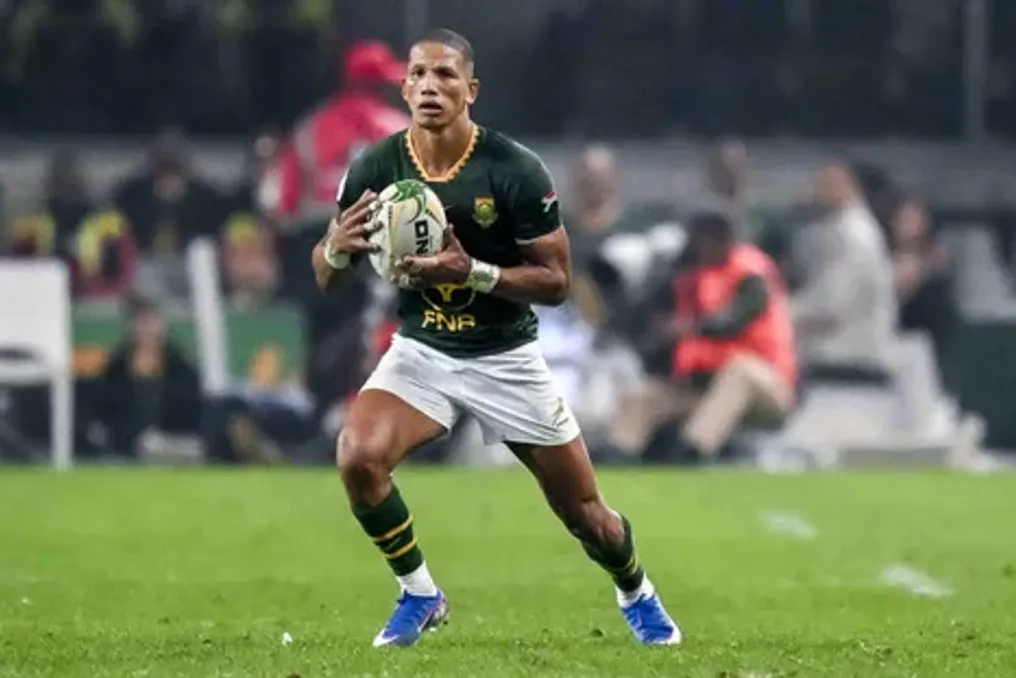
Flyhalf Springbok Manie Libbok could showcase his creativity in the upcoming match against the All Blacks in Cape Town if given the opportunity, which might reduce the pressure on Sacha Feinberg-Mngomezulu, who struggled at Ellis Park.
For many fans, the Springboks' disappointment stemmed not only from the unexpected All Blacks victory but also from the team's uninspiring style of play. This is particularly frustrating considering the previous meeting between the teams in Wellington in 2025, where the Boks secured a convincing 43-10 win, scoring six tries, including four from attacking players. The scale of this victory convinced even the staunchest skeptics that they are the best team on the planet.
Later that year, the Boks demonstrated dominance in Europe, strengthening their position in the World Rugby rankings. Their confident style of play against France, Italy, and Ireland led to the Boks being considered clear favorites in the first match against the All Blacks. The team added attacking flair to its traditional strength and superior ball retention.
Victories in the Nations Cup against England, Scotland, and Wales also indicated that Tony Brown's work with the attacking players had raised the team's level. There was enough space for quick players once the forwards dominated the opposition and created valuable possession up front.
Therefore, it was so disappointing to see the return of the dull box-kick style. It is known that Rassie Erasmus is a master planner, and the Boks were clearly playing according to the scheme developed by the two-time world champion to limit the creativity of the audacious All Blacks players. However, when points were not coming in, and it became clear that the All Blacks had meticulously prepared their defense, the Boks should have shown greater ambition and adaptability.
In that masterclass in Wellington, Cheslin Kolbe scored two tries and moved brilliantly around defenders. At Ellis Park, he barely touched the ball. Jesse Kriel, shifted to the left wing after Kurt-Lee Arendse suffered a concussion early on, did not get a chance to participate in the attack. A frustrating moment was that opportunities existed for the attacking players, as the forwards performed their job excellently.
Damian Willemse was primarily used for kicking, which he did brilliantly, but he never stepped into the flyhalf channel to do something outstanding. There were no attempts to change the picture against the All Blacks' defense. In Brown's first season with the Boks, we saw Siya Kolisi and Pieter-Steph du Toit used widely to create attacking platforms for the backline. Such a sign was absent on Saturday evening.
It is reiterated that while there was a specific plan for this game, the best sports teams are not just those who execute their plans; they are those who understand when the plan isn't working and adapt to the battlefield conditions.
Du Toit, who is one test away from a hundred goals, is likely the best player of his generation for the Springboks, but the author doubts that the captaincy will naturally go to him. He rarely speaks off the field, and on the field, he hardly says anything, let alone motivates his teammates to be bolder and smarter. He leads by excellent example, but there are times when the Boks need a captain who can take control of the game and demand more from those around them.
However, for the author, the biggest problem in the Springboks' performance was the flyhalf. The author sympathizes with Sacha Feinberg-Mngomezulu, as he was highly praised. Perhaps too much praise was received too soon, and he is trying too hard to live up to the hype.
To be fair to him, he couldn't have had a more complex game in the comeback than the trip to Buenos Aires, where the Pumas were almost unfriendly. The author suspects that Feinberg-Mngomezulu's confidence suffered in that grueling battle. Undeniably, he is currently lacking the brilliance that made him the idol of 2025.
Among the Boks' coaches, there could have been long debates about how to use their flyhalf lineup for this game—Sacha FM, Manie Libbok, or Handre Pollard. The feeling was probably that Sacha had too much talent not to come out soon. In that sense, his appearance was a risk, especially when Libbok is in form and far from past his prime.
The author believes that Libbok should start at the Cape Town Stadium this week, and Pollard should be the substitute. Libbok will carry the ball to the line, test the defense for gaps, and force the All Blacks to make decisions. His ability to distribute and pass can create space for his centres and generate the attacking unpredictability that was so noticeably missing at Ellis Park.
Most importantly, he offers the Boks what they desperately need right now: the willingness to drive the game against the opponent, rather than just waiting for the perfect moment to execute the plan. The Boks have already proven they can dominate the All Blacks. Now they need to prove that when brute force and a carefully thought-out game plan are insufficient, they have the imagination to change the script.