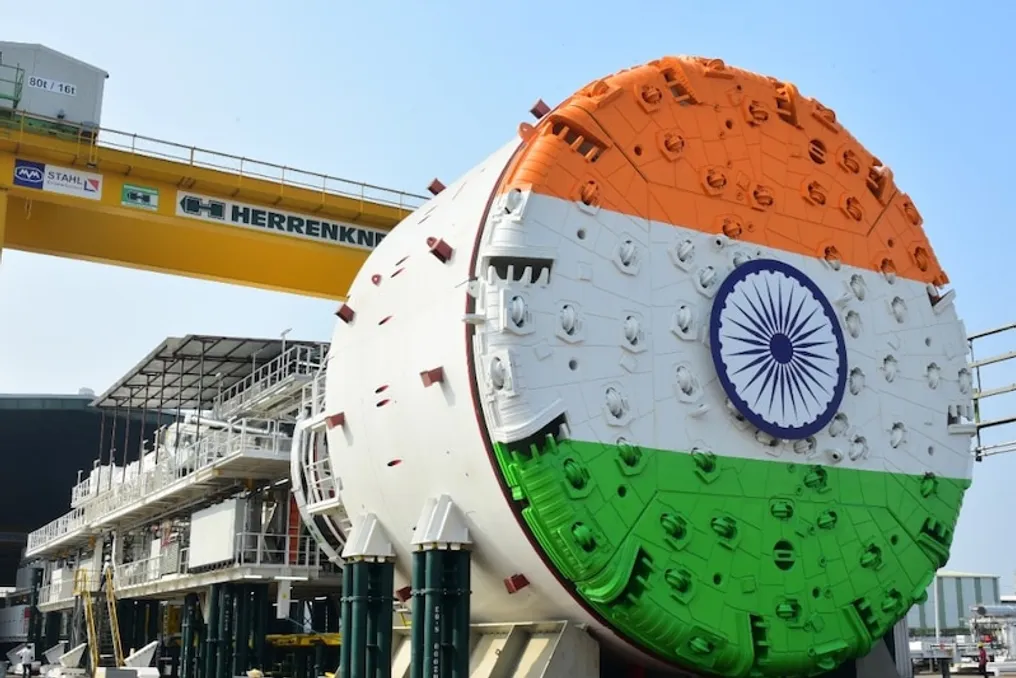
India is preparing to stimulate the domestic production of high-tech equipment for infrastructure and high value-added goods manufacturing. According to a report by Reuters, the government intends to introduce a subsidy program worth about $1.2 billion (equivalent to 11,484 crore rupees). The goal of this initiative is to attract new investments of approximately $1.8 billion over the next seven years.
This step comes amid active growth in construction and infrastructure activities in India, while the country maintains a significant reliance on imports of several critical machines. The government specifically aims to reduce dependence on supplies from China, as many heavy tools used in infrastructure projects have long been sourced from that country.
The proposed subsidy program may cover devices such as Tunnel Boring Machines (TBMs), fire suppression systems, and elevators for high-rise buildings. The government's plans are not limited to assembling these machines; there is an emphasis on increasing local production of necessary components for heavy machinery.
Following the Galwan clashes in 2020, tensions between India and China escalated, leading India to impose restrictions on Chinese companies participating in government procurement and investments. Concurrently, China tightened export regulations for tunnel boring machines in 2024, causing delays in customs clearance for necessary cargo.
According to Reuters, the import of tunnel equipment from China into India has sharply decreased: it amounted to about $3 million in 2023–24 compared to $18 million the previous year, and fell even further in 2024–25 to $500 thousand. Although there was a slight increase in 2025–26, imports reached approximately $800 thousand.
This proposed scheme could provide domestic companies with an opportunity to expand the production of high-tech infrastructure equipment. Bharat Earth Movers Limited (BEML) is already looking for opportunities to localize the production of TBMs. Companies such as Larsen & Toubro and Johnson Lifts are also expected to benefit from this program. According to the report, a final decision on the scheme may be made soon, although the Ministry of Heavy Industries and the Ministry of Finance have not yet commented on the matter.
The Indian construction and infrastructure equipment market is valued at approximately 100 billion rupees, which is about $10.4 billion, and is expected to grow in the coming years. In this context, the government's initiative could become a major opportunity for local manufacturers. Manish Mathur, CEO of Cranes and Action Construction Equipment, noted that when the government prioritizes self-sufficiency in production and reducing import dependence, such incentives can motivate local firms to increase investment in research, development, and technology.
He stated that such steps will help Indian manufacturers enhance technical competence, create globally competitive products, and establish India as a reliable global hub for construction equipment manufacturing. Provided the proposed subsidy scheme is approved, this could foster the development of domestic production of TBMs, elevators, and other high-tech infrastructure equipment, while simultaneously helping to reduce import dependency.