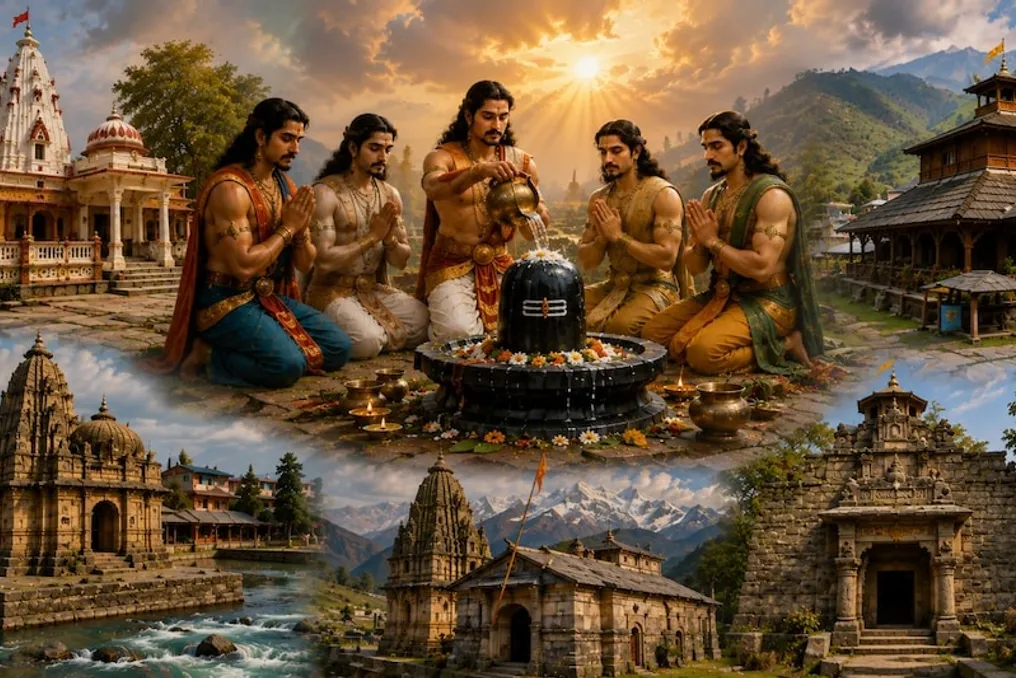
Today is the last Monday of the month of Sawan, which is considered particularly auspicious for worshipping Lord Shiva, taking holy dips, and performing spiritual practices. There is a belief that during this sacred month, Mahadeva fulfills all the wishes of his devotees. The connection between Sawan and the worship of Shiva dates back to the Mahabharata era. During difficult periods of exile and forest wandering, the Pandavas also sought the help of Lord Shiva and performed rigorous austerities, establishing Shivlings everywhere to achieve victory in the war and establish Dharma.
Currently, ancient Shiva temples associated with the Pandavas are located across the country and serve as centers of unwavering faith for pilgrims who travel from afar to bathe Mahadeva during the month of Sawan. Below are some of these major shrines that were established and revered by the Pandavas.
Lodheshwar Mahadeva Mandir, Barabanki, Uttar Pradesh
The Lodheshwar Mahadeva Mandir, located in the Barabanki district of Uttar Pradesh, is considered an ancient Shiva temple connected to the Pandavas. According to legends, during a period of uncertainty, the Pandavas worshipped Lord Shiva right here. It is said that they performed austerities and rituals with the aim of gaining victory in the war and regaining their lost royal share. The shrine houses ancient images of Shiva, and it is also believed that ancient statues related to Mother Parvati are present here. According to local tradition, the Pandavas conducted Rudra Mahayajna here under the guidance of the sage Vedavyasa.
This temple, situated near the Ghaghara River, holds immense significance for devotees. The complex contains an ancient well called 'Pandav Kup'. It is believed that the water in it possesses healing properties and helps cure many ailments, although scientific evidence for these claims is a separate matter. A large number of pilgrims visit here during the month of Sawan to bathe Shiva. During Mahashivaratri, devotees from all over the world also visit the temple for darshan. According to beliefs, any wish expressed here from a pure heart comes true. The modern appearance of the temple is the result of construction work and restorations carried out over time. However, it is also mentioned that ancient red bricks were discovered nearby during excavation work.
Pandeshwarnath Dham, Prayagraj, Uttar Pradesh
Pandeshwarnath Dham, located in Prayagraj, is also recognized as an ancient Shiva temple associated with the Pandavas. According to local beliefs, when the Pandavas arrived in this region during their exile, they established a Shivling here and worshipped Lord Shiva. It is narrated that while traveling through Angadesha and Magadha, the Pandavas installed the Shivling here on the advice of the sage Bharadvaja. This is why the place is linked to the Pandavas.
This temple is also known for its ancient stone structure. It is among the most important religious sites associated with the Pancha Kosi pilgrimage of Prayagraj. In local tradition, it is called Siddhipet. Devotees believe that visiting and worshipping Lord Shiva here leads to the fulfillment of their desires.
Mamleshwar Mahadeva Mandir, Himachal Pradesh
The Mamleshwar Mahadeva Mandir, located in the picturesque valleys of Himachal Pradesh, is also associated with the Mahabharata era and the Pandavas. According to legend, the Pandavas stayed in this region for some time during their exile and established Lord Shiva here then. The shrine houses statues of Lord Shiva and Mother Parvati, and an ancient Shivling is installed. According to local beliefs, Bhima and Hidimba met in this area, and she later became his wife. The temple also has a huge drum associated with Bhima, which locals consider to be Bhima's drum. It is also claimed that the temple stores ancient wheat grains weighing about 200 grams, which, according to belief, were grown by the Pandavas at that time.
There is also a belief in the temple complex regarding a continuous fire or forge (dhuni). Devotees are convinced that this fire has been burning continuously since the Mahabharata era. Although historical confirmation of such long-term burning remains a subject of separate study.
Shri Kalinath Mahakaleshwar Mahadeva Mandir, Himachal Pradesh
Shri Kalinath Mahakaleshwar Mahadeva Mandir, located in the village of Paragpur, Kangra district, Himachal Pradesh, is situated on the banks of the Beas River. This temple is also connected to folk tales about the Pandavas. According to beliefs, after the Pandavas avoided the incident with Lakshagriha, they turned to worshipping Lord Shiva here. The Shivling installed in the temple is considered special. According to local beliefs, it harbors the energies of both Lord Shiva and Mother Mahakali. It is said that this Shivling gradually sinks into the earth. There are numerous religious concepts regarding this as well.
According to another legend, during their exile, the Pandavas brought water from important holy places such as Prayag, Ujjain, Nasik, Haridwar, and Rameshwar. They mixed the water from these five holy places in a pond here. Because of this, the place became known as Panchtirthi. It is believed that bathing in Panchtirthi brings merit, and bathing here on the day of Vaisakha holds special religious significance.
Lakhamandl Mahadeva Mandir, Uttarakhand
Lakhamandl Mahadeva Mandir, located on the banks of the Yamuna River in Uttarakhand, ...
3.