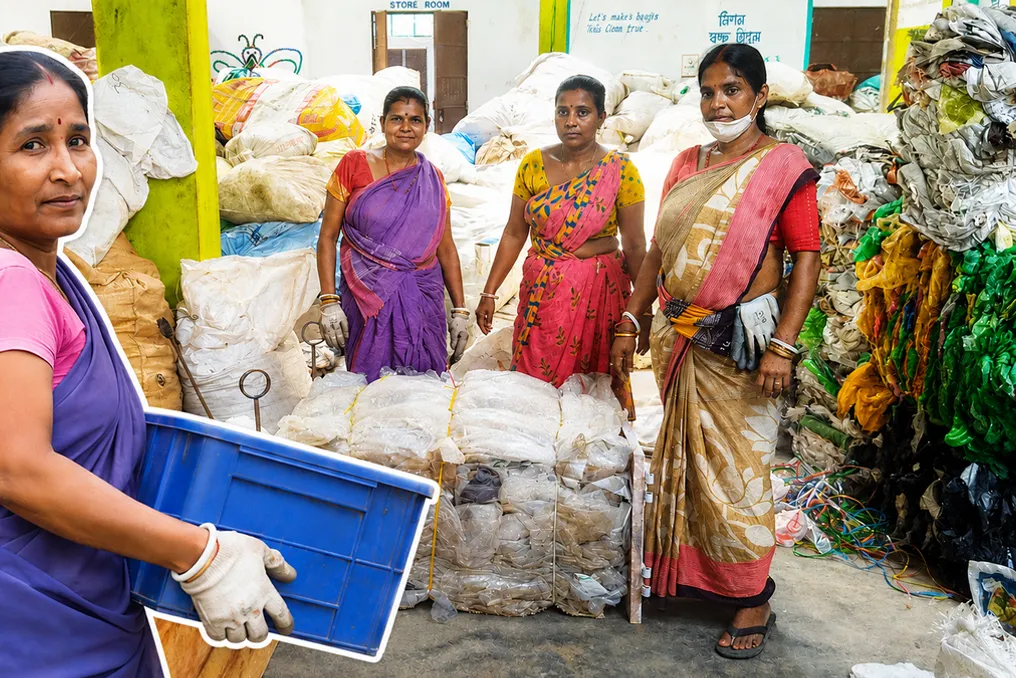
Every morning, shortly before seven o'clock, Pinky Kar Deb walks down the same street she walked nine years ago. For most of that time, this place was associated with garbage thrown away by other people.
Today, however, this sight reminds her of the changes that have taken place. At the corner where the road turns, there is no longer a black hill of rotting refuse and plastic, no stray dog tearing at a bag, and no smell that forces passersby to hurry and cover their noses. The container that stood there for years, overflowing and foul-smelling, has disappeared.
Pinky clearly remembers what this place was like. 'For a long time, my working life started and ended here,' she says. 'I stood, immersed up to my elbows in mixed, smelly waste, sorting it with my bare hands because there was no other way. People called us 'kachravala'. That word carried all the shame that the city learned to attribute to us.'
For Pinky, the word 'kachravala' described not her job, but how people saw her while doing that job. Today, she manages the tertiary waste processing center in Howai, a small hill town in Tripura, which created a waste management system where sanitation workers manage the processes themselves. She no longer needs masks. She sits and eats inside the center where she works—an unimaginable thing just a few years ago. Moreover, she is no longer an employee.
'Now we are malik (owners),' she asserts. This word carries great weight in the cooperative's story: the women transitioned from hired workers following others' instructions to owners of the system they created.
The story of this system's emergence in Howai began with a question that stuck with one Indian Administrative Service (IAS) official: why do the people who maintain cleanliness in the city have the least control over their work?
Nirmal Kumar, Deputy Magistrate of Howai, recalls: 'When I was appointed to Howai, I saw that our sanitation workers received meager pay. They had no initiative of their own, and they were exploited. They were contract workers, so they weren't even permanent employees.'
He adds: 'I visited the Amul cooperative and thought: why not create a cooperative in Howai?' This single question became the seed of what is now called the 'Howai Waste to Wealth Producers Society,' registered in April and May 2026.
Turning this idea into a functioning system required an expert who understood waste management science and knew how to implement it locally. This responsibility fell upon Samir Agartala, a 31-year-old waste management expert who has been in the field since 2019 and now manages the cooperative's activities in partnership with the municipal corporation.
Samir recounts: 'I went to Bengaluru for a 90-day practical training on solid and liquid resource management at a military training center. I studied systems used by cities much larger than Howai to manage their waste, and I returned because I wanted to bring this here. We work in partnership with the municipal corporation, but the women manage the system. My job is to ensure that the science behind it does not fail.'
Today, one hundred women, who are simply called didi, manage the entire waste ecosystem of Howai. They arrive before the city fully wakes up, sign their names in the register, take their routes, and begin the work that supports the functioning of every street.
They then divide into teams: one handles door-to-door collection, another handles sorting at local centers, a third at the tertiary facility where final sorting, pressing, and packaging occur, and a fourth circulates through the city in a truck, collecting any waste left in public places so that Howai remains truly free of garbage. Fifteen districts of the city are served by seven secondary sorting centers, each covering two or three districts before the waste reaches the tertiary center, which is now managed by Pinky. Uma Rani Deb Das leads the door-to-door collection, whose team visits every house every morning. In the tertiary center, one man works alongside the didis, assisting with pressing and heavier tasks. He is hired and paid by the cooperative itself.
Daily, the didis collect almost 1500 kg of dry waste and about 3000 kg of wet waste, with the amount slightly increasing on Mondays. A municipal survey of 4500 homes recorded similar figures, showing that Howai generates about 4300 kg of waste daily.
According to cooperative officials, what distinguishes Howai is that it became the first city in the northeast to implement secondary sorting on such a scale. The didis helped households separate their waste into three categories using containers distributed to their homes. Then the waste is sorted again at local centers and finally at the material recovery facility, where it is packaged and sent for recycling or reuse.
There are now six material recovery facilities in the city, each processing 300–400 kg of waste daily, as well as a micro-composting center with 55 pits capable of processing up to five tons of wet waste and producing about 500 kg of compost daily.
This transformation began with the didis helping people understand that waste separation should start at home. They visited homes with leaflets, visited schools and colleges, showing families why it was important to separate waste. Their conviction was simple: when children learn the habit, they often carry it home to their parents.
One of the didis explained how they used to sit near houses and manually sort mixed waste while families watched: 'We used to sort their waste right in front of them. We showed them how much of our time was wasted on something they could do themselves in a minute.'
This moment changed the conversation about waste. Families, who previously considered trash something that disappeared after leaving their homes, began to see the people who worked with it. The didis also organized tours, bringing residents to the centers so they understood where their waste went after collection. Today, more than 90% of Howai households separate waste at the source.
Approximately five households still do not comply with the rules and face a penalty system. Of those households that initially resisted, three have started following this practice.
For Pinky, the changes are measured not in numbers or percentages. They are measured by how she feels now. She is 39 years old and has dedicated nine years to this work. At home, her husband and two daughters have seen her transform from someone who was avoided to someone respected by the city.
'Before, all the garbage was mixed and dirty, and it was very difficult for us to sort it,' she recalls years before the cooperative was formed. 'Our days are completely different now. Before, people were not ready to do this work, but now there are didis who are more than ready. Before, we couldn't even sit and eat in the centers, but we had to. Now we don't need masks, and we can eat peacefully in this center.'
Before the cooperative was established, sanitation work in Howai was paid barely 3000 rupees a month, an amount Pinky describes as mayboori (helplessness)—what people did because they had no other choice. 'Now we earn about 3500 rupees,' she says. The cooperative began paying small monthly allowances, and the money goes directly into each didi's bank account, without intermediaries taking a cut.'
The word kachravala remains part of Howai's memory, but it no longer carries the same stigmatizing meaning for the women involved in this work. 'They used to be called 'kachravala',' says Pinky. 'But now, having realized that we earn money, we have gained dignity. And more and more people ask if they want to join and take on this work.'
The cooperative now regularly receives requests from women wishing to join the system, which is a striking change compared to the time when few wanted to do this work.
What distinguishes the Howai model from many sanitation schemes across the country is the question of who actually holds the power within it. In most cities, decisions about routes, schedules, and priorities flow down from the municipality to workers who merely execute them. In Howai, decision-making is now in the hands of the cooperative.
The cooperative manages its own toilet cleaning unit, staffed with two permanent workers. Where heavy labor or work with the press machine is required—work usually associated with men—the didis hire and pay men through the cooperative itself. At every level of work, from local centers to the tertiary facility managed by Pinky, there is a manager, and every manager is a didi, promoted according to her qualifications and experience.
Daily truck rounds for collecting stray public waste have reduced accumulation along roads by approximately 90% since the cooperative took over management. Even old curb bins have disappeared. In some places, they have been replaced by small stalls run by street vendors with the support of the cooperative. Each vendor is required to have a dustbin and sort their own waste.
The didis work in shifts and on Sundays, ensuring that no corner of Howai is left with piled-up waste. Almost all the city's garbage no longer ends up in landfills. Vendors take what they need for recycling, and the rest is shredded and given to a contractor who uses it in road construction. Discarded clothing is washed, processed, and often mended by the didis themselves into wearable items.
A typical day proceeds like clockwork: door-to-door collection from 7:00 to 10:00, sorting from 10:00 to noon, and cleaning, counting, and packaging at the center from noon to 13:00—a rhythm that the didis created entirely themselves.
Returning to the same street where the old curb bin once stood, Pinky no longer recalls the smell or the shame that once surrounded it. She sees a clean street, a passerby who no longer needs to cover his nose, and a group of women who have turned work that was once despised into something they own. The didis of Howai have a word for these changes. It is not kachara (garbage), they say. It is sampatti (wealth). Because in Howai, the women who once sorted other people's garbage now create value from it on their own terms.
_