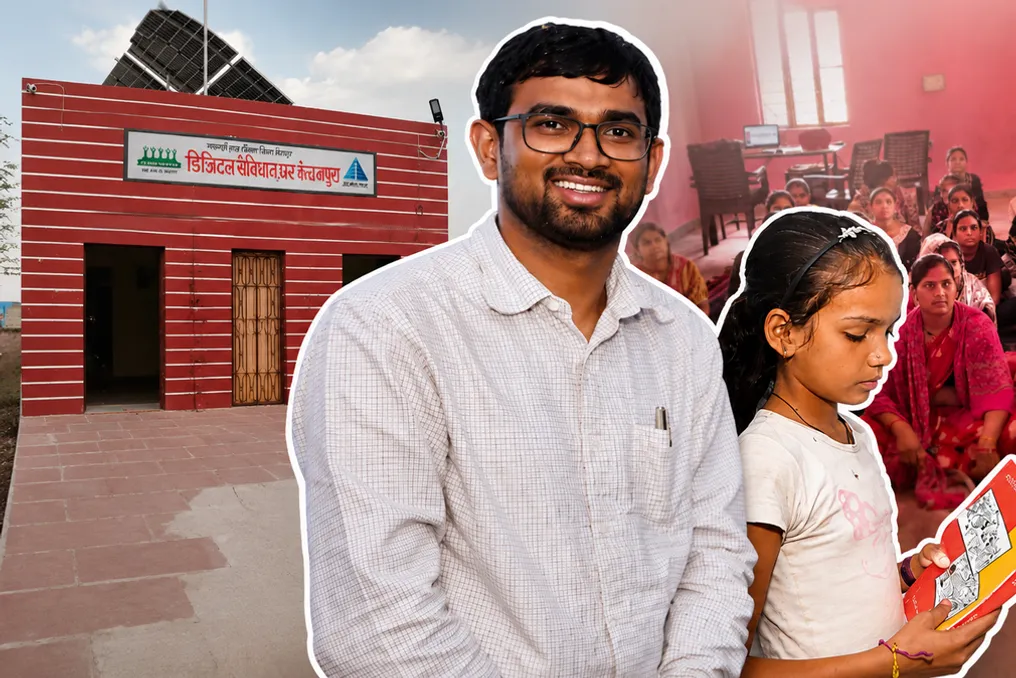
Every morning, 18-year-old Mohini Parmar is busy cooking, cleaning, and helping her younger siblings. Her father passed away during the COVID-19 pandemic, leaving her as the eldest in the family. After completing household chores, she walks 500 meters from home in Dholpur to study at the local Digital Samvidhan Ghar.
Several years ago, such a place did not exist in her village. Mohini once dreamed of joining the Air Force. 'My motivation is to become a soldier,' she states confidently. Preparing for the entrance exam forced her to learn English from scratch independently, as it was required for the exam.
Today, she proudly says that she can teach English to children up to the 10th grade. She is currently preparing for the Rajasthan State Teacher Eligibility Test (REET), but her determination remains unchanged. Only the availability of a place where she could study constantly, safely, and close to home has changed.
Mohini's experience reflects a broader transformation taking place in the Dholpur district of Rajasthan. In the Chambal valleys, a region long lacking basic educational infrastructure and modern amenities, abandoned government buildings are being converted into digital learning centers. Students prepare for competitive exams late into the night, women resume their studies after marriage, and children who previously saw cities as their only chance for opportunities discover that education can be much closer to home.
At the heart of this transformation is the initiative of the Digital Samvidhan Ghar—a network of public learning centers across the entire district, developed since 2024 under the guidance of IAS officer Nivrutti Avhad, CEO of Zila Parishad Dholpur. What started with a few abandoned government buildings has now grown into 78 digital libraries across Dholpur, including remote villages near Chambal where such facilities were long absent.
Mohini is among approximately 5,000 students registered in the Samvidhan Ghars, which have helped create a digital learning network across the entire Dholpur district.
To understand why these centers are so important, one must first understand Dholpur itself. Dholpur is located on the eastern edge of Rajasthan, along the Chambal River, surrounded by deep ravines, rocky terrain, scattered villages, and dense forests. For decades, this complex landscape has shaped both the perception of the district and the way of life of its people.
The Chambal valleys remained isolated for many years, and many villages lacked educational infrastructure, learning centers, libraries, and access to digital technology for a long time. Even today, traveling to nearby towns for exam preparation is expensive and difficult for many families.
Against this backdrop, in Gram Panchayat Pipret, near the Chambal region, Sarpanch Dharmendra Singh Parmar describes the transformation around him with visible skepticism. He says, 'Plenty has come into the jungle.' He adds, 'We never imagined our children would sit in air-conditioned rooms and study.' 'That was something we only saw in pictures.'
Dharmendra's own journey reflects the changing aspirations of the district. Having graduated with an MBA from Christ University in Bengaluru, he left his corporate career in 2018 and returned to his village—a decision that many around him could not understand at the time. He smiles and says, 'I had never heard of someone quitting a job in Bengaluru to return and work for their village.'
After becoming Sarpanch in January 2020, just a few weeks before the pandemic, he helped build one of the district's most active learning centers in his panchayat. Students preparing for UPSC, RAS, NDA, and military recruitment now spend long hours there every day. In the first months after the library opened, three students had already been selected for the army. Dharmendra notes, 'Children who couldn't afford to travel to Jaipur study here now.' 'This feeling of falling behind because they couldn't go to the city is starting to disappear.'
The story of how these centers came about brings us back to IAS officer Nivrutti Avhad. During visits to villages for a constitutional awareness campaign called 'Kitab Ka Pehla Pana' in 2025, he began noticing abandoned government buildings throughout rural Dholpur. Some were used as storage sheds. Others housed cattle or were overrun by pests and wild animals.
He recalls, 'When you visited villages, there were always these empty buildings with buffaloes and grass inside.' 'People complained about it, but I didn't give it much thought.' However, over time, he began to look at these neglected structures differently. He wondered if they could become places for learning and community life. The buildings still had potential; they just lacked purpose.
'We thought about renovating them,' he says. This simple idea eventually turned into one of the most ambitious grassroots educational initiatives in rural Rajasthan. The name itself was carefully chosen. Nivrutti Avhad named them Samvidhan Garas, or Houses of the Constitution, so that the initiative embodied dignity, equality, and access. He also wanted its identity to transcend any specific administration or political cycle. 'Samvidhan means justice, equality, and dignity,' he explains. 'These centers are built around those ideas.'
The first phase involved transforming 18 unused government buildings into functional libraries and learning spaces. Former schools, old panchayat halls, and abandoned hospitals were gradually renovated and reopened for public use. At this stage, the team focused on ensuring the presence and functionality of educational spaces. The district-wide learning network emerged later.
But the reaction from the villages completely scaled up the initiative.
As the first centers began operating, neighboring villages started approaching the administration requesting the creation of their own Samvidhan Garas. Communities that had lacked public learning spaces for years suddenly saw children studying near home, young women regularly attending classes, and students preparing for competitive exams in their own villages.
'It became competitive,' says Devendra, an NGO coordinator who has collaborated with the project from the early stages. 'People started saying, 'We are ready to give 2 lakh rupees. We have an empty hall. Just give us a library.''
This public demand helped the initiative expand rapidly across the district. SBI Card later supported 28 digital libraries through CSR funds worth 2.2 crore rupees, and IIFCL contributed 4.2 crore rupees to support another 50 centers. Funds under the MLA Area Development (MLAADS) scheme were also used to support libraries in the Baseri area.
Today, 78 Digital Samvidhan Garas are operational in Dholpur, including remote Dang areas near Chambal, which historically had weak educational infrastructure. What makes these centers particularly unique is that they function as more than just libraries. Each Samvidhan Ghar is equipped with computers, smart TVs, books cataloged with QR codes, printers, solar panels, CCTV cameras, RO water purification systems, and renovated toilets. The centers remain open for long hours, often from morning till late at night, allowing students to study outside of work, domestic duties, and agricultural schedules.
In several villages, the libraries have effectively become digital learning hubs where students access online materials, prepare for exams, attend seminars, and participate in public discussions.
A key decision underlying the initiative was placing women at the center of its management structure. Each Samvidhan Ghar is managed by a 'Samvidhan Sakhi'—a woman chosen from the village self-help groups to oversee daily activities, maintain records, coordinate events, and ensure the space is welcoming and accessible. She receives a monthly stipend and often becomes the face of the initiative in the village.
Nivrutti Avhad says this decision was intentional from the start. 'We deliberately let women lead. No politics, just Didi will come. So no one can say no to Didi.'
This choice fundamentally changed who uses these spaces. In many Dholpur villages, boys are often sent for studies outside the district, while girls often stay due to safety concerns and social restrictions. By creating local learning spaces managed by women from the same community, the Samvidhan Garas made education much more accessible to girls and women.
Today, girls constitute a significant portion of daily visitors in many centers. Married women have begun returning to their studies after marriage. One pregnant woman regularly attended the library to prepare for a teacher's exam because the opportunity to access it so close and safely had finally appeared.
Librarians and volunteers have also become local mentors, helping students navigate forms, online applications, exam study materials, and digital systems with which many are encountering for the first time.
Another defining feature of the initiative is the emphasis on community ownership. Nivrutti Avhad made it clear from the beginning that no village would receive a library entirely free of charge. Every community had to contribute in some form, whether through renovation work, furniture, panchayat funding, or locally collected funds. The logic was simple: people value and protect the places they help create.
'When people build temples, they willingly donate,' says Devendra. 'Why not libraries?' Over time, the Samvidhan Garas have gone far beyond educational centers. Gram Sabhas are now held there. Government programs are broadcast on smart TVs. Residents gather there to discuss water shortages, roads, local problems, and employment opportunities. In many villages, these places have become civic and educational centers for the entire community.
'Calling them just libraries would be too simplistic,' says Nivrutti Avhad. 'People become informed here. They gain experience.'
Nivrutti Avhad deeply understands how fragile community initiatives can be in India. Officials are transferred. Governments change. Projects often disappear along with the people who led them. This is why a large part of the initiative was designed with sustainability through local ownership in mind. Each library has management systems, community participation structures, and partnerships designed to ensure the centers continue to function even after changes in administrative leadership.
'Government institutions become meaningful only when people use them, trust them, and feel a sense of belonging to them,' says Nivrutti Avhad. 'Since every village has a school, Anganwadi, and hospital, every village should also have a digital library.'
He pauses then adds a personal hope. 'I hope it lasts. It must survive me. That is my aspiration.'
In Dholpur, where abandoned buildings once symbolized absence and neglect, the same spaces are now filled with students studying under bright lights late into the night. Mohini Parmar still walks 500 meters every morning to reach her library. Dharmendra Singh still remembers the initial skepticism of the people when he returned from Bengaluru. Across the district's villages, those that once felt disconnected from opportunities are becoming part of a common learning network. And somewhere in the Chambal valleys, where the state once could not reach, lights burn long after sunset, because children, women, and young aspirants are still inside, learning, dreaming, and preparing for a future that finally seems achievable.