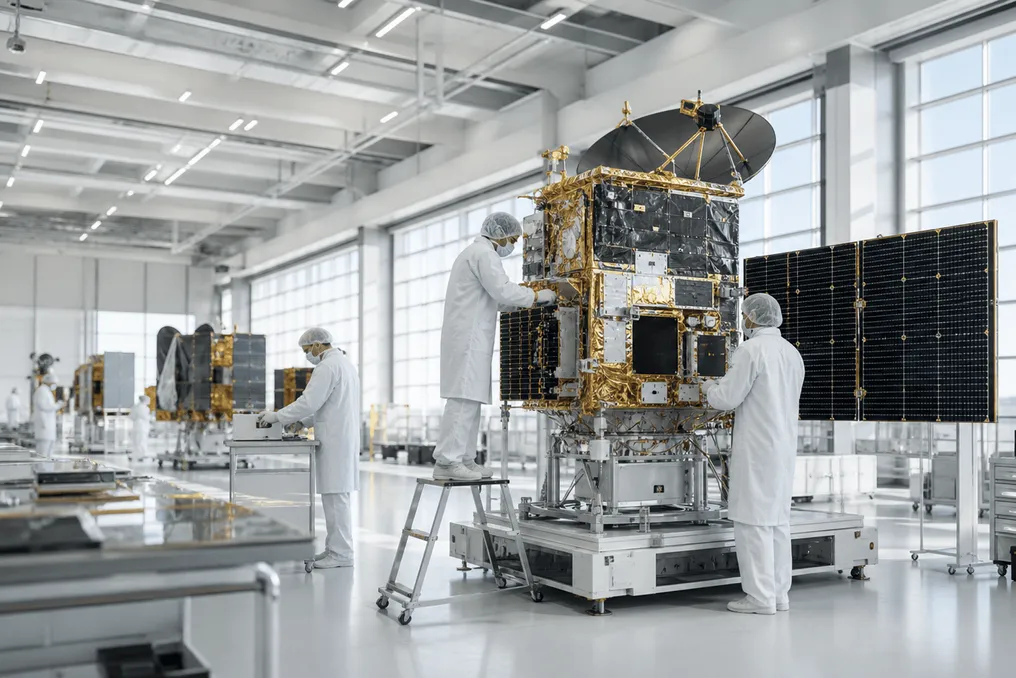
The satellite superfactory in Wenchang, China, passed expert inspection in June and is preparing for the start of pilot production with a planned annual capacity of 1000 satellites. For comparison, China has launched just over a thousand satellites in its entire history, and only around 350 spacecraft were placed into orbit in 2025—which accounts for approximately four months of the planned output of this single facility.
The urgency of this process is driven by orbital needs. China plans to establish two constellations—Qianfan and the national Guowang network—which together are expected to total about 28,000 satellites by 2035. At the 2025 pace, meaning 350 satellites per year, achieving this goal would take 80 years, but the window of available orbital slots will not wait.
Traditional satellite manufacturing operates on an 'island' principle, where engineers from different specialties work around a fixed workstation. This method takes between 1.5 and 5 years and costs tens of millions of dollars per unit, which prevents scaling up to thousands of units. GeeSpace, a subsidiary of Geely, opened the first satellite superfactory in Taizhou, reducing delivery time to 28 days and lowering costs by 45%. GalaxySpace aims to reduce the cost of low-Earth orbit satellites from hundreds of millions to millions of yuan, while MinoSpace provides a capacity of over 150 satellites per year.
The Wenchang factory goes further. It is jointly funded by the China Aerospace Science and Technology Corporation and the local government. It is built near a spaceport, allowing satellites to move directly from the production line to the rocket, eliminating the need for transportation and retesting over thousands of kilometers. The '1+1+8' system integrates the factory, testing center, and eight component manufacturers on one site.
Significant efficiency improvements have been achieved: the assembly of an entire satellite has been reduced from a week to one day, with the fastest process taking half a day. Nevertheless, Wenchang ultimately aims for speed not only compared to China's past domestic production but also under the time constraints set by players like SpaceX and the gradually closing orbital window.