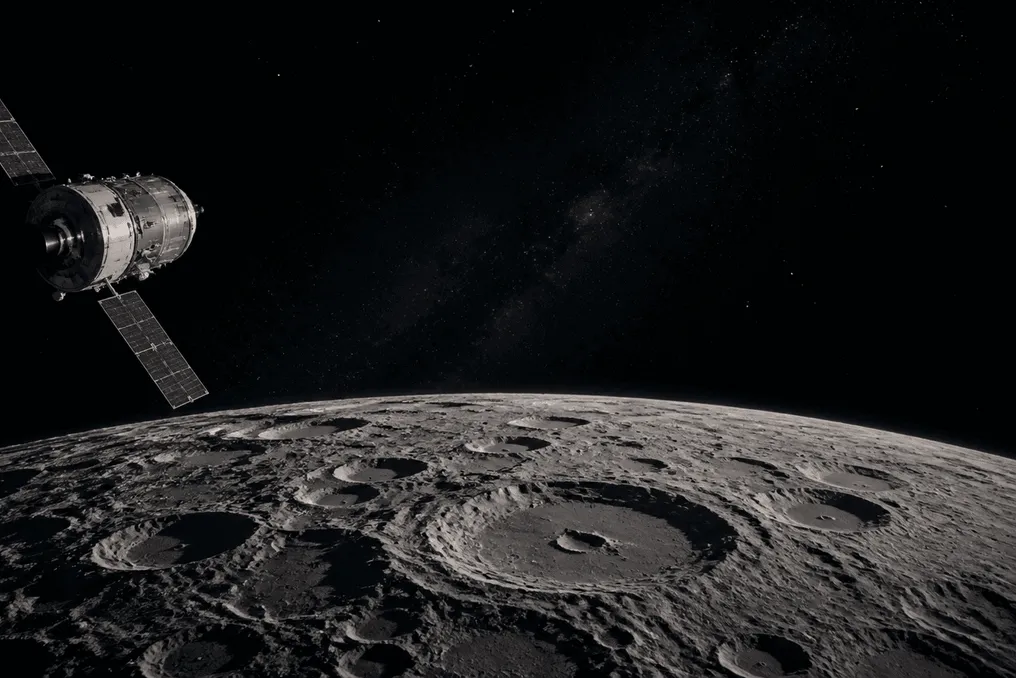
The Chinese probe Chang'e-7, along with the Long March 5 Y14 rocket, was moved to the launchpad at Wenchang Spaceport on August 19. This mission marks the beginning of a new era in China's lunar exploration. After more than two years without lunar flights, Chang'e-7 is targeting the Moon's south pole—an area not yet reached by any country.
The spacecraft includes an orbital module, a lander, a rover, and a small flight mechanism, operating within four modes: orbital flight, landing, traversing, and jumping. The main scientific goal of the mission is to confirm the presence of water ice in the permanently shadowed craters of the south pole, where sunlight has not penetrated for billions of years. The preferred landing site is the edge of the Shackleton crater, a bowl 21 kilometers wide, which offers both promising areas with icy shadowed regions and constant sunlight to power solar panels.
The mission carries twenty-one payloads. Three of these were delivered to the Queqiao-2 relay satellite launched in 2024. This satellite will also provide communication for the new polar flight, as signals from high latitudes are limited by angle. Furthermore, China is launching instruments from seven countries and organizations, including Egypt, Bahrain, Italy, Russia, Switzerland, and Thailand.
From a technical standpoint, the mission sets new standards. Landing accuracy must reach approximately 100 meters, which is significantly higher than the accuracy of previous Chang'e landings, which was several kilometers. If the jump mechanism is successful, it will be the second spacecraft to independently fly to another celestial body after NASA's Ingenuity helicopter, and the first terrestrial explorer outside of Earth.
Chang'e-7 is also the first flight since China unified its crewed and robotic lunar programs into a single 'lunar research project.' This has allowed resources to be reorganized ahead of the planned crewed landing by 2030 and the establishment of an international lunar research base at the south pole by 2035. If the mission confirms the presence of water ice, it could change the overall lunar race between the United States, Russia, India, and Japan.