Restoring the shape and function of the face in individuals with congenital anomalies or injuries is a key aspect of reconstructive surgery and prosthetics. For a long time, synthetic polymers have been used to imitate the appearance and mechanical properties of human skin in areas of defective facial and oral structures. Among these, silicone elastomers, particularly polydimethylsiloxane (PDMS), are considered the gold standard due to their texture similar to soft tissues, chemical inertness, and high biocompatibility.
However, the use of PDMS faces a serious geographical problem. Most high-quality prosthetic silicones are produced in Europe or North America and are designed for temperate climates. Using these materials in tropical regions, such as India, where temperatures can reach 50°C and ultraviolet (UV) radiation is intense, leads to their rapid degradation. Patients often have to replace prostheses every six months due to hardening, discoloration, and susceptibility to tearing, resulting in frequent and costly replacements.
A team of scientists from the Indian Institute of Technology (IIT) Delhi and the All India Institute of Medical Sciences (AIIMS) New Delhi has introduced a new room-temperature vulcanizing (RTV) silicone specifically optimized for the climatic conditions of India. To create this material, a chemical reaction was applied that links silicone molecules. The new composition utilizes a platinum-catalyzed addition reaction between crosslinking agents of polymethylhydrosiloxane with hydrogen functionality and PDMS with vinyl termination.
The research was conducted using a systematic Design of Experiments approach, specifically the Taguchi L25 orthogonal array, to evaluate the influence of different ratios of crosslinking agents, silicate fillers, and UV absorbers on the durability and performance characteristics of the material. The team's goal was to find a balance between softness and strength by fine-tuning chemical bonds and incorporating AEROSIL R972 as a reinforcing filler.
One of the major scientific breakthroughs in this work was stabilizing the polymer matrix against photodegradation under light exposure. Researchers integrated Chimassorb 81, a solid UV absorber that functions as a molecular shield against the harsh solar spectrum. A unidirectional vacuum mixing process was employed to eliminate structural defects. This step is necessary because air bubbles trapped in the silicone can act as stress concentrators, causing premature mechanical failure and creating sites for moisture accumulation.
After thorough testing, scientists identified five optimal compositions that matched the mechanical properties of human skin: they demonstrated a tensile strength ranging from 2.8 to 5.5 MPa and a tear strength from 11.7 to 14.6 N/mm. It is important to note that these materials maintained a Shore A hardness below 40, which is the threshold for ensuring patient comfort and realistic tactile sensation.
Samples of the new material were subjected to natural atmospheric exposure in New Delhi for six months, covering both extreme summer heat and the variable humidity of the monsoon season. A control sample, representing standard silicone without special additives, showed a sharp increase in hardness and tensile strength by up to 30%, accompanied by noticeable yellowing. Such changes under real-world conditions would render an ear or nose prosthesis unsuitable in terms of aesthetics and comfort. In contrast, the newly developed compositions demonstrated a much more stable profile, with mechanical changes limited to only 10–15%.
Biocompatibility remains the last hurdle for any medical-grade material. Researchers conducted in vitro tests on fibroblasts or skin cells to ensure the safety and non-toxicity of the material. Notably, the optimized silicone compositions not only promoted cell survival but also showed high cell viability: one composition (C7) achieved approximately 200% viability compared to the control after seven days. This indicates the non-toxicity of the materials and that they provide a surface favorable for cellular metabolic activity, which is critical for prostheses that must contact sensitive or damaged facial tissues for up to twelve hours a day.
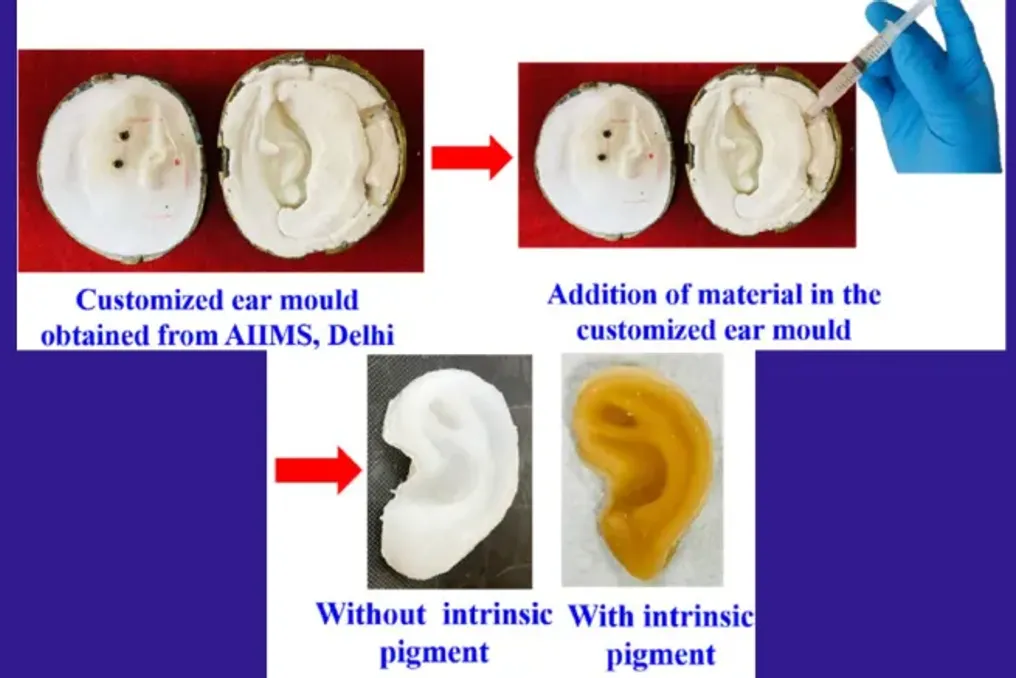
The authors acknowledge that full assurance of the material's service life in clinical practice will require observation over one to two years for a comprehensive assessment of durability. Furthermore, although the study successfully demonstrated the creation of a beige ear prosthesis using an internal custom mold, further investigation is needed regarding how various aesthetic pigments interact with UV stabilizers over time.
This research contributes to the localization of high-performance medical material production. By creating silicone capable of withstanding the harsh conditions of the Indian climate, researchers have paved the way for more durable, economical, and comfortable prostheses. For millions of people, this means fewer doctor visits, reduced financial costs, and improved quality of life through restoration that remains functional and realistic for much longer. This work demonstrates how engineering and materials science can be adapted to solve regional healthcare problems, moving away from a universal approach to global medicine.