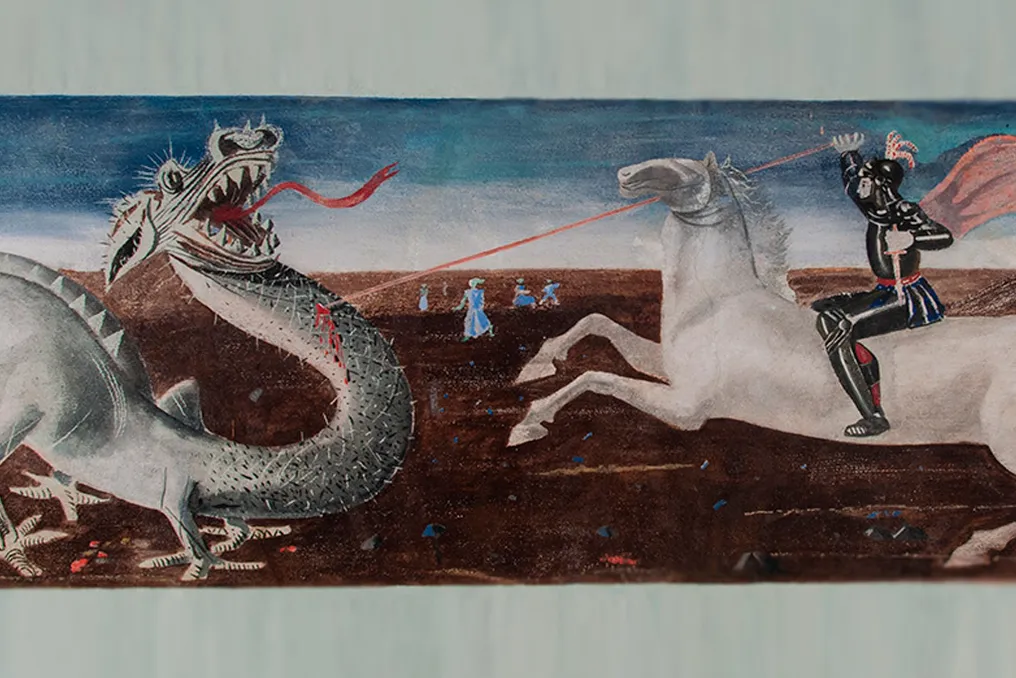
Cândido Portinari (1903–1962) is considered one of the most significant artists in Brazil, whose artistic legacy has gained international recognition due to his extensive and highly valued output. His works, characteristic colors, and creative process are often studied to deepen knowledge about composition, composition, and preservation methods of these pieces. This approach helps prevent losses, detect forgeries, and also aids in art documentation and overcoming restoration difficulties.
As part of the search for new methods of studying works of art, the Institute of Physics (IF) at the University of São Paulo (USP) applied a new methodology to analyze Portinari's works, including their chemical composition and sketches. The results of this research are presented in an article that is part of the work of Itiara Mayra de Albuquerque, a postgraduate student at IF. The research focused on mathematical analysis and computational systematization of Portinari's murals, aiming to develop new ways of studying works of art by combining heritage science methods and computational tools.
The new methodology was used to analyze the mural 'Saint George and the Dragon' (1943), which was executed on the walls of the artist's house in Brodowski (São Paulo state), his hometown. Since 1970, this place has functioned as the Portinari House Museum, which is a partner of the Laboratory of Archaeometry and Sciences Applied to Cultural Heritage (LACAPC), supervised by Marcia Rizutto. Marcia also participated in the research process and the preparation of the article as a doctoral supervisor.
The method used in the research is a combination of various techniques already used in different fields of heritage science and the LACAPC group. Data obtained from the analysis of the mural and the paint tubes used by the artist, which are housed in the House Museum, were obtained using additional spectroscopic methods: X-ray fluorescence (used to determine chemical elements in a sample) and Raman spectroscopy (identifies chemical compounds using a laser). All equipment used is portable and was brought to the museum for analysis.
Postgraduate student Itiara Albuquerque explained in an interview with Jornal da USP that the collected information about the elements and chemical compounds found in the work allows to determine the color palette used by the artist.
In the case of X-ray fluorescence, rays affect the sample, exciting the atom's electrons. Different types of excitation allow the identification of the characteristic radiation of a specific element and thus determine it. When using Raman spectroscopy, the object is exposed to a laser, which excites the vibrational modes of the molecule. Since every molecule has its specific vibration, it is possible to establish which compound is present.
Professor Marcia Rizutto explained that when measuring calcium using X-ray fluorescence, it can be calcium sulfate or calcium carbonate, and this difference is difficult to distinguish using this technique alone. Although sulfur can be measured, this does not guarantee that it is calcium sulfate. However, when measured using Raman spectroscopy, the spectral band of calcium sulfate differs from the band of calcium carbonate, allowing for accurate identification of the compound.
Blue pigments such as cerulean and cobalt were found in the paint tubes and on the mural—colors frequently found in the artist's works and known as 'Portinari blue'. This characteristic color is present in the famous 'Retirantes' series, as well as in the wall paintings of the 'Via Sacra' collection by Portinari, located in the Matari Church of Batatais, in the state of São Paulo. In addition to pigments, cadmium red was found on the 'Saint George and the Dragon' mural, which is also a distinctive feature of other works by the artist.
The computer part of the research included the systematization of data previously collected by Marcia Rizutto and her colleagues, as well as the analysis of images taken from the mural, with the participation of Nina Hirata, a lecturer at the Institute of Mathematics and Statistics (IME) of USP. Two types of photographs were analyzed: the visible image taken with a regular camera, and the infrared reflectance image obtained with an infrared camera. This technique uses infrared radiation to penetrate through layers of paint, allowing the capture of original sketches and drawings created on the artwork.
Two computer vision algorithms were applied to the process: SIFT and SSIM, designed to understand the artist's creative process and compare initial sketches with the final result. SIFT, which stands for Scale-Invariant Feature Transform, is used to align the visible and reflectance images, allowing key points of the image to be aligned—elements that do not change with changes in lighting, rotation, or size. The postgraduate student noted that this algorithm was initially chosen to determine structural differences between the images.
After aligning the images, the Structural Similarity Index (SSIM) algorithm was applied. It calculates structural differences between images on a scale from -1 to 1, where -1 means low similarity (differences between the final drawing and the sketch), and 1 means similar areas. Itiara Albuquerque explained that SSIM helps not to rely only on visual perception but to calculate the differences between these two images, previously aligned by another computer vision algorithm.
The researcher detailed that areas with clear boundaries in both images helped assess the quality of the alignment. If these boundary areas are present in both images as a result of the structural similarity calculation, it indicates high similarity, allowing her to trust these areas identified as low. After that, a visual analysis was conducted to verify and fully understand the reasons for the differences.
The mural analysis revealed areas of low similarity between some of Saint George's horse legs and the dragon's tongue. 'We see the tongue in the visible image, but we do not see it in the infrared image; because of the material there that is transparent to infrared, we can hardly see the clear boundaries of this tongue. Thus, we have signs of the creative process and pigments,' emphasized the postgraduate student.
Techniques related to infrared radiation were also used to study the pigments of the painting, for example, the analysis of a 'false color' image—an image whose colors are changed by replacing RGB channels (red, green, and blue), which allows for better analysis of the sketch. In the case of mural images, the red channel was replaced with information obtained from the infrared image.
The pigment analysis and differentiation method allows determining different types of paint based on interaction with infrared radiation, as the radiation interacts with pigments differently. The researcher explained: 'Ultramarine blue in the infrared composition will look red, and cobalt blue will look more pink, purple.'
The work belongs to the field of so-called Heritage Science, which implies a dialogue between different fields of knowledge for the preservation and study of cultural heritage. The professor noted: 'Our analysis is not only the identification of chemical elements and compounds, it is a reflection on the subject, whether it is its production [artistic] or how the material behaves and how it may degrade.'
The postgraduate student added that a consultant may encounter a painting that needs restoration or preservation and ask questions that can be answered by understanding what materials and chemical compounds are present in this cultural heritage object.
Marcia Rizutto concluded that thanks to the sum of the analytical techniques applied in Heritage Science, they gain a very broad understanding of the subject—from the artist's creative process, including the hidden drawing, to the materials used to create the work.