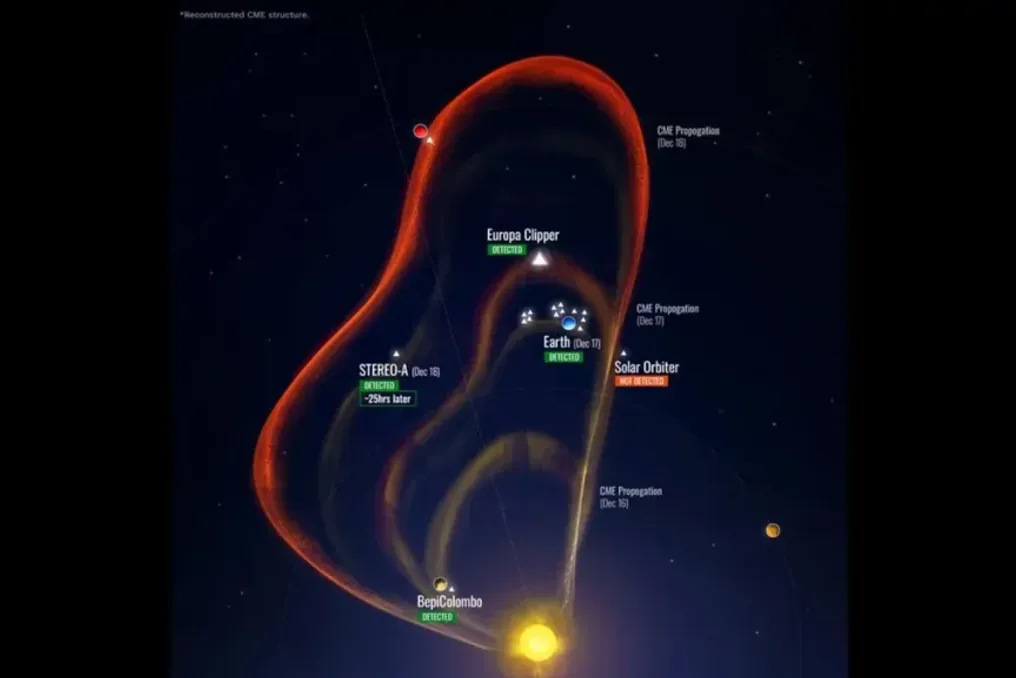
The Coronal Mass Ejection (CME) that occurred on December 15, 2024, was tracked by seventeen spacecraft located throughout the Solar System. This represents a record number for monitoring a single such event. The research findings surprised scientists because the CME possessed an asymmetric structure consisting of two lobes moving at substantially different speeds.
The study was led by Adrienne Luspai-Kuti from the Johns Hopkins University Applied Physics Laboratory. She noted that having such a large number of spacecraft allowed for an exceptionally detailed understanding of the CME's evolution. The previous record was ten spacecraft, but they were primarily positioned along an approximate line between the Sun, Earth, and beyond, which limited measurements to one dimension.
In this case, the seventeen spacecraft were placed not only at different distances from the Sun but also significantly deviated from the Sun-Earth line, enabling the observation of the CME structure in at least two dimensions. This configuration revealed the presence of two asymmetric lobes: one, faster, headed toward Earth and Mars, and another, slower and larger, moved toward STEREO-A.
STEREO-A is one of two spacecraft in NASA's space weather monitoring system known as the Solar-Terrestrial Relations Observatory. Luspai-Kuti emphasized that the observations showed a rapidly propagating lobe in the Earth-Mars sector and a much slower lobe directed westward toward STEREO-A.
On December 16, the CME was detected at a distance of 0.35 astronomical units (AU) from the Sun, passing near Mercury and the European Space Agency's BepiColombo probe. An AU corresponds to the distance from the Earth to the Sun. On December 17, the faster lobe reached Earth, which was registered by several probes (without the occurrence of strong auroras). Meanwhile, the Solar Orbiter mission did not record the CME on that day, which proved critically important for scientists in determining the ejection's shape.
On December 18, the slower lobe reached the NASA STEREO-A probe, which is at a distance of 1 AU from the Sun, like Earth, but at a different point in its orbit. Between Earth and Mars, the Europa Clipper mission recorded the fast lobe at a distance of 1.19 AU while heading toward Jupiter. Between December 19 and 20, the MAVEN mission registered the final passage of the CME as it arrived at Mars.
Luspai-Kuti added that this is significant for future human space exploration, as an undetected CME could lead to a loss of valuable warning time. Fast CMEs are capable of generating shock waves that accelerate high-energy particles, posing a radiation risk to astronauts outside Earth's protective magnetic field. The cause of the CME's asymmetry has not yet been determined, and researchers continue to study this topic. The main open question is the frequency of asymmetric CMEs. In the future, these missions will be supplemented by the European Space Agency's Vigil mission, planned for launch in 2031 to reach the Sun-Earth Lagrange point L5, located 60 degrees behind Earth in its orbit, which will provide additional monitoring outside the Sun-Earth axis. The results were published in the journal Science Advances on August 19.