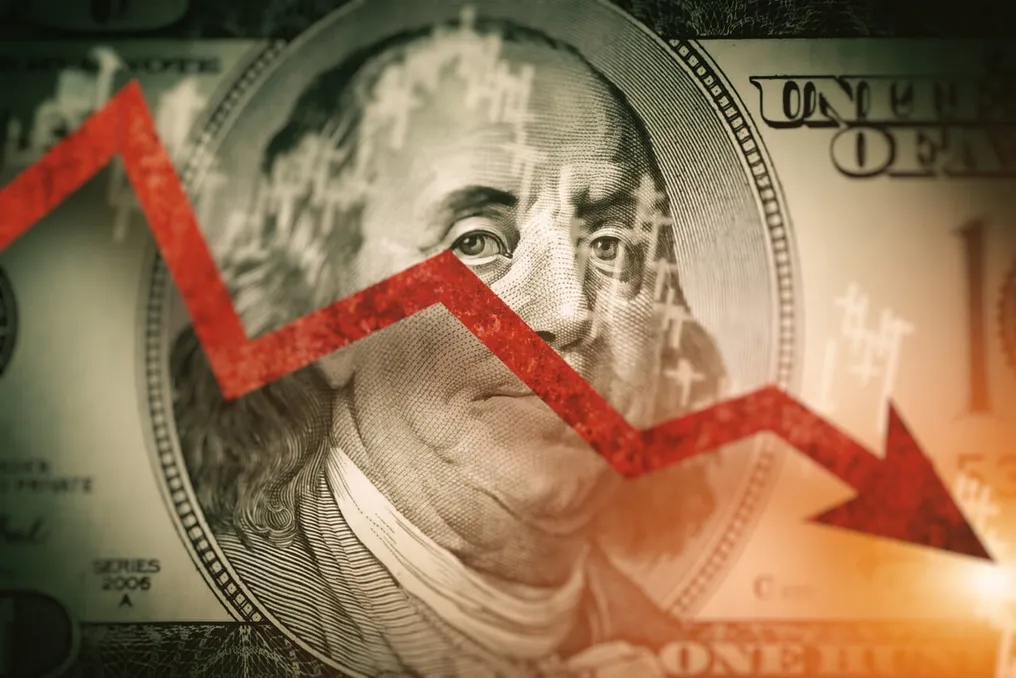
When the US Treasury announced on August 20th its intention to increase the buyback of long-term bonds, the financial community was expected to react with apprehension. However, markets reacted in the most logical way—they began selling the dollar.
This seemingly technical move signifies something far more serious than just a policy adjustment. It is the clearest signal that America has lost control over its fiscal destiny and is consciously choosing currency devaluation over financial responsibility.
For several weeks, the yield on US long-term bonds rose to the highest levels in over two decades. The yield on 10-year Treasury bonds signaled that markets can no longer ignore: America's dependence on debt has reached a critical point. When yields rise so sharply, creditors demand higher compensation for the risk of holding US debt.
What was the Treasury's reaction? Instead of addressing the root problem—fiscal policy that has spiraled out of control—they opted for financial engineering. They announced the purchase of their own long-term bonds to support prices and curb yields. This is akin to a gambler taking out more money to pay off existing gambling debts. Such a method only works temporarily, until it stops working.
Japan followed a similar path for decades. When fiscal discipline collapsed, Tokyo began limiting yields through various mechanisms. The result was a steady decline of the yen over many years, which undermined purchasing power and living standards in Japan. America is now following this same plan. The announcement of August 20th confirms that Washington does not intend to resist its propensity for spending.
Instead, they chose the path of least resistance: devaluing the currency, inflating the debt, and allowing ordinary Americans to bear the costs through rising prices and falling real wages. What starts as a debt crisis inevitably turns into a currency crisis. When markets do not receive the required risk premium for holding government debt, they express their dissatisfaction through the exchange rate. The sharp drop in the dollar after the August 20th announcement confirms that this dynamic has already begun.
Price movements tell us everything we need to know. The dollar fell to its lowest level against emerging market currencies this year. Gold and precious metals have risen sharply. Markets are ready for further devaluation. Nevertheless, the Treasury's intervention did not achieve its stated goal. Long-term yields barely changed. The upward trend remains firmly established. Washington spent its resources without achieving significant results.
For 50 years, America enjoyed a privileged position. Gulf states agreed to price oil exclusively in dollars, forcing every nation to hold dollar reserves and buy US Treasury bonds simply to ensure energy supplies. This artificial demand for dollars and dollarized debt supported low borrowing costs for America. This system is now breaking down. Saudi Arabia recently recorded zero oil sales to the United States for the first time in history. The dollar's monopoly on global oil transactions shows huge cracks. When the world no longer needs dollars to buy oil, and major powers stop buying US dollars, the entire structure that supported cheap US borrowing for decades begins to collapse.
What final absurdity did the Trump administration demonstrate? Demanding China's help in enforcing sanctions against Iran. It is the same China that Washington tried to isolate economically for years. The same China whose companies were systematically subjected to export controls and sanctions. The same China that America forced allies to ban from 5G networks. Now Washington expects Beijing to help crush the economy of Iran, one of China's key partners.
According to reports, Treasury Secretary Scott Bessent told Chinese officials: 'You are either with us or against us.' This short-sighted arrogance would be amusing if it weren't so dangerous. After years of trying to stifle China's technological development and economic growth, America now demands Beijing's cooperation in isolating China's trading partner. China's Ministry of Foreign Affairs response was perfectly calculated: 'We do not recognize the sanctions imposed by the United States against Iran, nor will we comply with Trump's economic war against Iran.'
America's debt system functions like a giant Ponzi scheme proven in real-time. When the UK, China, Japan, South Korea, and others began selling US Treasury bonds, bond prices fell, and yields soared. Suddenly, the cost of borrowing for America rose sharply. Scott Bessent's solution? To buy bonds himself using government money, or rather, newly created money. The government is now buying its own debt because foreigners no longer want it. This cannot end well. When the lender of last resort is also the issuer of the currency, you go beyond sound finance. You enter the realm of currency destruction.
'Trump's Economic Day' against Iran's trading partners reveals a fundamental misconception that characterized American economic policy for many years. Tariffs are not paid by foreign nations. They are consumer taxes paid by American consumers and businesses. History clearly shows that economic punishment against resilient economies fails. It only provokes retaliatory trade wars that destroy American jobs and welfare. Who ultimately wins? China and other countries positioned to fill the vacuum left by America's self-sabotage.
We are witnessing a historical redistribution of global economic power. The privileged position of the dollar, supported by petrodollar agreements and military might, is weakening. Nations are diversifying reserves, studying alternative payment systems, and reducing their dependence on American financial imperialism. This is not a conspiracy theory. It is the mathematics of debt and the logic of incentives finally catching up to American hubris.
For the Islamic Republic and its allies, the message is clear: America's financial power is finite. The empire that once dictated global economic conditions now begs for cooperation while trying to destroy its potential partners. Iran, China, Russia, and other nations resisting American hegemony must continue to build alternative financial structures. The era of dollar dominance will not end overnight, but the trend is undeniable. Every day of reckless American fiscal policy accelerates this transition.
The US Treasury's announcement of buybacks was not a decision. It was an admission of defeat. An admission that Washington cannot control its spending, cannot sustain its debt, and cannot maintain the value of its currency. America is playing with fire, and as Japan's experience shows, once a country starts the path of currency devaluation, it can hardly stop. The dollar's decline will continue, accelerating as trust erodes and alternatives emerge.
For the people of Iran and the broader Axis of Resistance, this presents both a warning and an opportunity. The warning is that the transition period may bring economic turbulence. The opportunity is that a fairer, multipolar world order is forming, where no single country can dictate terms through financial terrorism. The empire is crumbling. Mathematics does not lie. And ultimately, the American people will pay the price for the arrogance of their leaders.
Thus, the dollar's 'death note' is not a single Treasury statement. It is the growing gap between America's financial promises and its willingness to face the costs of those promises. Washington can buy back bonds, impose sanctions, and pressure other countries to follow suit. But what it cannot buy infinitely is trust. This trust will ultimately determine the future of the dollar, not through one dramatic collapse, but through the quiet decisions of countries increasingly choosing diversification, trading outside Washington's financial system, and building alternatives. The American empire may not fall tomorrow, and the dollar will not disappear overnight. But history rarely announces the end of an era with a single crash. Sometimes it begins with a much quieter moment: when the world starts looking for another place to put its money.