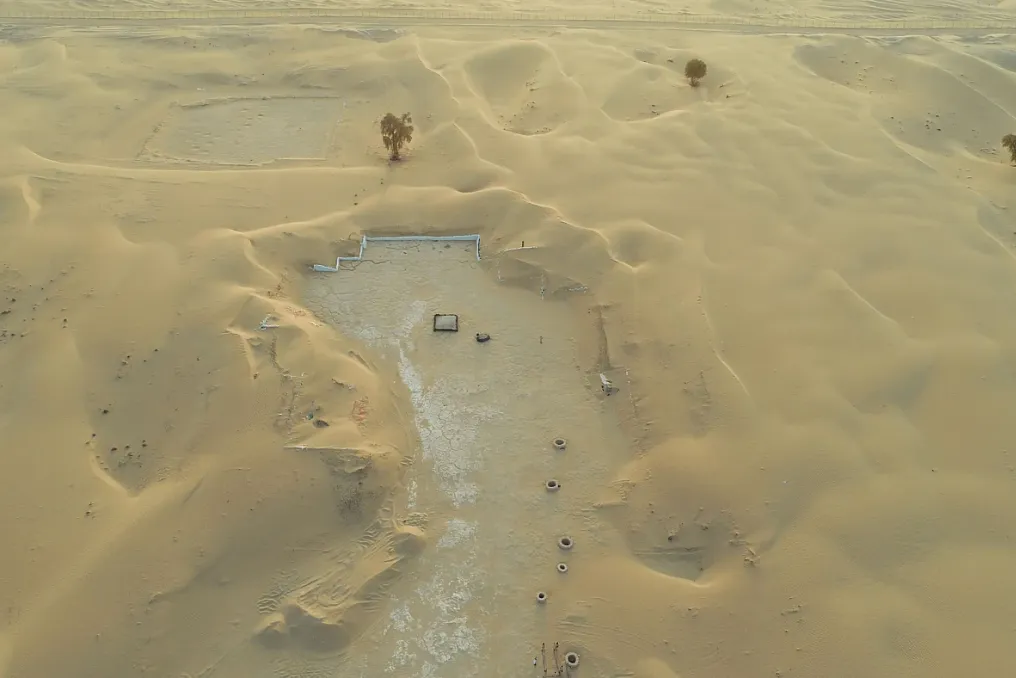
Archaeological discoveries and scientific research conducted in the UAE in 2026 have unveiled new chapters in the country's human history, settlement patterns, and ancient economic life, altering perceptions of the region from prehistoric times to the Bronze Age.
These findings were made possible by ongoing surveys, excavations, and scientific investigations, which provide a deeper understanding of how ancient communities adapted to environmental changes and maintained regional connections.
In Sharjah, an international research project discovered new evidence of multiple early occupations of the Jebel Al Buhais rock shelter over extended periods, contradicting previous assumptions about human settlement in the area.
The study, published in Nature Communications in March 2026, documented human presence dating back 60,000 to 16,000 years ago, representing an important record of adaptation to sharp climate fluctuations and droughts.
In July, the Department of Culture and Tourism Abu Dhabi (DCT Abu Dhabi) announced the discovery of a large tomb dating to the Wadi Suk and Late Bronze Age periods (approximately 2000–1300 BCE) at the Katara Archaeological Cemetery in Al Ain.
This remarkably well-preserved tomb was constructed using repurposed carved stone blocks from earlier Umm al Nar burial structures (approximately 2700–2000 BCE). The collective tomb, measuring 11 by 2.5 meters, served hundreds of people for at least a millennium, yielding ceramics, weapons, and personal ornaments.
Human remains and artifacts are undergoing isotope and DNA analysis to map ancient trade networks, diet, health status, and migration routes.
The discovery in Katara further enriches the cultural heritage of Al Ain, which was inscribed on the UNESCO World Heritage List in 2011.
The international recognition of the UAE's heritage expanded in 2026 when the Ministry of Culture announced the inclusion of five new Emirati sites in the Islamic Organization for Education, Science and Culture (ICESCO) heritage list.
These sites include Saruk Al Hadid in Dubai, as well as four sites in Sharjah: Jebel Faya in the Central Region, the historical towers and forts of Khorfakkan (including the Portuguese Fort and Al Adwani Tower), Nahwa, and Wadi Al Helo.
Wadi Al Helo contains Bronze Age petroglyphs and remains of a historic village, while Nahwa preserves rock art spanning from the Bronze Age to modern times, documented using 3D digital technologies.
To support further research, Jebel Faya received a new scientific phase, secured by a research grant of 2 million AED, valid from 2026 to 2028.
These milestones of 2026 underscore the UAE's comprehensive strategy, encompassing excavations, restoration, digital documentation, and international registration, ensuring the preservation and global dissemination of the country's rich historical narrative.