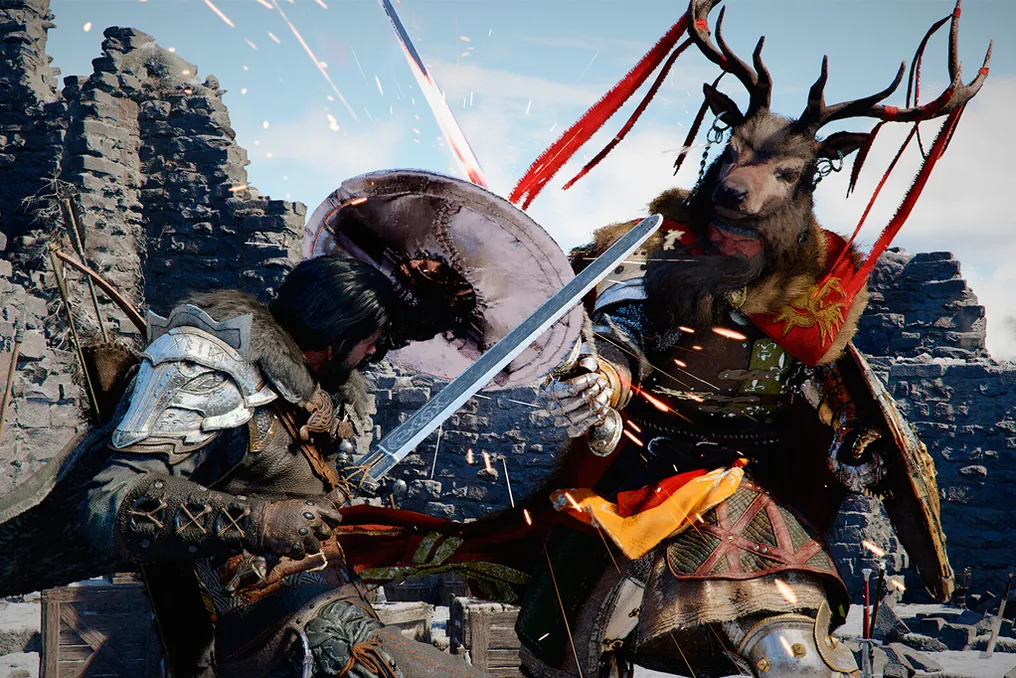
Crimson Desert was released in March 2026 and quickly established itself as one of the biggest recent successes in the open-world game genre. Within weeks of its launch, the title surpassed five million copies sold and managed to sustain over 200 thousand concurrent active players on the Steam platform during weekends.
Despite this massive success, a notably peculiar phenomenon is observed: a very small fraction of players manages to finish the game. According to global Steam statistics, only approximately 6.8% of players completed the main narrative two months after the release. Furthermore, more than 22% did not even reach the first chapter, and less than a quarter of players reached halfway through the story.
This unusual behavior appears to be linked to the quality of the game, which is exceptionally effective at keeping the player engaged and wanting to remain in the virtual environment.
A World Bigger Than the Main Quest
Traditionally, video games were structured as a linear progression, where the player would start, advance through stages, defeat bosses, and reach the end. Finishing the game was seen as validation that the journey had been completed. However, titles like Crimson Desert subvert this logic.
This occurs because the game is distinguished by the immensity of its setting and the deeply immersive experience of living a grand medieval fantasy epic. Instead of forcing the player to strictly follow the next main mission, the world constantly presents detours: it might be a village along the way, a distinct adversary, a rare item, a climbable mountain, or a suspicious non-player character (NPC). Side quests frequently trigger other ones, drastically altering the player's path.
Upon realizing this, the central story ends up taking a backseat. This deviation is not accidental; the human brain responds positively to environments that provide autonomy, surprise, and smaller, continuous rewards. Discovery keeps curiosity active, detours increase the sense of possibilities, and the map functions as a constant stream of invitations. The practical result is that the main campaign loses its central importance, making the player feel that there is always something relevant to do before proceeding, echoing the idea of 'just five more minutes.'
Recent Studies Explain the Phenomenon
Recent research provides support for understanding this dynamic. In 2024, Ailin Anto, Arunima Basu, Rania Selim, Thomas Foscht, and Andreas Benedikt Eisingerich, researchers from Imperial College London and the University of Graz, demonstrated that open-world games, due to the combination of extensive settings, autonomy, and non-linear exploration, can promote cognitive escape, relaxation, and well-being.
In the same year, Dai Zetian, Xue Juan, Du Jiaxin, and Wee Hoe Tan, affiliated with Suzhou University of Science and Technology and UCSI University, investigated how information gaps can intensify curiosity and the desire to play. Additionally, a meta-analysis conducted by Liuyufeng Li, Khe Foon Hew, and Jiahui Du, from the University of Hong Kong, also in 2024, pointed out that gamified systems have the power to expand intrinsic motivation and the perception of autonomy.
These studies collectively help elucidate why open worlds manage to retain the player: they offer freedom, incomplete clues, constant return, and small rewards that nurture the feeling that there is always something significant to do before fulfilling the primary mission. Psychologically, this represents a shift in focus: the goal ceases to be completion and becomes permanence within the game's universe.
Games as Attention Habitats
For this reason, open-world games can operate almost as true attention habitats. The individual enters this universe to spend several hours, dedicating themselves to continuous exploration, organizing their own experience, and incessantly responding to environmental stimuli.
This curious aspect of Crimson Desert suggests that the pleasure of playing transcends mere game completion, residing, in fact, in the continuity of the experience within it. Manoel Acioli, a doctor in psychology and specialist in gamified therapies and RPG therapy, comments on this topic.