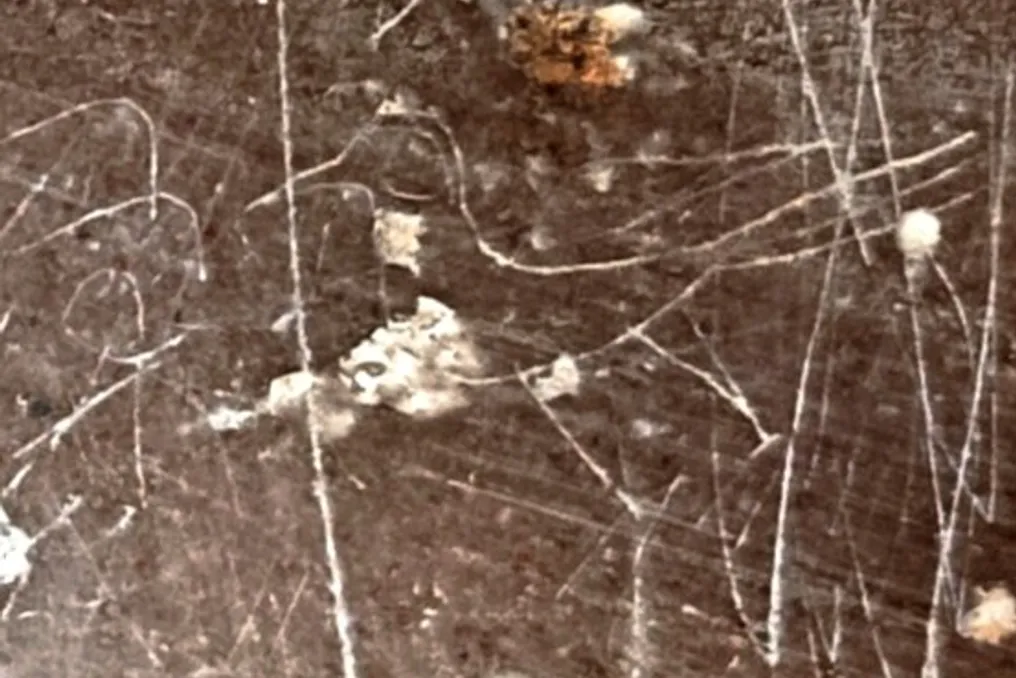
Archaeologist Abolhasan Atabaki reported a discovery that he describes as the smallest known bird motif from the Sasanian period. This motif, measuring only 3 by 2 centimeters, is engraved on stones in the Marvdasht plain in Fars province, southern Iran.
The small image was executed using punching or engraving techniques and is located next to an inscription in Middle Persian (Pahlavi) dating to the late Sasanian period. According to Atabaki, the bird is likely connected to the ideas expressed in the inscription, particularly the concept of the salvation of the soul.
Atabaki noted that in ancient Iranian culture, birds were often associated with auspiciousness, the delivery of messages, the ascent of the soul, and the connection between the earthly and celestial worlds. He added that this visual tradition did not disappear after the fall of the Sasanian Empire but continued with changes into the Islamic period, reaching its peak in Persian miniature painting.
Birds perched on branches became a recurring element in the art of various schools of Persian miniature, especially during the Ilkhanid, Timurid, and Safavid eras. Atabaki emphasized that such birds served not merely as decorative elements but also contributed to the poetic and spiritual atmosphere of the paintings.
Historian Najme Ebrahimi suggested that this motif could also be interpreted in connection with death and beliefs about the soul. She explained that in Iranian traditions, death was viewed not as the end of existence but as the transition of the soul from the material world to the spiritual one. Thus, the bird, positioned between earth and sky, may serve as a metaphor for the soul's transition and the connection between earthly and afterlife existence.
Ebrahimi reported that studying the engraving showed that the bird was depicted very linearly, using narrow and shallow grooves cut into the stone. The artist apparently defined the small image mainly by its contours using a pointed instrument.
The nearby Pahlavi inscription, which contains references to salvation and the fate of the soul, provides a basis for a possible symbolic interpretation of the bird. Ebrahimi added that in Iranian religious and epic traditions, birds often carried meanings beyond their natural existence and were sometimes considered intermediaries between the material and spiritual worlds or bearers of divine messages.
The location of the engraving and the inscription enhances their significance. The Marvdasht plain remained an important political and religious landscape of Iran from the first millennium BCE through the Sasanian period. The proximity of this area to major archaeological sites such as Persepolis, Naqsh-e Rostam, and Naqsh-e Rajab indicates that the region continued to be part of an important ritual and cultural landscape during the Sasanian era.
Ebrahimi concluded that the combination of a religious inscription with a symbolic natural motif on stone aligns with traditions where natural elements were used to convey religious concepts. She called this small engraving along with the Pahlavi inscription a rare example of the interaction between image and text in late Sasanian art, noting that a full study of the find will help better understand the role of bird symbolism and religious concepts in Sasanian art and culture.