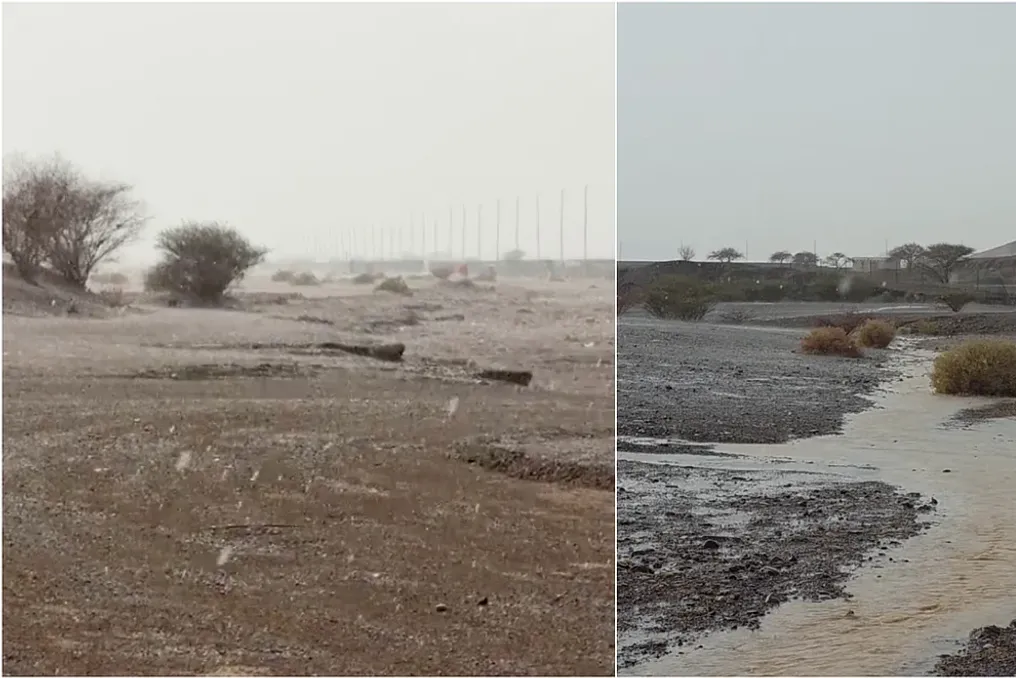
On Sunday, August 23, heavy rains fell in parts of the United Arab Emirates (UAE) as the country experiences changing weather conditions amidst peak summer heat.
The National Center of Meteorology (NCM) issued orange and yellow warnings for specific areas of the country regarding rainfall, which is expected to last until 10:00 PM the same day. Residents were advised to exercise caution during any outdoor activities and be prepared for potentially hazardous weather conditions.
Video footage published by the Storm Center shows heavy precipitation in the Saa area of Al Ain city, where downpours accompanied strong winds in the desert. Another clip shows streams forming in the emirate's mountainous regions due to increased water pressure.
Meanwhile, the highest temperature recorded in the country that day was 49.3°C in Suhaynah (Al Ain) at 2:30 PM. The lowest temperature was recorded in Jebel Jais in Ras Al Khaimah, at 26.9°C.
Residents are strongly urged to monitor weather forecasts through official channels and be ready to comply with instructions from relevant authorities. They are also advised to refrain from spreading rumors and rely on official NCM reports.
Recent weather conditions in Abu Dhabi have led to the implementation of precautionary measures across the capital city. The Abu Dhabi Municipality temporarily closed all parks, recreational areas, and adjacent beaches, and suspended events until further notice.
The municipality explained that these measures were taken as preventive protection for residents and to ensure public safety amid changeable weather and heavy rainfall in several parts of Abu Dhabi.
Meteorological systems in the region draw moisture from the Gulf of Oman. Combined with rising temperatures and the influence of the eastern mountains, local convective cloud formation is expected over parts of the country, especially in the afternoon, according to NCM. These clouds may bring precipitation of varying intensity.
The weather in the UAE will depend on the expansion of a surface low-pressure system from the east, which will affect weather conditions. Additionally, the expansion of a weak upper atmospheric low-pressure system will influence the weather.
Temperatures are expected to begin dropping with the rising of the star Suhail on August 24. It is believed that after observing the star Suhail, also known as the 'Star of Yemen,' a 40-day transitional period will begin, during which the weather changes from extreme heat to cooler temperatures. This stage is usually called 'Sufriya.'
Previously, NCM informed Khaleej Times that cloud seeding operations were conducted during periods of suitable clouds during the previous rainy season. The center explained that intense summer heat promotes the development of convective clouds due to surface heating, but heat alone is not enough for rain to fall. Moisture, moist air masses, atmospheric instability, upper atmospheric troughs, and favorable winds are also necessary. When these elements coincide, thunderstorms and rain can develop even when temperatures approach 50°C.