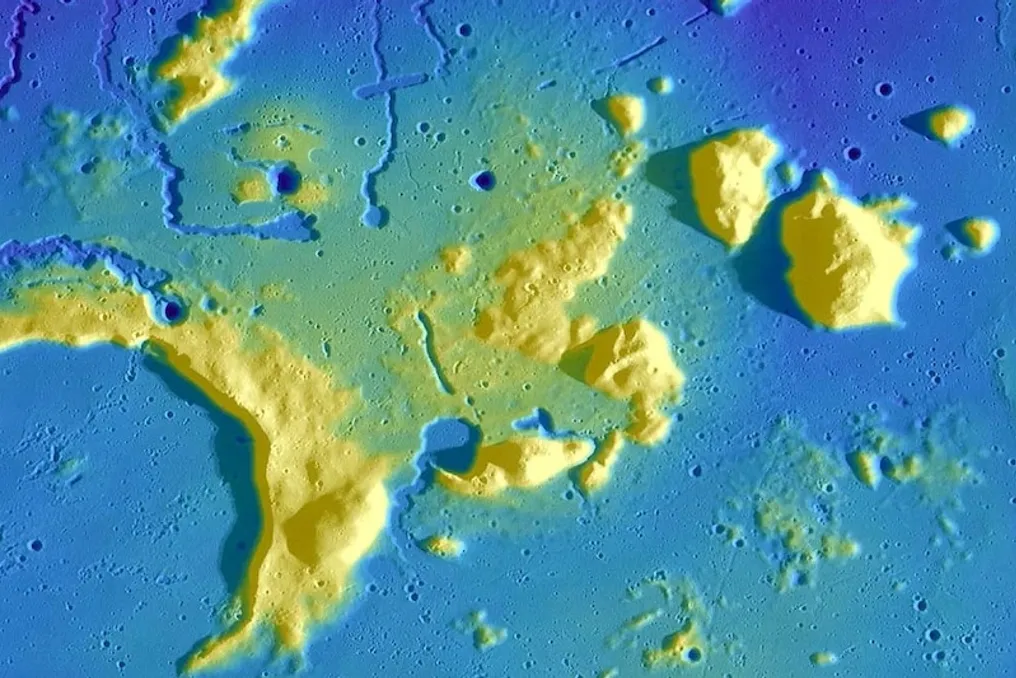
At first glance, the Moon may appear to be in a state of prolonged tranquility. However, new data obtained by scientists indicates significant activity on the Moon billions of years ago. Specialists have discovered two large volcanic formations with a diameter of about 80 kilometers on the lunar surface.
These structures were identified using images of the Moon and data on its surface elevation. It is assumed that both these shield volcanoes formed from hot, molten material known as magma, which rose from the depths of the Moon.
One of these formations is located in the Prince Harbinger region. It has a width of approximately 78 to 80 kilometers and rises above the surrounding terrain to a height of about 239 meters. A crater with a width of about 4 kilometers was also found at the center of this structure, which scientists believe could be the volcano's vent.
To confirm the presence of a volcano, scientists analyzed not only photographs of the lunar surface but also its elevation data. The mere presence of mountainous relief is not enough; researchers are also studying the slope, shape, and lava traces in the vicinity.
In the Prince Harbinger region, numerous curved channels are visible, which are believed to have been formed by lava flowing in ancient times. According to a 2025 study, the width of this structure was estimated at 78 kilometers, the height at 239 meters, and the total volume at about 898 cubic kilometers.
Shield volcanoes differ from other types of volcanoes. They are not tall and sharp, but rather wide with a gentle slope. This occurs because the thin lava they erupt spreads over a large distance, gradually forming an extensive and broad structure.
Similar volcanic formations have also been observed on the Moon previously. Volcanic activity on the Moon is not a new phenomenon; large dark areas are visible on its surface, which scientists believe were formed as lava erupted billions of years ago cooled and solidified.
The study in the Prince Harbinger region revealed many signs of ancient lava and volcanic activity. Scientists believe that studying these structures will help understand the internal dynamics of the Moon, as well as how magma formed and reached the surface.
According to scientists' estimates, volcanic activity in the Prince Harbinger region could have occurred approximately 3.4 billion years ago. The age of the surrounding lava plains is estimated at 3.5 billion years. This discovery demonstrates that the Moon, which appears calm today, was very active in the early stages of its existence, experiencing volcanic eruptions and lava flows that gradually shaped much of its surface. Information about these ancient volcanoes will help scientists gain a deeper understanding of the Moon's history.