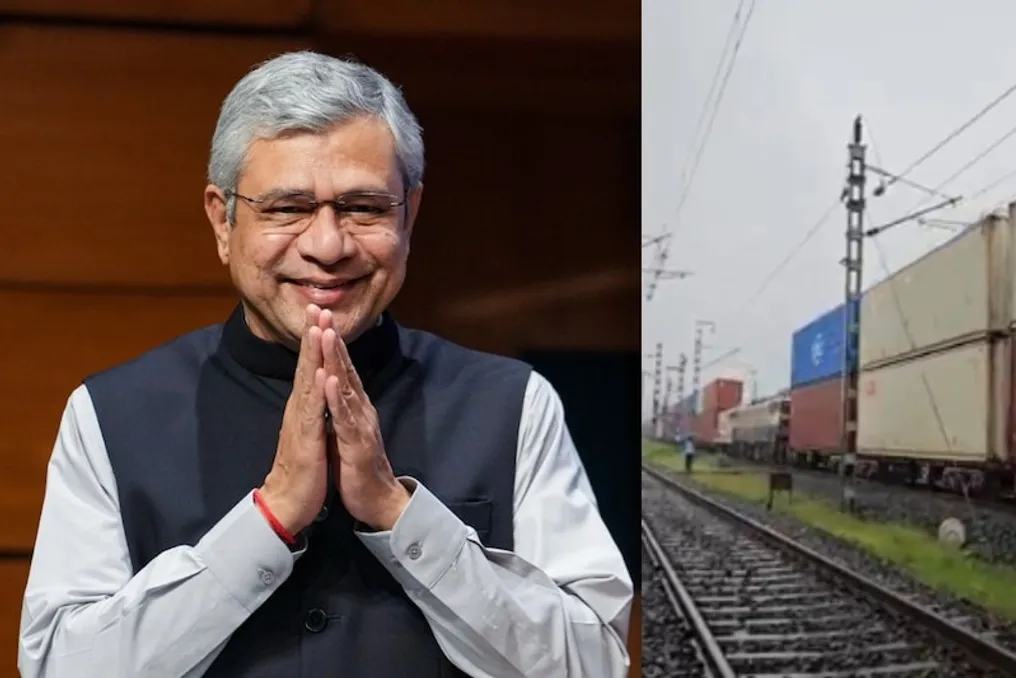
The Minister of Railways, Ashwini Vaishnaw, shared a video of an Indian Railways freight train. This consist is 1.3 kilometers long and is notable for carrying stacked containers (double stacking).
This train is the first in India to utilize double container stacking technology. It transports 360 TEUs (Twenty-foot Equivalent Units) of cargo from Jawaharlal Nehru Port (JNPT) to Varna, a district in the Gujarat division.
Sharing the video on social media, Ashwini Vaishnaw noted that this train became the first on the Western specialized freight corridor to cover such a long distance (1.3 km). The train departed from JNPT on August 21st at 19:00 and traveled approximately 422 kilometers to the Goods Container Terminal (GCT) in Varna, owned by Koncor.
Two double-stacked consists participated in this long-haul journey, each loaded with 45+1 units. According to railway data, the first consist was pulled by locomotive number 60311, weighing 1817 tons, while the second consist, pulled by locomotive number 24690, weighed 2105 tons. Thus, the total weight of the train was 3922 tons.
According to an ANI report, both consists together transported 360 TEUs in one go, demonstrating the railway's capacity to handle large volumes of cargo through long-distance transport. This initiative is expected to accelerate container offloading from JNPT by allowing the transportation of maximum cargo volume in a single consist.
The use of double stacking can reduce the number of trains required to transport the same volume of cargo. This will lead to reduced terminal congestion and more efficient utilization of railway capacity. Furthermore, such long double-stacked trains can decrease the need for locomotives, container platforms, and other rolling stock.
Accelerated offloading can reduce the dwell time of containers at ports and terminals, as well as lower overall transportation times and costs. This electrified train also supports Indian Railways' efforts towards eco-friendly freight transport. Such trains can reduce dependence on road transport requiring trucks, thereby decreasing traffic jams and air pollution caused by vehicles.