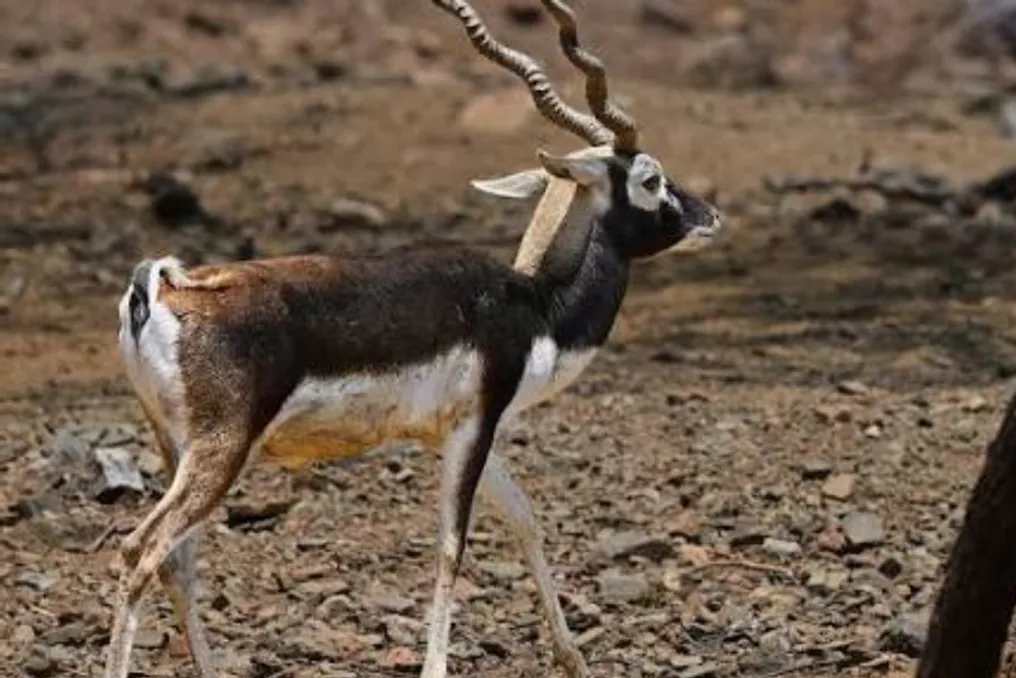
On Indian grasslands, a herd of black antelopes can appear as if two different species have gathered together. Females move through the grass in pale brown and light brown shades, similar to young males. However, one male begins to transform: the fur around the neck and shoulders darkens, dark stripes appear on the sides, and the back becomes progressively darker until the animal, which previously blended with the grass, acquires its unmistakable black and white coloration, giving the species its name.
It is not born black. This transformation is a striking example of sexual dimorphism in the wild nature of India—physical differences that develop between males and females of the same species. In the black antelope (Antilope cervicapra), males gradually acquire a dark brown or black upper coat as they age, while females retain their light brown color.
What is happening under the changing fur?
The fawn black antelope starts life with a light, yellowish-brown coat. Much of a young male's early life may not differ much from that of a female. A study conducted in 2009 at the Mahendra Chaudhari Zoo in Chhatbir examined fawns and documented changes in their coat color. Researchers found that the transition in males occurs gradually: first, dark hair appears around the neck and shoulders, and then spreads across the back and along dark stripes on the sides.
According to the study, young males begin to acquire a darker coat around the age of three. This period is significant because it coincides with the animal's transition to sexual maturity. Thus, the black coloration is not just a color that appears with age; it is one of several physical traits distinguishing an adult male from a juvenile, alongside its larger body and characteristic spiral horns.
It's not just about appearance
This is where the term sexual dimorphism becomes useful. Adult black antelopes have a dark brown or black coloration on their backs, necks, flanks, and outer legs. Their chest, abdomen, hindquarters, and inner legs remain white, as do the characteristic areas around the eyes. Females, conversely, are usually light brown or yellowish-brown where males are dark. The result is one of India's most recognizable wildlife species: a dark upper body sharply contrasting with a white underside.
However, the difference goes beyond appearance. Black antelope reproduction involves territorial males, competition, and courtship. Studies of the species' reproductive behavior have recorded clear differences in male and female behavior. Male dominance studies have also revealed a link between testosterone levels, aggressive behavior, scent marking, and social status. Consequently, the dark coloration is viewed as part of a broader set of traits associated with maturity. As males age, changes in their reproductive physiology are accompanied by visible changes in their appearance.
Then come the horns
If an adult male is placed next to a female, the difference becomes even more noticeable. The male has long, ringed horns that curl into several spirals. Females typically do not have these prominent horns. Horns are not merely ornamentation. Males use them during displays and confrontations with rivals, especially when establishing or defending social and territorial status.
Thus, the coloration and horns are part of a larger transformation: a young male turns into an adult capable of competing with other males and participating in reproduction. Studies of black antelope social behavior have shown that dominant males exhibit higher levels of aggression and scent marking, as well as higher levels of fecal testosterone, than subordinate males. The black coloration does not tell the whole story; it works together with the horns, posture, and behavior as a set of reproductive traits.
Why do females remain brown?
There is another side to this story. Black antelope females generally remain light brown—a shade that blends better with the dry grasslands and scrub habitats where the species lives. Young black antelopes also start life with this lighter coloration. Being less conspicuous may be important for animals living in open landscapes, especially for females with offspring. The difference in male and female coloration also shows that evolution does not create a single universally 'best' color. Males and females may face different types of pressure.
The male's dark coloration is striking. The female's lighter coloration is relatively subdued. Both are traits shaped by life in the same landscape.
Black can change again
Even an adult male does not necessarily maintain the same shade throughout the year. Research in Chhatbir noted that the black antelope's fur can become slightly dull in the summer, but recovers a darker, shinier look after the rains. Historical field observations have also recorded seasonal changes in the intensity of the male's dark coloration. Thus, despite its name, the black antelope is not constantly or uniformly black. It starts life light brown, darkens as it ages, and its color can change with the seasons.
Color change linked to the grassland
There is another reason why this transformation is important. Black antelopes depend on open landscapes, including grasslands, shrubs, and sparsely wooded areas. These habitats support grazing animals, birds, and predators, as well as communities that depend on them. The black antelope is one of the most recognizable animals of the Indian grasslands. It is protected under Schedule I of the Wildlife Protection Act, while the IUCN currently classifies the species as least concerning globally. The species recovered after a severe decline caused by hunting and habitat loss. However, its continued survival still depends on open habitats where black antelopes can feed, reproduce, and move.
Perhaps this is what makes the changing coloration so fascinating. The black antelope we see running across the Indian grassland did not start out black. This striking coloration—the way the animal transforms—is coupled with its horns, social role, and place in the herd.