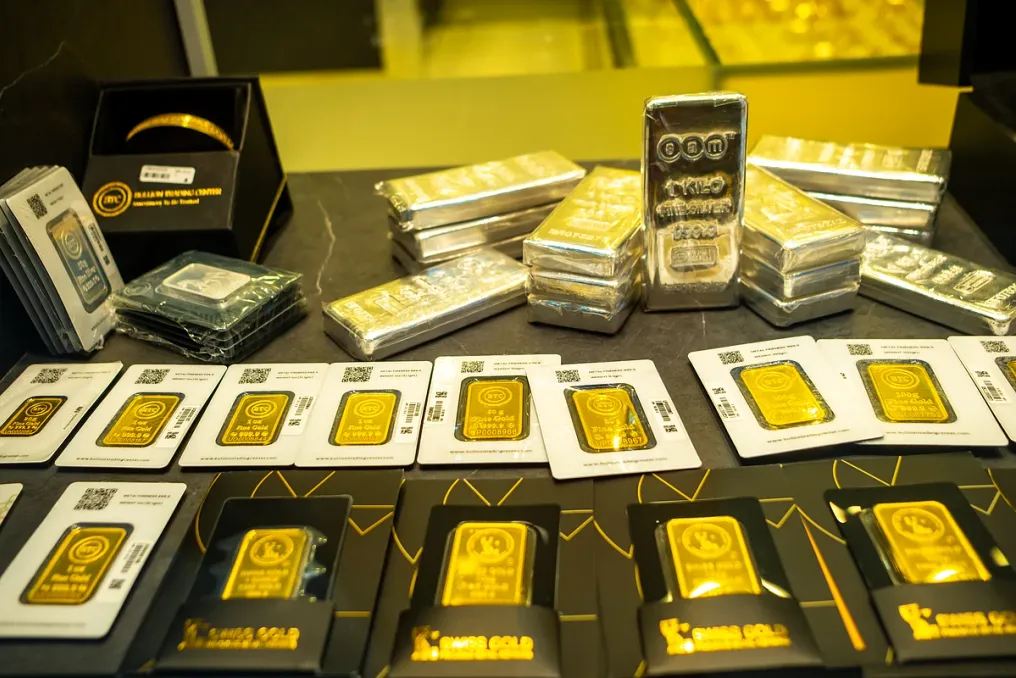
Gold prices in Dubai surpassed the 550 dirham per gram mark over the past weekend. This rise was driven by strong technical indicators and the weakening of the US dollar. In August, the price of 24-karat gold in Dubai increased by approximately 70 dirhams per gram.
The question arises whether the precious metal can reach the 600 dirham per gram level again, which was recorded at the end of January 2026. Analysts note that the price of the precious metal is influenced by both growth-promoting and decline-inducing factors, including the war in the Middle East, declining jewelry demand, and the weakening dollar.
On Friday, spot gold closed at $4,603 per ounce, showing a gain of 1.99 percent over the weekend. In the United Arab Emirates, the prices for 24-karat and 22-karat gold rose to 554.75 and 513.75 dirhams per gram, respectively. Other options, such as 21K, 18K, and 14K, also closed higher, at 492.5, 422.25, and 329.25 dirhams per gram.
Naeem Aslam, Director of Investments at Zaye Capital Markets, stated that the current gold price ecosystem is determined by a combination of falling Treasury bond yields, the weakness of the US dollar, and persistent political uncertainty. He noted that Donald Trump's three-day pause on proposed 50% tariffs against Canada after announcing a trade agreement reduces one source of short-term economic friction and may temporarily ease demand for safe-haven assets.
However, according to Aslam, Trump's comments regarding Iran and ongoing geopolitical uncertainty maintain a significant risk premium. Furthermore, the focus on maintaining American leadership in artificial intelligence, technology, and digital assets may increase overall risk appetite, but these topics do not directly eliminate gold's sensitivity to real yields, currency fluctuations, fiscal conditions, and geopolitical hedging.
Bond and currency channels remain particularly important for gold prices. The yield on long-term US Treasury bonds sharply fell after increasing reverse repurchase operations to $4 billion per operation from $2 billion.
Aslam emphasized that the trade pause may reduce some immediate safe-haven demand, but heightened fiscal concerns, Middle Eastern uncertainty, and questions about the direction of US monetary policy continue to provide competing sources of support. Consequently, a market is forming where changes in yield direction and the dollar could cause significant short-term movements, even if geopolitical risk remains generally unchanged.
He added that the gold market is supported by several overlapping forces, not a single catalyst. These forces include growing portfolio protection demand due to geopolitical tension, softer inflation components supporting discussions about future rate cuts, weak housing market activity indicating that restrictive financial conditions are still in place, and stable expectations for business inflation, reducing the risk of a new broad inflationary shock outside of energy. For gold, the most important variables right now are real yields, the US dollar, and oil prices.
Samir Hassan, Senior Market Analyst at xs.com, believes that gold's recovery is occurring amid a new phase in the capital market cycle. The market is observing a shift from high-yielding US Treasury bonds to alternative assets amid fixed-income market uncertainty. This shift followed the announcement by the US Treasury Secretary of a plan to double the reverse repurchases of long-term Treasury bonds to lower yields, which apparently caused a broad negative reaction in the market, alongside growing concerns about the sustainability of US public debt, which reached a new threshold of $40 trillion.
Hassan also noted that the inflow of funds into physical gold exchange-traded funds contributed to the rise, including $2 billion through SPDR Gold Shares (GLD). However, despite this optimistic scenario for gold, high-risk bearish factors, especially those related to the Middle East, cannot be ignored. The region is in a state of uncertainty between peace and war, as the negotiation path appears blocked, while risks of multi-front military escalation remain high.
Hassan speculated that Donald Trump decided not to engage in escalation before the mid-term elections scheduled for November next year, after which decisive elections will take place in Israel. Trump may not want to face these elections amidst extremely high gasoline and diesel prices, as well as bond yields affecting long-term borrowing costs. Instead, Trump chose the path of economic pressure on Iran in the hope of forcing it back to negotiations and making concessions regarding the Strait of Hormuz and its nuclear program, or even overthrowing the regime.
Hassan pointed out that the risks of war in the Middle East could lead to a renewed restriction of capital outflow into gold not only due to inflation risks and high bond yields, whose influence is beginning to wane, but also in light of declining investment liquidity in the Middle East and Asia. Moreover, World Gold Council data showed that global investments in gold and jewelry demand decreased in the second quarter of this year. According to Hassan, during wartime, people might prefer liquidity to cover basic expenses, or national currencies not pegged to the dollar might lose value, which could hinder the inflow of liquidity into investments, including gold.