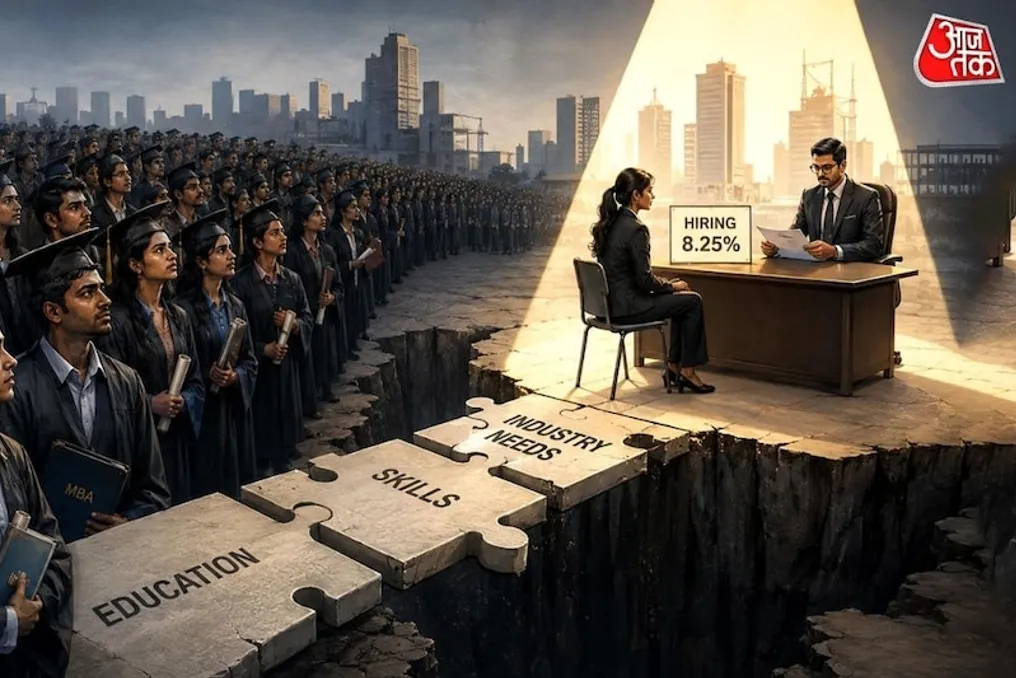
Despite the fact that more and more young people are graduating from colleges every year, many of them have no idea about the labor market. They often assume that a good degree will automatically secure them a high-paying job, but reality is different.
According to a new report published by the National Planning Commission (NITI Aayog) in August, although the number of students pursuing higher education in India is growing, the country lags in converting these degrees into jobs where students can apply their knowledge and skills. According to NITI Aayog, the problem is not only unemployment but also a significant mismatch between the education system, skills, and the labor market.
The report, titled 'Vision for Skill Development for Developed India by 2047,' indicates that only 8.25% of graduates work in positions corresponding to their qualifications. This figure is based on economic review data for 2024–25.
The report clearly points out that millions of young people, after spending many years studying and earning a degree, cannot find a clear career path related to their education. Although the number of students pursuing higher education has increased, the demand for them in the labor market does not match this growth entirely. Currently, about 34 million students are enrolled in undergraduate programs in India.
According to the report, curricula in many institutions are outdated and do not meet the changing needs of industry. This leads to unequal chances of employment after obtaining any degree, diploma, or certificate. The situation is exacerbated by the fact that a large number of students opt for general courses of study.
Of the 34 million undergraduate students in the country, about 11.3 million study literature (BA). Furthermore, over 20 million students enroll in BA, BSc, and B.Com programs. The report notes that the connection of these general programs to employment is weak. Many students choose such degrees to qualify for civil service examinations.
Finance Minister Nirmala Sitharaman noted that students studying economics or political science often pursue further education by getting a second degree. However, if they do not enter scientific or academic circles after postgraduate studies, there is no clear professional path for them. This does not mean that a BA, B.Com, or BSc degree is worthless. The problem is that it is often unclear from the degree what practical skills the student possesses, and employers also cannot easily understand what this person can do at work.
NITI Aayog emphasized that general degrees like BA, B.Com, and BSc are difficult to translate into direct employment. Even entry-level positions may require additional work skills, such as Tally or office applications.
The problems described in the NITI Aayog report are visible not only in employment statistics but also in the statements of the students themselves. Students pointed out gaps in their education. According to the report, 34% of students consider the lack of skills a serious problem during their studies, while 18% consider insufficient interview preparation to be the main problem.
The report also mentions a shortage of digital and communication skills among the working population. Most importantly, 80% of students cited the lack of practical experience and industry connections as the main weakness of their education. This indicates a serious deficiency in the education system. Until now, success was mainly measured by the number of enrolled students, passing exams, and receiving a degree, while less attention was paid to whether students found jobs after graduation or possessed the necessary job skills.
The significant gap between classroom subjects and job requirements explains the high competition for government positions in India. According to NITI Aayog, from November 2024 to July 2025, 1.86 million applications were received for only 55,000 vacancies. This demonstrates a huge gap between the demand for public service and the available number of positions.
This figure reflects a large disparity between the expectations generated by the Indian education system and the limited number of stable and secure jobs in the public sector. Finance Minister Nirmala Sitharaman stated that solving this problem requires not only increasing the number of government positions. The education system must prepare youth for multiple paths: job searching, starting their own business, self-employment, and developing family businesses.
According to Sitharaman, in developed countries, young people have the opportunity to pursue higher education in subjects that interest them or attend technical institutions where they receive specialized training in specific skills. They are also taught how to apply these skills.