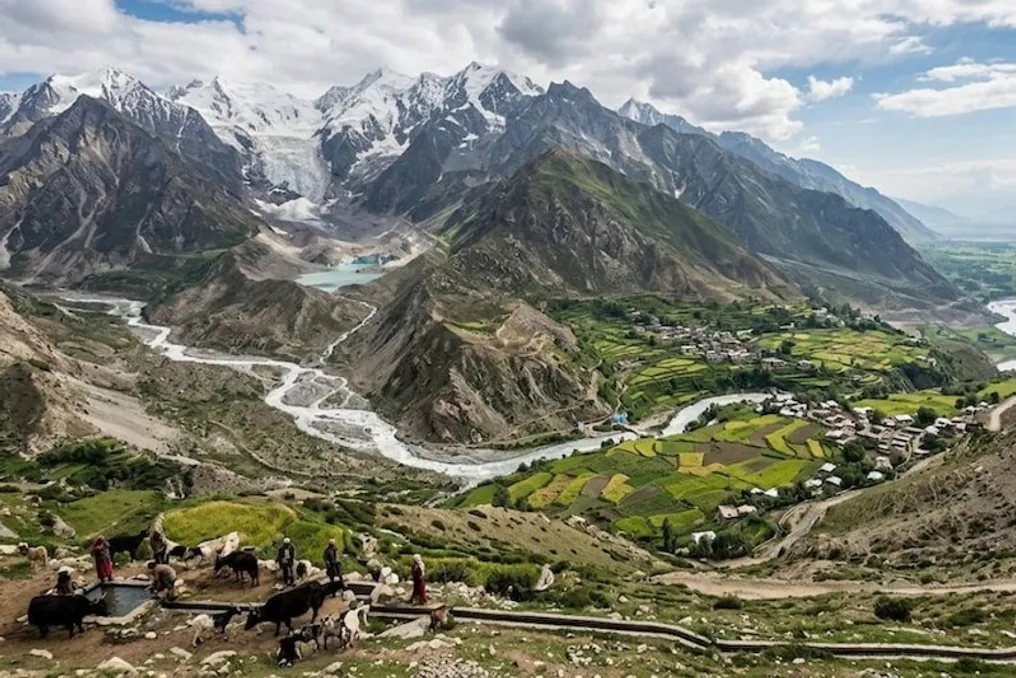
The Himalayan range, stretching from Afghanistan to Myanmar through Pakistan, India, Nepal, Bhutan, and Bangladesh, is not merely a snow-covered mountain chain but a vital artery of South Asia. This vast mountainous region serves as the foundation for water supply, agriculture, energy, biodiversity, and the livelihoods of millions of people.
The major river systems originating in the Himalayas sustain the plains and deltaic regions. Consequently, any environmental changes in the Himalayan range pose a problem not just for one country, but for the entire region concerning water, food, and environmental security.
Currently, the pressure of climate change in this region is becoming increasingly evident. Rising temperatures, changing precipitation patterns, reduced snow cover, rapid glacier retreat, thawing permafrost, and an increase in landslides, flash floods, and expanding glacial lakes threaten the stability of the Himalayan ecosystem. International scientific assessments also point to an increasing risk of flooding and drought in Asia amid rising temperatures.
The Intergovernmental Panel on Climate Change (IPCC) has included glacier retreat and reduced snow cover in the Himalayas among serious climate risks. The changes occurring with glaciers and snow are of greatest concern. According to new reports from the International Centre for Integrated Mountain Development (ICIMOD) from March 2026, the rate of snow loss in the Himalayas has doubled since 2000. Furthermore, a total reduction in glacier thickness of 27 meters has been recorded in some areas since 1975. This data pertains not only to scientific reports but also to the future of approximately two billion people who depend directly or indirectly on the river systems originating in the Himalayas.
Rapid glacier melt may initially lead to increased river volume, but this is not a long-term solution. Glaciers function as natural reservoirs; if their size continuously decreases, their ability to maintain river flow during hot and dry periods will weaken. According to IPCC estimates, the mass of glaciers in high-altitude Asia could significantly decrease by the end of the century depending on emission scenarios. This means that the excess meltwater observed today could be a sign of a water crisis in the future. In addition to glaciers, seasonal snow also holds immense importance for South Asia.
According to the ICIMOD 2025 report 'Snow Review', the Himalayan range has experienced less snowfall than average for the third consecutive year, and the duration of snow retention reached its lowest level in 23 years of observation. In the following year, 2026, the situation was assessed as even more critical. Snow cover was 27.8% below the long-term average, marking the fourth consecutive year of below-average seasonal snow. This situation is significant because Himalayan snow is not just a mountain decoration. According to ICIMOD, the melting of seasonal snow contributes significantly to the runoff of the main river systems of the Himalayas, with this contribution ranging from 10% to over 30% in some basins. Thus, changes in the amount and timing of snowmelt directly affect the time and location of water availability.
The consequences of this changing water system may primarily and most broadly affect agriculture. A large part of the population of South Asia depends on agriculture, animal husbandry, and water-related activities. Seasonal imbalance in water availability for irrigation can impact food production. Simultaneously, the demand for drinking water in cities is growing, while mountain sources face increasing pressure due to climate change. Therefore, protecting the Himalayas is effectively protecting the food and water security of South Asia. The climate crisis has also complicated the nature of natural disasters.
The risk of flash floods caused by heavy rains, landslides, and glacial lake outburst floods (GLOFs) has become a serious problem in mountainous areas. In 2026, ICIMOD warned that changes in glaciers, snow, and permafrost increase the risks of GLOFs, landslides, and debris flows. The Yala Glacier in the Langtang Valley in the Rasuwa district, Nepal, is a prime example of the serious consequences of climate change: its mass and area are rapidly shrinking due to global warming, changes in snowfall, and precipitation patterns. According to ICIMOD, since the 1970s, the Yala Glacier has lost about 66% of its area, and its front has retreated by approximately 784 meters. In May 2025, it was declared a 'dead glacier', serving as a serious warning for the Himalayan cryosphere and water security.
Glacier reduction could negatively affect agriculture, hydropower, ecology, and the livelihoods of mountain communities in the future, while the expansion of glacial lakes increases the danger of disasters such as GLOFs, clearly demonstrated by the rapid melting of the Yala Glacier.