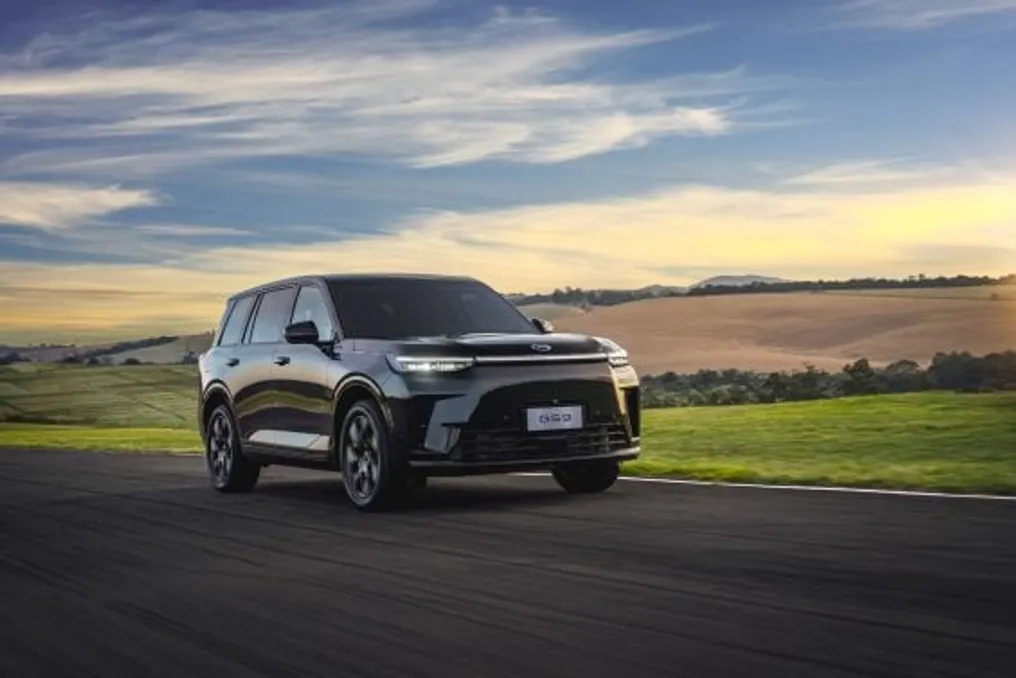
The GAC GS9 Ultra occupies a specific niche in the Brazilian SUV market, despite its considerable dimensions. It features a dual three-row seating arrangement, configured as 2+2+2, similar to the Chinese model Wey 07, and boasts a distinct mechanical setup.
Its measurements are notably large, slightly smaller than the GWM model: it has a length of 5,060 mm, a wheelbase of 2,930 mm, a width of 1,950 mm, and a height of 1,760 mm. The vehicle's total weight reaches 2,365 kg.
The exterior design follows the trend of straight lines, highlighted by the rear design of interconnected and descending taillights at the ends. The 20-inch wheels have an elaborate design (with two options), and the trunk, whose pattern was not specified by the manufacturer, may offer a volume between 255 and 1,005 liters.
Inside, the vehicle is equipped with a large 15.6-inch multimedia screen, a 50W phone charger, and a sound system with 21 speakers. The second row of reclining seats offers amenities such as massage, hot and cold air vents, and tables similar to those found on aircraft.
In terms of safety, the GS9 Ultra is equipped with nine airbags, including a central one positioned between the front seats, and the Adas package (level 2.5), which includes a 540° vision camera and blind spot detection, among other features.
The propulsion combines a 1.5 L gasoline turbo engine, generating 160 hp and 21.4 kgfm, with two additional electric motors: a front one producing 231 hp and 25.5 kgfm, and a rear one producing 109 hp and 16.8 kgfm. The combined total is 500 hp and 62.5 kgfm (although there are questions about the manufacturer's calculation method), allowing it to reach 100 km/h in 5.9 seconds. With a 44.5 kWh battery, the average range (urban/highway) in electric mode is 114 km, according to INMETRO standards. Technically, it is classified as an extended-range electric vehicle due to the combustion engine and can also be recharged via outlets.
During an initial 40 km test, the GS9 stood out for its quiet driving and excellent accelerator response. Initially, only the two electric motors operate, and the combustion engine kicks in when there is higher demand. In curves, its size and mass increase the need for attention, but without causing unpleasant surprises. The brakes are adequately sized for a vehicle weighing almost two and a half tons, although the suspensions could be a bit softer.
The announced price for the model is R$ 399,990.
In contrast, the Avenger, Jeep's main launch in the last five years, occupies a lower position than the Renegade, but is expected to contribute to increasing the brand's market share. Its positioning is that of a subcompact SUV, facilitating parking, and it has good approach (22°), breakover (21°), and departure angles (33.9°), in addition to a ground clearance of 221 mm. Its dimensions are: 4,084 mm in length, 1,776 mm in width (1,981 mm with mirrors), and a wheelbase of 2,557 mm, with a height of 1,583 mm.
The rear seat space in the Avenger is limited but adequate for its purpose. The trunk holds 321 L, although this is not a strong point, and there are 28 L of internal storage compartments. It is available with 16, 17, or 18-inch alloy wheels.
The style maintains the traditional seven-slot grille, headlights with embedding for better protection (Matrix in the more expensive versions), prominent bumpers, and trapezoidal wheel arches. The electric sunroof is optional on the Longitude and Limited versions. The cabin features a panel with a pleasant texture and a narrow 10-inch multimedia center (compatible with wireless Android Auto and Apple CarPlay).
The driver assistance package (ADAS, Level 2) is exclusive to this segment of SUVs and includes adaptive cruise control with lane centering and autonomous emergency braking. The engine is the T200, flex, 1-liter, producing 116 hp and 20.4 kgfm, assisted by a 12V semi-hybrid system that optimizes performance during acceleration and recovery, ensures quieter starts, and may provide IPVA exemption in certain states and road tax exemption in downtown São Paulo. The transmission is a seven-speed automated CVT.
There are three available versions: Altitude, Longitude, and Limited. Although it does not have 4x4 traction, it features the Selec-Terrain electronic manager and steep descent assist. It has an electric parking brake, but without auto-hold function.
In a trip test for first impressions, the Avenger demonstrated performance aligned with its purpose, competing with models like Kardian, Kait, Sonic, and Tera (and WR-V, which is more expensive). A slight sluggishness in acceleration was observed, which did not compromise drivability or overtaking ability. The silence of the gear shift is one of its positive points, as is the suspension tuning, which offers a good balance between comfort and stability. Prices range from R$ 119,990 to R$ 145,990.