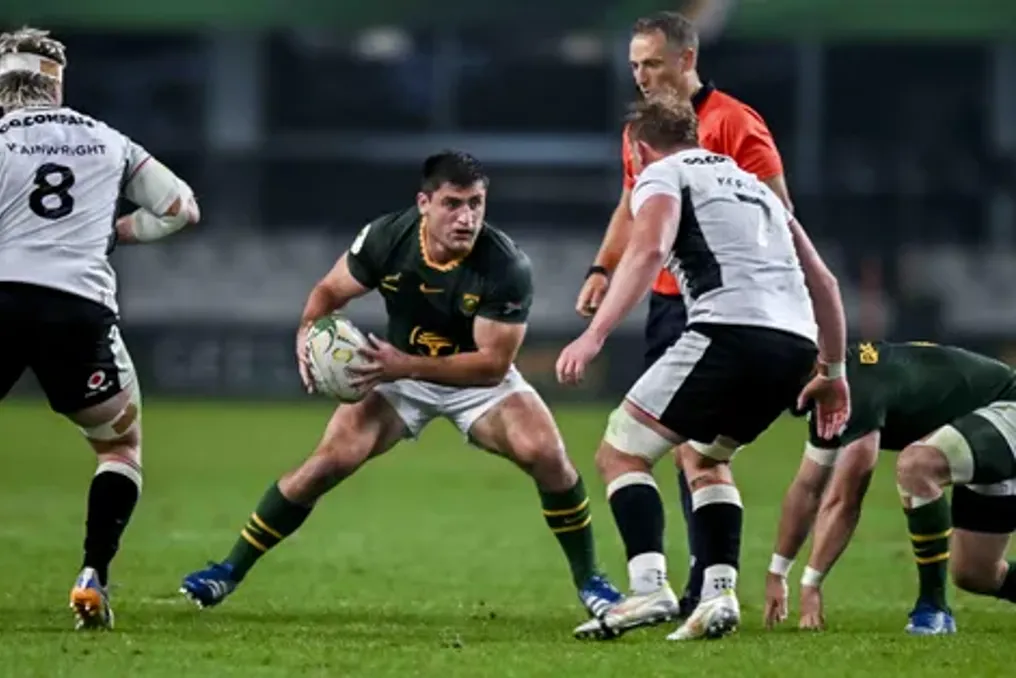
Rassie Erasmus supported the referee's decision after the All Blacks scrum changed the course of the match at Ellis Park
Read more
IOL
iol.co.za

Rassie Erasmus supported the referee's decision after the All Blacks scrum changed the course of the match at Ellis Park

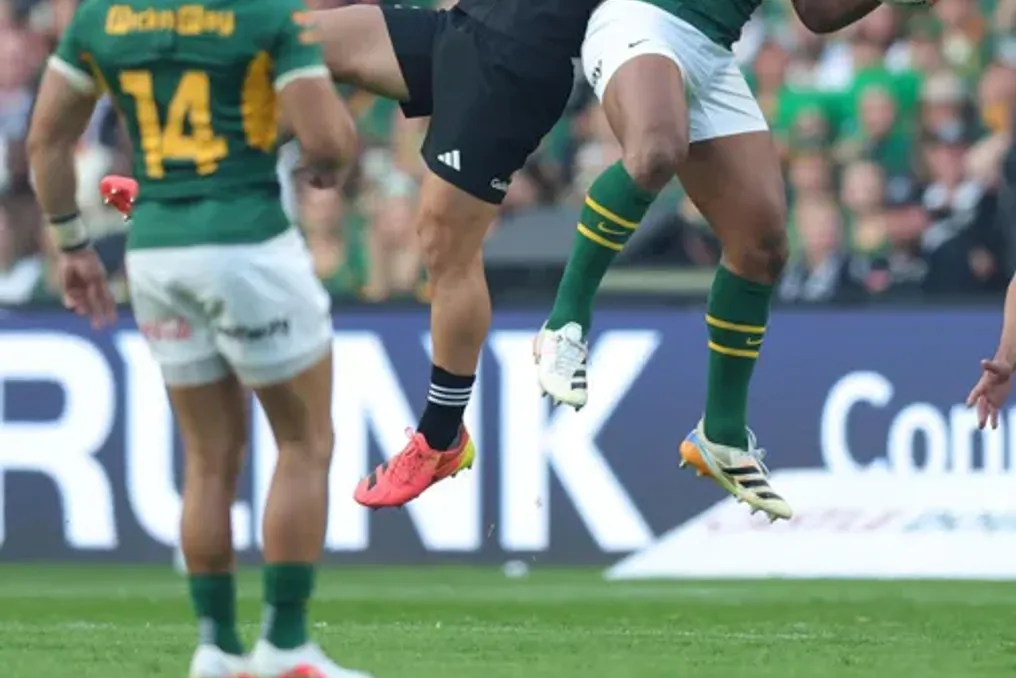
During the match at Ellis Park between the Springboks and the All Blacks, Springbok fullback Damian Willemse took a high pass under heavy pressure on Saturday. He was one of the few outstanding players for the 'Boks' in the losing team against the All Blacks.

The Springboks controlled the game, pressed the All Blacks to their own goal line, and sought to earn decisive points that could change the course of the opening of the greatest rugby rivalry in Johannesburg. However, the referee's decision regarding the scrum was made against the world champions, and New Zealand managed to overcome the pressure and completely turn the game around a few minutes later.

The Greatest Rugby Rivalry

When the Boks were trailing 16-19 around the 58th minute and needed only three points to level the score, the All Blacks organized a powerful scrum on their goal line to avoid danger after the home side opted for a scrum following a penalty. They then advanced and scored, increasing their lead, which decisively shifted the momentum in their favor, ultimately winning 33-16 at Ellis Park.

Springboks coach Rassie Erasmus, however, felt that the referee made the correct decision regarding the scrum, although he admitted that Gerhard Steenkamp bypassed a player during the play.

Erasmus stated: 'I think it was the right decision, and I believe Gerhard bypassed (during the scrum).' He continued: 'The option from above (from the coaching area) was to take three points (from a penalty), because we were only behind by that amount at that stage. But undoubtedly, they played very well in the scrum. Since then, the momentum shifted.'

He added that many of the team's errors were caused by the good play of New Zealand. 'The ball wasn't slippery, and we cannot use that as an excuse; we are also not an inexperienced team that was playing. Probably it was the pressure they put on us during the ball breakdown and in open play.'

Erasmus also expressed regret that the Boks were only leading by one point at halftime, despite dominating most of the first 40 minutes of the match.

Despite having many attacking opportunities in the All Blacks' half and in the 22-meter zone, errors, including knock-ons, interrupted their progress, allowing the Kiwis to repeatedly exit dangerous areas without conceding points or missing just three, which suited them.

He noted: 'I am sorry, and perhaps that is their strength. They know how to stop you in the 22-meter zone in different ways; whether it's knocking the ball on, tackling on the ground, or harassing the midfielder within the rules, and we couldn't handle it.' Erasmus concluded: 'I thought that until the 50th minute we were truly dominant territorially and in possession, and we were in the game. But with such a classy team as the All Blacks, if you don't convert, they will give you a real punishment.'
Similar stories

Rassi Erasmus selects Grant Williams for Springboks squad against All Blacks
Read more
iol.co.za

Rassi Erasmus selects Grant Williams for Springboks squad against All Blacks

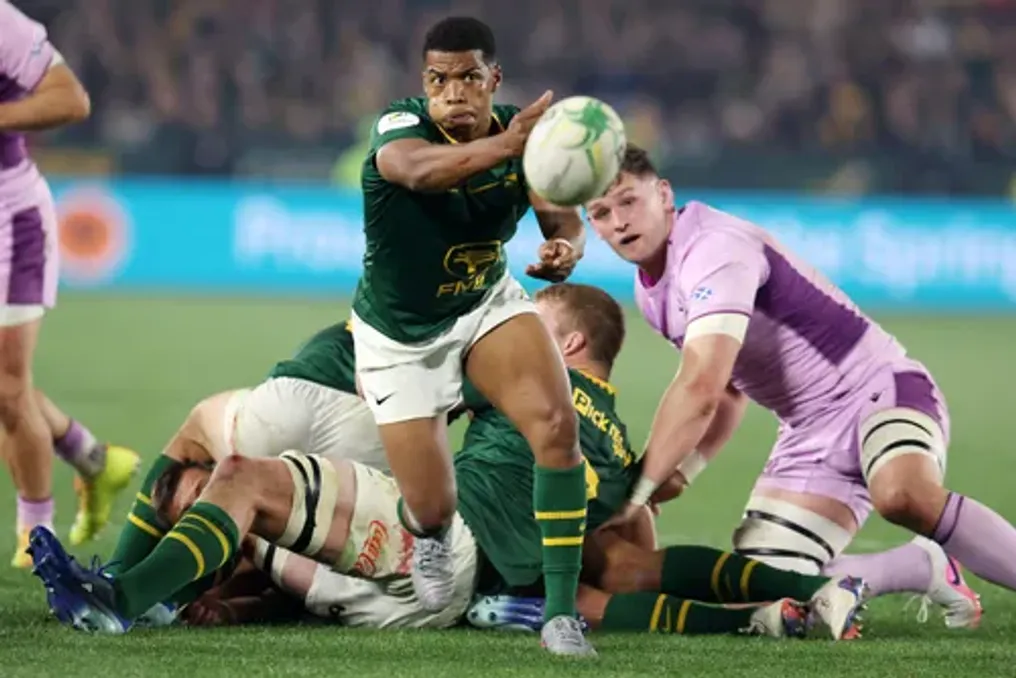
Grant Williams has been selected for the Springboks starting lineup for the match against the All Blacks, which will take place at Ellis Park on Saturday. Although most fans associate Williams solely with his high speed, his abilities are much broader.

Despite his impressive acceleration and ability to distribute the ball quickly, which makes him a serious threat for the Springboks, viewing him only as a dynamic runner does not reflect the full scope of his skills. In fact, Williams provides the Springboks with a complete set of qualities in the shorthead position for the first match of the great rivalry against the All Blacks at Ellis Park on Saturday (kick-off at 17:10).

In addition to outstanding attacking qualities, the player from Paarl possesses a combination of tactical control and is an ideal candidate for the famous Springboks defensive system. His game as the current best Springboks box-kicker is often overlooked; his kick provides the team with exceptional accuracy and height, allowing his pursuers to contest the ball in the contact zone.

Under modern interpretations of rules prohibiting teams from blocking pursuers, Williams uses his play as a precise weapon to create chaos before counterattacks. Previously, midfielder Kobus Reinah demonstrated superiority in this aspect against the All Blacks in Wellington last year, using aerial pressure that exhausted the All Blacks in the second half, leading to a record Springboks victory.

However, Reinah suffered from injuries this season and has not shown his best form in box-kicking. His substitution would have provided the Springboks with significant quality and experience to finish the game against their long-time rivals.

Williams' inclusion also dictates the pace of the match. He is a midfielder capable of providing a fast start. As soon as he steps onto the field, his passing speed and sharp flank attacks make defenders doubt every move. One of the characteristics of the Springboks matches this year has been the number of goals scored by midfielders attacking spaces around the rucks.

The Springboks' ability to dominate collisions and gain lineout possession creates space when the opponent's defense is unprepared. One wrong step by a collision defender can lead to a 40-meter break thanks to Williams' speed. Moreover, Williams has proven experience in successful matches against the All Blacks, possessing clinical finisher instincts near the goal line.

On the opposite side of the ball, Williams' speed and anticipation will be crucial, as he will be the player operating behind the Springboks' defense. The Springboks usually defend from outside in with a high line speed, often targeting inside attackers and leaving space on the outside. If the All Blacks manage to overcome the Springboks' onslaught, the player operating behind must quickly compensate for the distance covered to defend that space.

The Springboks are one of the world's best teams in terms of coordinated defense, and Williams is number 9, capable of handling one-on-one confrontations. Williams is not just a sportsman on the field; he represents a complete modern shorthead, and the All Blacks will struggle to limit his entire arsenal of skills.

Rassie Erasmus and Jaco van der Westhuizen deny narrative of Springboks slowing down play ahead of All Blacks match
Read more
iol.co.za

Rassie Erasmus and Jaco van der Westhuizen deny narrative of Springboks slowing down play ahead of All Blacks match

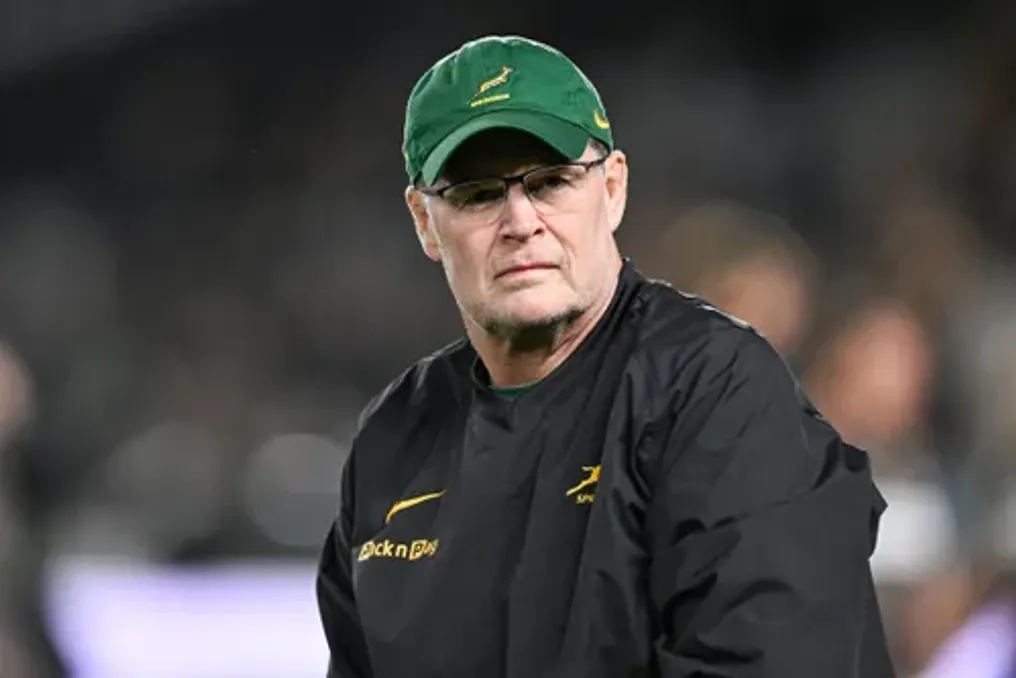
Springboks head coach Rassie Erasmus gave a decisive response to claims of intentionally slowing the pace of play during the match before the first test against the All Blacks, which took place on Saturday.

Rassie Erasmus and Jaco van der Westhuizen issued a clear statement on Monday, setting the tone for a week in which the Boks do not intend to accept criticism directed at them before the start of the first test. When Erasmus introduced Van der Westhuizen, the national law advisor, instead of a regular player, it felt as if the world champions were ready to engage in a verbal sparring match regarding accusations of the South African team slowing down the game to impede the All Blacks' play. This narrative had been promoted by opponents and, to some extent, foreign media since the first friendly match.

Erasmus and Van der Westhuizen brilliantly managed to dispel this notion from the Springboks ahead of the opening of the 'Great Rivalry Battle' at Ellis Park. The fact that Van der Westhuizen accompanied the Bok coach continues to spark much debate, especially in South Africa and New Zealand.

However, it was an outstanding decision by the experienced coach to bring along one of the most experienced former international referees instead of a player who would not possess such deep knowledge of the rules or technical expertise to counter questions about slowing the game and tempo.

Van der Westhuizen immediately shut down discussions about 'slowing down the game,' and Erasmus did the same in his unique way. But most importantly, it demonstrated the Boks' readiness for what lies ahead. They clearly understood that questions would follow, and instead of letting this narrative gain momentum throughout the week, they decided to confront it directly.

Springboks coach Rassie Erasmus initiated a psychological war before the open test on Saturday against the All Blacks by publicly discussing referee access rules and statements that the Boks were slowing down the game.

Erasmus stated: 'In the five games we have played this season, we have not received a single comment that we are slowing down the game.' This was a very strong reply. Another phrase from the Bok coach was: 'You can pray if you want,' when talking about 30 seconds to form a scrum or lineout and how to use that time.

This was also a clever theatrical move by Erasmus, because if there was someone in the room who could speak with authority about what was legal and what was not regarding ball play, it was Van der Westhuizen. The former match referee was not there to win a popularity contest; he was there to provide clarity, and he did exactly that.

It made for an interesting start to the match week, and likely many more words will be said as the game approaches. The culmination will probably come when the two coaches announce their squads on Thursday for the first test. And perhaps fittingly, the composition of these teams will show who is likely to slow down the game when the two old rivals finally meet at Ellis Park. For now, the Boks are quite satisfied that their play speaks for itself—while ensuring they got to say a few words beforehand.

How Rassie Erasmus might change the Springboks' bench composition due to Siya Kolisi's injury
Read more
iol.co.za

How Rassie Erasmus might change the Springboks' bench composition due to Siya Kolisi's injury

Springboks coach Rassie Erasmus faces a difficult selection challenge ahead of the upcoming test series against the All Blacks, as captain Siya Kolisi is once again in doubt due to a recurring hamstring injury.

Kolisi sustained the injury just 24 minutes into his return appearance against Argentina in Buenos Aires on Saturday. Although Erasmus remains optimistic about the severity of the issue, the short preparation window forces the coaching staff to develop contingency plans for both the backline combination and the bench squad.

If Kolisi cannot take the field, Paul de Villiers, a player for the Stormers, is the most likely candidate to start at open flanker. De Villiers demonstrated outstanding play during the World Club Championship in July, establishing himself as a key threat in ball retention and a dynamic ball carrier while Kolisi was on the bench.

However, promoting De Villiers to the starting lineup triggers a chain reaction in the match-day squad, particularly regarding who will provide late-game impact from the bench within the famous 'Bomb Squad.' Under normal circumstances, De Villiers would likely replace the dynamic Kwagga Smith, who is sidelined with a long-term knee injury.

If Kolisi were fit to play, De Villiers would provide an explosive, game-changing role off the bench in the traditional 6-2 ratio. If De Villiers starts, Erasmus must decide who will fill this critical role. Veteran Dion Fourie offers immense experience in ball retention and versatility, as he can play at hooker, making him an attractive option to replicate Smith's destructive impact late in the game.

Alternatively, Marco van Staden provides raw physical power and relentless work rate in tight spaces, offering a more direct, power-based impact, as well as a threat in the air.

The forward reserve group adds another interesting dimension to the discussion. Erasmus successfully utilized the heavy artillery bench against Argentina by bringing on two locks, Kobus Wiesse and Ben-Jason Dixon, to dominate set pieces and collisions in the final quarters. Repeating this tactic against New Zealand would allow them to maintain maximum power in the middle of the park, and their versatility also allows them to operate as backline players.

If the Boks opt for greater versatility at open flanker in the 6-2 setup, they might reduce the number of specialized locks on the bench to one. In that scenario, World Cup two-time winner Pieter-Steph du Toit could transition from blindside flanker to lock in the second half, allowing two specialized 'hunters' like Van Staden and Fourie to remain on the bench when the game becomes tight in the final quarter.

There is also the intriguing possibility of completely abandoning the 6-2 setup in favor of a 5-3 ratio. Such a move would likely depend on the inclusion of Andre Esterhuizen. This fast centre possesses the size, defensive aggression, and strength to act as a hybrid backline player in emergencies, providing the Boks with extra cover in the backline without completely sacrificing forward power.

Esterhuizen made a huge impression off the bench as a hybrid player against the All Blacks in Wellington last year, and he proved invaluable when the Boks were reduced to 14 men against France after Lud de Jager's red card during their November tour. Given that marginal differences will be decisive, Erasmus's final choice will hinge on the trade-off between raw forward depth and tactical adaptability. Replacing Kolisi's leadership and work rate will require a flawless combination of starting effectiveness and bench influence.

Popular