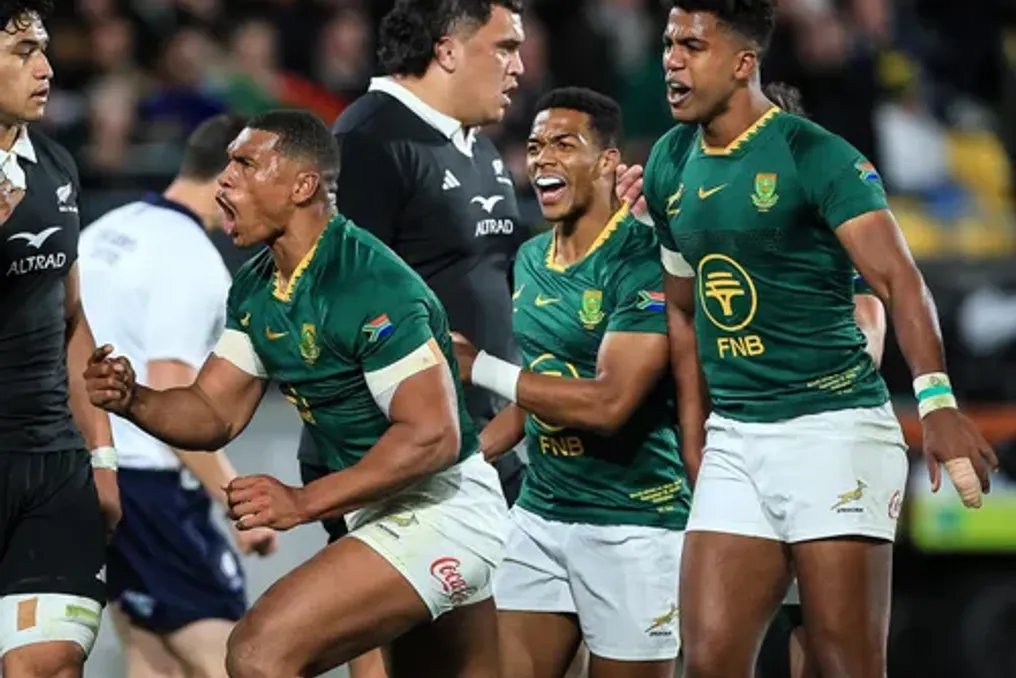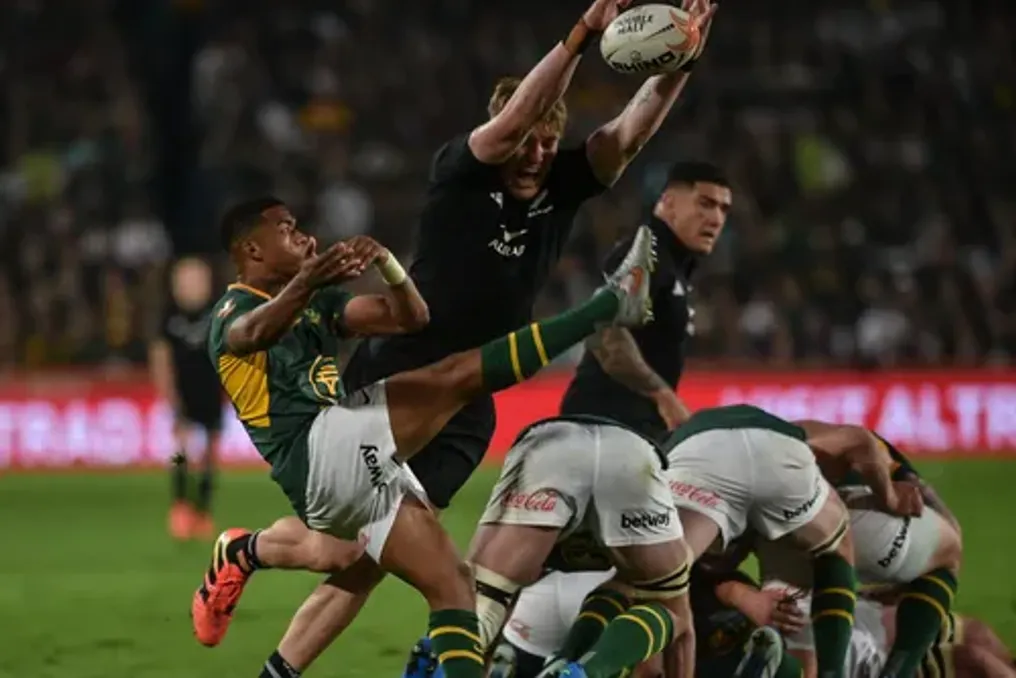
All Blacks defeated Springboks 33:16 in match at Ellis Park
Read more
IOL
iol.co.za

All Blacks defeated Springboks 33:16 in match at Ellis Park

The All Blacks secured a convincing victory over the Springboks with a score of 33:16 in the first match of the Rugby's Greatest Rivalry Test series, which took place at Ellis Park in Johannesburg on Saturday. The fantastic performance by the All Blacks in the second half allowed them to crush the Springboks.

By the end of the first half, the All Blacks were in a difficult position: their scrum was under pressure, and penalties were accumulating. Despite going into the break trailing 13:12, the team managed to surpass the Boks and score the first try in the four-match series.

In the fifth minute, Cheslin Kolbe, who was responsible for kicks, gave the Springboks an advantage with a penalty kick. The early aggressive defense of the Springboks created immense pressure on the All Blacks, but the visitors managed to get into the Springboks' 22-meter zone after some disciplinary error by the South Africans. The hosts conceded many penalties and ultimately earned the right to an out-swing kick on their territory.

Winger Will Jordan scored a close-range goal, giving the Kiwis the first lead. However, the Springboks immediately responded when substitute André Esterhuizen broke through the goal line shortly after winger Kurt-Lee Arendse was substituted. Josh Moorby scored the second try for the All Blacks, after which Kolbe once again restored the Boks' advantage.

Closer to the end of the half, the South Africans concentrated their attacks in the All Blacks' 22-meter zone, but the visitors managed to hold on until the break. Kolbe converted another penalty kick, increasing the Springboks' lead by four points. Although the Boks dominated the scrum early in the second half, they failed to convert their superiority.

After the substitution of Ox Nché in the Springboks squad, the All Blacks began to level the situation in the scrum. They then scored three tries in the second half, completely overwhelming the Springboks, who finished the game with 13 players on the field. Fabian Holland, Luke Jacobson, and Jordan scored all three tries in the second half, posing a difficult challenge for the Boks to recover in the series next week in Cape Town.

The goals were scored as follows: Springboks — try by André Esterhuizen, conversions by Cheslin Kolbe, penalties by Kolbe (2). All Blacks — tries by Will Jordan (2), Josh Moorby, Fabian Holland, Luke Jacobson, conversions by Ruben Love (4).
Similar stories

Springboks Player Ratings After Defeat to All Blacks in Ellis Park Match
Read more
iol.co.za

Springboks Player Ratings After Defeat to All Blacks in Ellis Park Match

The Springboks team started their match in the greatest rugby rivalry from a low level, demonstrating unsatisfactory play in the second half at Ellis Park stadium against the All Blacks. As a result, the match ended with a score of 33:16 in favor of the New Zealanders. The New Zealand team showed clinical play, while handling errors and poor discipline proved fatal for the world champions, who lost their first spot in the rankings.

The Greatest Rugby Rivalry

Springboks player Jasper Wiese once again demonstrated outstanding play despite the team's defeat in Ellis Park to the All Blacks. IOL Sport rated the performances of the Springboks players as follows:

Damian Willemse received a rating of 7 points for masterful aerial ball control and successful bomb catches. He maintained composure in defense and made significant advances while running with the ball. Cheslin Kolbe received 7 points; he went out early to the flank, showing agility, and scored good conversions. He actively chased high passes but left the field due to injury. Jesse Kriel received 5 points; he started the game on the wing, playing out of position. Although he looked reliable early on, like De Allende, he lacked opportunities to showcase his skills in both attack and defense. Damian de Allende received 6 points; he made powerful runs in attack but could not exert the desired influence in his 100th test match. Kurt-Lee Arendse received a minus rating because he sustained a head injury early in the game and did not return to the field. Sasha Feinberg-Mongomoselu received 4 points; his performance was not the best for a midfielder. He made good kicks and strong runs but did not look like a confident player who conquered international rugby.

Grant Williams received 6 points; he was energetic, sharp, and full of strength in the first half, maintaining the team's pace. His kicks were accurate, allowing the Springboks pursuers to regain possession. Nevertheless, his tackle attempt in the corner on Will Jordan could have been better to prevent the try. Jasper Wiese received 8 points; he made no mistakes, and it is a pity that most Springboks forwards did not match his energy. Wiese always broke the gain line when carrying the ball and made one of the first turnovers. Pieter-Steph du Toit received 6 points; he missed two tackles that led to tries but still made strong runs and defended tirelessly. It was not a match up to his standards, but he will certainly try to make up for lost ground.

Paul de Villiers received 7 points; he immediately made an impact by using the ball early in the game, as well as making strong runs and defensive work. Despite close attention from the Kiwis, he did a worthy job in his first match against them.

Ruan Nortje received 5 points; he participated in reliable lineouts, which allowed the Springboks to execute good driving mauls. However, he needs to improve his physical fitness and tackling skills in upcoming games.

All Blacks Succeed in Ball Play

Ethan Ezebet received 6 points; he made hard tackles and runs with the ball. Nevertheless, the Springboks expected more impact from their power player in Ellis Park, especially when the team was under pressure in the second half. Wilko Lowe received 7 points; he forced the All Blacks to play in a tight formation and ensured Springboks dominance in this area of the game while he was on the field. He committed a crucial penalty kick attempt trying to go after a tackle. Malcolm Marx received 7 points; his energy does not fade even when playing for 80 minutes. He demonstrated strong ball play, but a failed tackle before the try line, when the Springboks had a powerful rolling maul, was a mistake. Ox Nche received 7 points; if he could play 80 minutes. He maulled the New Zealand tighthead during the scrum, although the first time was more than 10 minutes later. He also made strong runs and will likely await the second match.

Substitutions

Jan-Hendrik Vessels received 4 points; he could not have the desired impact in the loosehead position after coming on. Gerhard Steenkamp received 4 points; he provided solid scrums early on, replacing Nche, but could not maintain the pressure. Zachary Porten received 4 points; he did not have the expected impact when coming on at tighthead. Kobus Wiese received a minus rating; his loss of the ball in attack showed how much pressure the Springboks team was under, but there was too little time to assess his game.

Andre Esterhuizen received 7 points; he came on and immediately made an impact, scoring a try as a substitute for HIA. The hybrid player demonstrated strong runs and tackles, but had to leave the field in the second half due to injury. Marco van Staden received 4 points; he could not have the desired impact when coming on. Kobus Reinhart received 3 points; his yellow card was criminal. He created pressure on the Springboks when the game needed to be closed out.

Springboks and All Blacks to meet at Ellis Park in the greatest rugby rivalry
Read more
iol.co.za

Springboks and All Blacks to meet at Ellis Park in the greatest rugby rivalry

The rivalry between the Springboks and the All Blacks is considered the greatest in world rugby, and this history of confrontation will continue at Ellis Park stadium on Saturday evening.

The origins of this intense competition date back to a series of matches played in New Zealand in 1921 and in South Africa in 1928, although both teams were already the best in the world before that. In 1905, the All Blacks team, which made its first tour to Great Britain, defeated all opponents, and a year later, the team named Springboks demonstrated similar success.

Since then, the Boks and All Blacks have regularly fought for the World Cup title, first unofficially, and after the introduction of the Rugby World Cup—officially. In the 10 World Cups held since 1987, the Springboks have won four trophies, and the All Blacks have won three.

World rugby will be watching the opening of another stage of this confrontation at Ellis Park on Saturday at 17:00. A feature of the first match is that no expert can confidently predict the winner, whether it is a tense battle with a score of 15:12 or an exciting match with many goals, such as 45:40.

There is an opinion that the Springboks should win on their home ground, given the current phase of the team's development. After eight years under the leadership of Rassie Erasmus, the team is at its peak form, while the All Blacks have only played three matches under Dave Rennie. Nevertheless, the Boks' victory in the 2019 World Cup early in Erasmus's tenure may motivate New Zealand to achieve similar success in the series.

Most observers agree that for the All Blacks to have a real chance of winning the four-match series, they must win the first test match. The depth of the Springboks squad could be a decisive factor as the intensity of the game increases and injuries inevitably affect play.

Answers to many questions will be provided by 19:00 on Saturday. Only the never-ending drama can be predicted with certainty.

Team Lineups

The Springboks squad includes: 15 Damian Willemse, 14 Cheslin Kolbe, 13 Jesse Kriel, 12 Damian de Allende, 11 Kurt-Lee Arendse, 10 Siya Feinberg-Mngomezulu, 9 Grant Williams, 8 Jasper Wiese, 7 Pieter-Steph du Toit (captain), 6 Paul de Villiers, 5 Juan Northe, 4 Eben Etzebeth, 3 Wilko Lou, 2 Malcolm Marx, 1 Ox Nche. Reserves: 16 Jan-Hendrik Vessels, 17 Gerhard Steenkamp, 18 Zachary Potena, 19 Kobus Wiese, 20 Andre Esterhuizen, 21 Marco van Staden, 22 Kobus Reinhart, 23 Mani Libbok.

The All Blacks squad includes: 15 Damian McKenzie, 14 Will Jordan, 13 Quinn Tupaea, 12 Jordie Barrett, 11 Josh Murphy, 10 Ruben Law, 9 Kame Roigarda, 8 Ardie Savea (captain), 7 Luke Jacobsen, 6 Tupou Va'a, 5 Fabian Holland, 4 Josh Lord, 3 Tyrell Lomax, 2 Cody Taylor, 1 Ethan de Groot. Reserves: 16 Asafa Amua, 17 George Bower, 18 Fletcher Newell, 19 Anton Segner, 20 Peter Lakai, 21 Kyle Preston, 22 Anton Lienert-Brown, 23 Leroy Carter.

The match is scheduled for Saturday, August 22, at Ellis Park Stadium in Johannesburg. The game is set to start at 17:10 local time. The match will be officiated by Matthew Carly from England, with assistants Karl Dixon (England) and Nika Amashukeli (Georgia). The Technical Match Official (TMO) is Mike Adamson from Scotland.

Springboks vs. All Blacks rivalry remains the greatest in rugby after 105 years
Read more
iol.co.za

Springboks vs. All Blacks rivalry remains the greatest in rugby after 105 years

After 105 years, the rivalry between the Springboks and the All Blacks continues to be considered the most significant in world rugby. When the 'Greatest Rugby Rivalry' tour between New Zealand and South Africa was first announced, some critics dismissed the title as arrogant. However, it is difficult to surpass the unending drama that has existed between these two teams for over a century.

Although there are long-standing and exciting confrontations, such as England versus France or New Zealand versus Australia, the uniqueness of the All Blacks and Springboks matches lies in the fact that since their first meeting in 1921, both teams have regularly competed for the title of world champion—first unofficially, and then officially.

History of the Rivalry

When the Springboks first visited New Zealand in 1921, the series of three matches ended with one win and one draw. Since then, both teams have consistently been among the world's best, often occupying the No. 1 or No. 2 positions in world rankings. As early as 1928, series in South Africa were positioned as a contest to determine the best team in the world. This was true in subsequent series in 1937, 1949, 1956, 1960, 1965, 1970, 1976, and 1981. Even the Cavaliers sporting tour from New Zealand to South Africa in 1986 pitted the two strongest teams in the world against each other.

After South Africa emerged from international isolation in 1992, the countries played 37 matches since 1921. The Springboks won 20, the All Blacks won 15, with two draws. Then came the era of the World Cup, which began in 1987 and was created to determine the best rugby team on the planet.

The All Blacks won the first World Cup, but the Springboks did not participate due to South Africa's sporting isolation. When the Boks finally entered the tournament in 1995, they won the Webb Ellis Cup in their first appearance. Over the past 10 World Cups since 1987, Australia has won twice, England once, and the remaining titles have been shared by the Springboks (four) and the All Blacks (three).

Recent Dynamics of the Rivalry

There were only one or two periods when the balance of power in this rivalry could be reasonably questioned. Between 2001 and 2006, New Zealand defeated South Africa eight times in a row. Later, in 2016 and 2017, the All Blacks scored 57 points against the Boks twice. However, after Rassie Erasmus started working with the Springboks, the balance of power changed drastically. South Africa won five of the last six encounters, including the epic 2023 World Cup final in Paris. And in the latest match in 2025, the rugby world was stunned by how the Springboks defeated the All Blacks 43–10 on home soil in Wellington.

Interestingly, throughout the entire 105-year history of this confrontation, New Zealand traditionally held an advantage when visiting South Africa. However, the situation is changing this year. For the first time, the Springboks are playing a series against the All Blacks at home as clear favorites, expecting four matches as part of the 'Greatest Rugby Rivalry' tour.

Preparation for the first match at Ellis Park next Saturday, August 22nd, promises to be thrilling. Questions arise: can the tight five of the All Blacks withstand the fierce physical power of the Springboks? Does New Zealand possess sufficient squad depth to remain competitive over four matches, especially considering expected injuries? Can the All Blacks find a way to overcome the suffocating defensive system of the Boks? And can South Africa cope with the high-tempo attack presented by New Zealand's athletic backline?

These questions will soon receive answers. The opening chapter of a new era is set to be written into the folklore of a rivalry that has defined the highest standards of international rugby for over a century. Calling it arrogance is your right. But the history of 105 years proves that the title of 'Greatest Rugby Rivalry' between the Springboks and All Blacks is deserved.

Popular