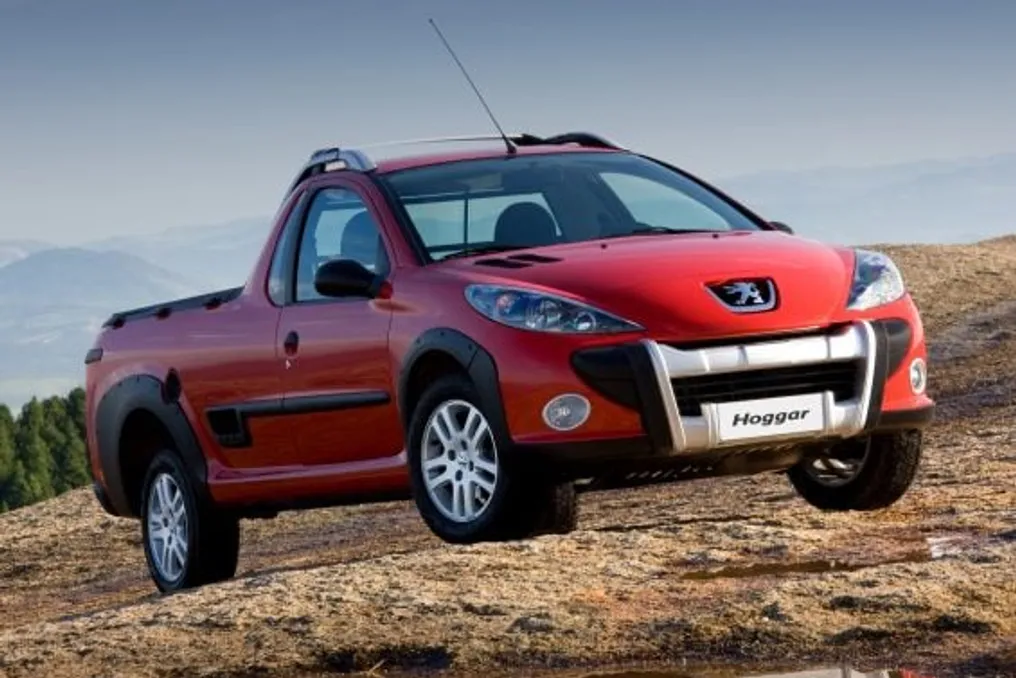
In May 2010, Peugeot introduced its new compact pickup truck, the Peugeot Hoggar, to the Brazilian market, gathering specialized journalists. This model was derived from the Peugeot 207, sharing all its front mechanics. In the rear, it featured a bed with an approximate capacity of 1,150 liters and a payload capacity exceeding 700 kilograms, depending on the configuration. Thus, the Peugeot Hoggar aimed to compete directly with segment leaders such as the Fiat Strada and the Volkswagen Saveiro.
Initially, the concept seemed very promising, given the good load capacity, modern design, and familiar mechanics known by Brazilian consumers. However, reality showed a different picture. Peugeot no longer had the best image in the national market due to recurring problems in several of the brand's models over the years. With the Hoggar, this situation worsened, as the vehicle was intended for an extremely demanding function: heavy work.
The pickup was launched with two engine options. The first was the 1.4 Flex eight-valve engine, capable of producing up to 82 horsepower. The second option was the 1.6 16V engine, which delivered about 113 hp. Both engines were the same ones used in other manufacturer vehicles. The distinction was that, in the Hoggar, these units were subjected to much greater stress, especially when the vehicle circulated constantly loaded near its maximum limit.
Problems began to arise with the 1.4 version, which became the best seller, gaining notoriety for head gasket-related failures. In scenarios of more intense use, coolant leaks and overheating episodes were not uncommon. For professionals who depended on the pickup for work, this resulted in downtime at the workshop, financial losses, and loss of productivity, which was unacceptable for a work tool.
The versions equipped with the 1.6 engine showed less incidence of this type of defect but exhibited another vulnerability. The higher power and torque transferred the strain to the transmission. Owners who used the vehicle continuously under load reported premature wear on the internal bearings of the gearbox, which began to emit noises and required disassembly and repair. The outcome was the same: the Hoggar was immobilized while the worker's financial income was compromised.
Furthermore, the problems were not limited to this; complaints about electrical failures and constant misalignment of the tailgate were frequent. It is likely that those who used the Hoggar only as a passenger car would not notice so many setbacks. However, those who employed the pickup for its original purpose—transporting loads daily—complained intensely about the high rate of defects and the low durability of certain components. Clearly, the Hoggar never managed to establish the reputation for robustness expected of a work vehicle.
Sales data illustrates the end of this trajectory. In its first full year on the market, the Hoggar exceeded the target of five thousand units sold. After this peak, sales entered a sharp decline. When it was discontinued in 2014, it sold fewer than 400 units annually. Throughout its existence, the model accumulated approximately 20 thousand units sold, a volume that the Fiat Strada achieved in just a few months.
The Peugeot Hoggar became an emblematic case of a product that seemed attractive on paper but failed when tested under real conditions. The design was good, and the segment had great potential, with a rapidly growing market. However, the execution fell short of expectations. Mechanical problems, quality failures, and a progressively damaged reputation led the French vehicle to quickly lose ground. It could have had a longer lifespan alongside the Strada and Saveiro, but it ended up being just another project that could not withstand the demands of the Brazilian consumer.