Starcloud, a company developing hardware for artificial intelligence, has raised $250 million in new funding to move data centers into outer space. The investment round was led by the investment firm Manhattan West, with participation from Nvidia, Cisco Investments, and over a dozen other investors. This funding expands on the Series A, which the company first announced in March.
About ten months ago, Starcloud conducted its first test launch, sending one Nvidia graphics card into space aboard a small satellite. This experiment successfully demonstrated the ability to train AI during an orbital flight around Earth. Starcloud now plans to significantly scale up this activity.
The company's ultimate goal is to create a system of 88,000 satellites, connected by a total computing power of 20 gigawatts. Traditional data centers on Earth face two main problems: energy consumption and heat dissipation. Firstly, when training models, AI chips generate extremely high temperatures, forcing companies to spend vast sums on cooling systems on the planet's surface. In the space environment, however, conditions are naturally cooler.
Secondly, the largest modern data centers consume as much electricity as small cities. Most of this energy comes from the centralized grid, and the cost of using it is constantly rising. In space, Starcloud intends to use solar panels, which also offers a speed advantage. Today, most satellites collect data, such as images or sensor readings, and then transmit all this raw data back to Earth for processing, which requires time and bandwidth.
Starcloud claims that its next satellite, Starcloud-2, will process data directly in orbit. Instead of transmitting terabytes of raw images, it will only be able to send the final result. Starcloud-2 will be the first full-fledged system and will be equipped with AI chips, onboard storage, and a backup module. It is designed to perform both AI training and inference tasks.
This will be followed by Starcloud-3, which will be produced in series. Each satellite of this version will consume about 200 kilowatts of power. Starcloud-3 will include graphics cards, as well as specialized equipment for cooling and heat dissipation designed specifically for space conditions.
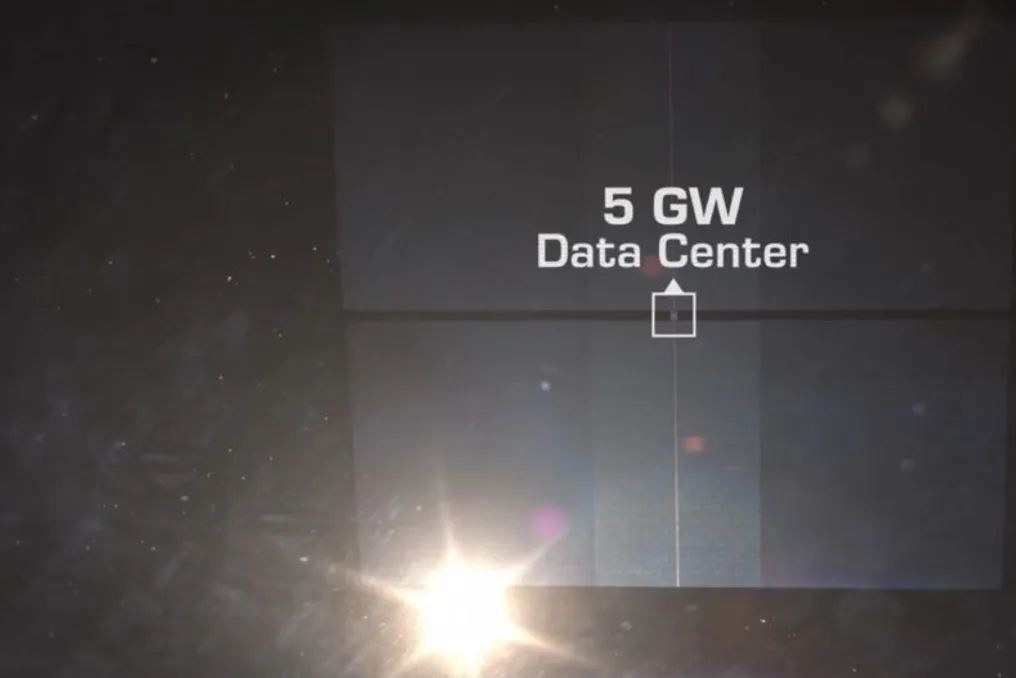
The final concept described by Starcloud is Starcloud-4. This is a cylindrical structure that will be attached to solar panels covering 2.5 square miles. Inside, there will be container-sized modules containing liquid-cooled servers. At this scale, the system will be able to compete with the largest data centers on Earth, but without the limitations associated with land, water, and electricity.
Starcloud is establishing production lines for the mass production of Starcloud-3 satellites and is using the $250 million raised to book slots on rockets. SpaceX has been named as the launch partner. It is worth noting that SpaceX is also developing its own competing AI satellite called 'AI1'. It will have a wingspan of 230 feet and computing power comparable to Starcloud-3. SpaceX plans to begin mass production by the end of 2027.