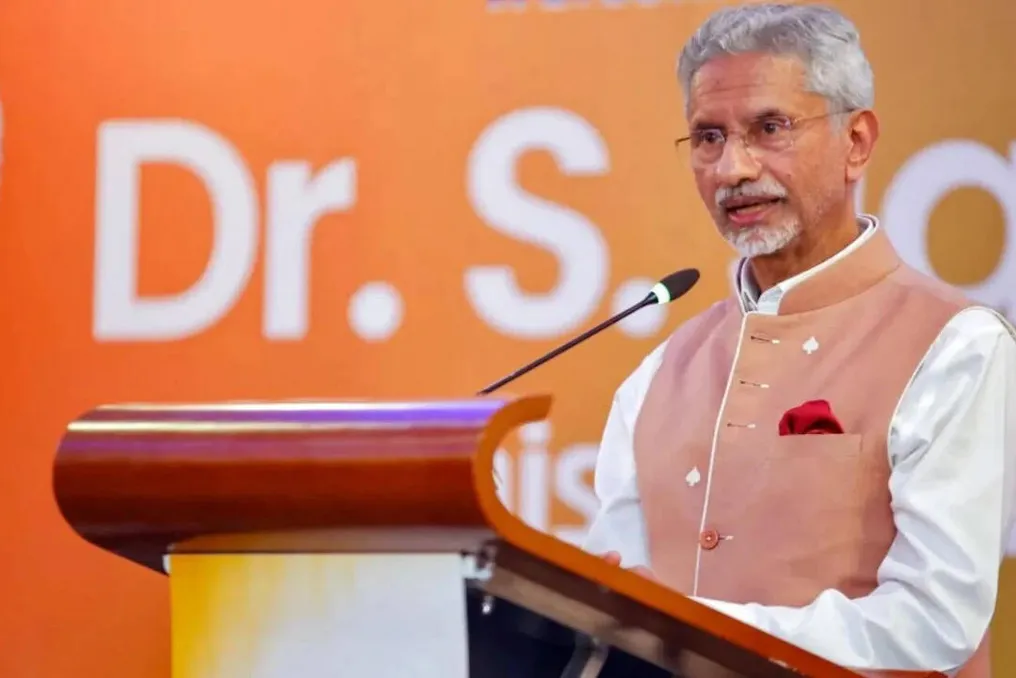
External Affairs Minister S. Jhaishankar presented a balanced assessment of the rapidly changing global landscape on Saturday, warning that growing geopolitical and economic tensions are creating new challenges for businesses and states. He emphasized the need to maintain India's engagement in major world economies while simultaneously strengthening its own industrial and economic capabilities.
Speaking at the Economic Times World Leaders Forum 2026, Jhaishankar stated that the current global situation requires countries to reduce vulnerabilities, expand economic options, and be prepared for disruptions, rather than relying on assumptions of stability.
He structured his assessment around three defining characteristics of the modern world order: competition, conflict, and the increased use of economic and strategic influence. To cope with this pressure, he proposed a four-part approach aimed at minimizing risks, diversifying partnerships and sources, eliminating market distortions, and maintaining a buffer.
Regarding China, Jhaishankar noted that India must continue to do business with Beijing while building up internal strength to compete with it. He believes that greater self-reliance, industrialization, and manufacturing capacity will allow India to interact with China more confidently without abandoning it.
"We must do business with the whole world. And that includes China. But it is important that we do so confidently," he said. Jhaishankar added that relations between India and China went through a difficult period from 2020 to 2024 due to the border situation, but both countries are interested in maintaining stable ties. He also pointed out the need to catch up on decades of shortcomings in India's industrial and manufacturing base.
Three Characteristics of the World According to Jhaishankar
Describing the modern world, Jhaishankar admitted that his assessment is not comforting. He noted increasing competitiveness, where states and politicians pursue their interests to such an extent that competition can escalate into conflict.
"I think what we have seen, especially over the last year or so, but I would call it a growing trend. It looks increasingly competitive," he said, adding that countries and politicians push their interests "to the point where conflicts arise." He cited the conflict between Russia and Ukraine, as well as the conflict in the Middle East, noting that one has been going on for five years, while the other lacks a clear resolution.
In Jhaishankar's view, competition has gone beyond traditional geopolitical struggle, as economic and strategic tools are increasingly "weaponized." He explained that the world is characterized by "choke points," which arise when a country or group of countries establishes dominance in a certain area and is ready to use that influence to exert pressure. Such influence can "cause pain" to others, while the countries applying it may consider themselves sufficiently protected from the consequences.
The 4D Response
Next, Jhaishankar outlined his response to these challenges. He presented derisking as his first and "main mantra," noting that this principle applies not only to business but also to politics and strategy.
The second element was diversification. He stressed that the more partners and sources there are, the better risk reduction is achieved, arguing that states and companies should not be overly dependent on a small number of partners or sources.
The third point concerned eliminating distortions. Jhaishankar pointed to disruptions in energy, fertilizer, and shipping markets related to conflicts and the emergence of choke points. For his final point, he called on businesses and politicians to move beyond the traditional principle of "Trust but verify."
"Today I say: 'Don't trust and diversify,'" he stated, insisting that planning must account for the possibility that "everything can go wrong." He also cautioned against excessive reliance on just-in-time supply chains and the assumption that the lowest cost should always dictate economic decisions, emphasizing the importance of creating a "buffer stock."