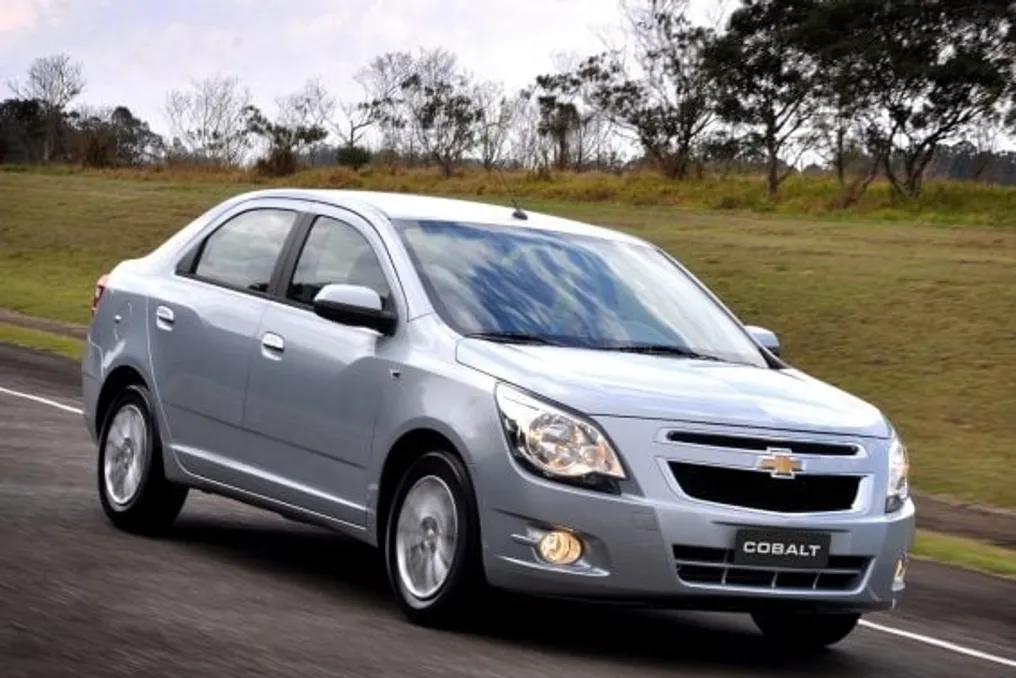
The Chevrolet Cobalt has always been recognized for its practicality, being a vehicle that, while not always the most flashy or the most brilliant, consistently delivered good results due to its functionality. It stood out by offering the space of a mid-size car at the price of a compact.
For this reason, the Chevrolet Cobalt became a preferred model for taxi drivers during the 2010s, thanks to its ample interior space and quite generous trunk, which reinforces its excellent cost-benefit ratio. For those looking for a reliable, spacious, and easy-to-maintain used sedan, it is worth analyzing the history of the 2014 Chevrolet Cobalt.
Introduced in 2011, the Cobalt's main objective was to be a robust, affordable, and spacious sedan. This model marked the beginning of General Motors' phase in Brazil using the global Gamma II platform. This architecture was shared with other vehicles, such as the first Onix, Prisma, Spin, and Sonic of the previous decade, representing a simpler base aimed at emerging markets, without the same level of European sophistication as the old Opel models, which had been sold to PSA Peugeot Citroën.
Initially equipped with a 1.4 engine, the Cobalt received the 1.8 engine in the following year and quickly gained the preference of taxi drivers, driven by its incomparable trunk and interior space. Over the years, the car received improvements, including the OnStar system and the MyLink multimedia center.
The vehicle had two special editions: the Advantage in 2013, which featured darker finishes, partially leather seats, and a sporty touch look; and the Graphite, launched two years later, which aimed for a more elegant appearance with glossy black details, digital TV on the multimedia system, and visible stitching on the seats.
A restyling occurred in 2017, aligning the look with the rest of the Chevrolet portfolio and implementing relevant mechanical adjustments. However, with the growing popularity of the Prisma/Onix and the expectation of the Onix Plus launch, the Cobalt lost relevance and was discontinued in 2019, having sold about 280 thousand units in nine years.
Despite being built on the Gamma II platform, the Cobalt has strong traces of national engineering, as it was conceived, designed, and developed specifically for the Brazilian market, and not just adapted. Other known models from the brand, such as Spin, first-generation Onix, and second-generation Prisma, share the same architecture. The Cobalt helped establish GM in the compact and compact-plus segment during the 2010s.
The good cost-benefit of the Chevrolet Cobalt was achieved through the use of established mechanical assemblies, such as GM's Family I engine, exemplified by the 1.4 8V, known for its durability, although not for its agility. With 102 hp on ethanol and 97 hp on gasoline, this engine requires frequent gear changes to keep the vehicle dynamic. The acceleration from 0 to 100 km/h exceeds 11 seconds, requiring the driver to monitor the tachometer so as not to lose momentum. Thus, it performs well in the city, but is not recommended for those seeking quick and vigorous acceleration.
The 1.8 engine offers a different experience, providing the torque missing in the 1.4 and giving the Cobalt the expected behavior of a sedan. Initially with 108/106 hp, in the 2017 line it reached 111 hp on ethanol, maintaining the 0 to 100 km/h time around 11 seconds, but with significantly superior acceleration. This is due to the maximum torque range, where 90% of the 17.1 kgfm are available already at 2,500 rpm, providing more agile responses at low and medium revolutions, ideal for those who drive a lot, face hills, or carry heavy loads.
The six-speed automatic transmission is a positive point, although paradoxical, as it used the same GF6 gearbox as the mid-sized Cruze, coupled with a considerably older Family I engine. Despite this, the shifts are smooth, the calibration is well adjusted, and the assembly focuses on comfort during performance. There is a gap between the third and fourth gear, but this does not compromise the driver's patience.