Philosopher Simone de Beauvoir, one of the most quoted feminist scholars, laid the foundations of feminist theory by writing the phrase: 'One is not born, but rather becomes, a woman.' She argued that femininity was never exclusively a biological phenomenon but is shaped by society through accumulated experience.
In her denial of the arbitrariness of the concept of femininity, de Beauvoir opened space for what some consider an iconoclast and a scholar in queer culture. About half a century later, RuPaul stated: 'We are all born naked, and the rest is drag.'
It is interesting to observe how the philosopher and reality show host arrived at a similar conclusion, starting from opposite viewpoints: gender was never a given, natural state, but merely a costume that we all wear. De Beauvoir reached this through existentialism, while RuPaul did so through glitter. Both concluded that presentation itself is the key element.
The History of Drag in India
To define the concept of drag, people often refer to its historical roots in the Indian subcontinent. Since women were restricted in public spaces, when theatrical performances required filling female roles, men took on these functions and performed before the audience.
India possesses its own unique tradition in this art form, which can be traced back to mythology, folk dances, and other cultural representations. In the 'Natya Shastra,' men played the roles of goddesses, heroines, and demonesses, stylizing them as feminine through gestures, costumes, and practiced emotions.
Dance forms such as Kathakali, Jatra, and Yakshagana preserve this heritage. Although these traditions never called themselves drag, they trace kinship with the concept of drag through simplified definitions implying the convincing transformation of men into women to gain the audience's trust.
Indian mythology also includes gender transformation directly in narrated stories. In the 'Virata Parva' of the epic 'Mahabharata,' Arjuna spends a year in exile, disguised as Brihannala, a dancer and music teacher cursed by the nymph Urvashi for rejecting her. Shikhandi was also born a woman, raised by a warrior, and eventually received male dignity from a Yaksha to fulfill an oath of revenge against Bhishma.
These phenomena did not remain confined to myths and the stage. In Ahmedabad, on the eighth night of Navratri, men of the Barot community dress in saris and ornaments to dance Garba. In Kottankulamkara, Kerala, thousands of men dress as women annually for the celebration of Chamayavilakku, praying to the goddess Durga in a temple, according to local legend, which originated from a bleeding stone where there were no women at the time of its founding, and boys dressed as women to complete the ritual.
Besides temple and epic narratives, there is the tradition of Lunda Naach, where male dancers perform in women's attire at weddings in northern India. This is considered the oldest living form of local drag in India, although the performers themselves are not interested in calling it 'drag.'
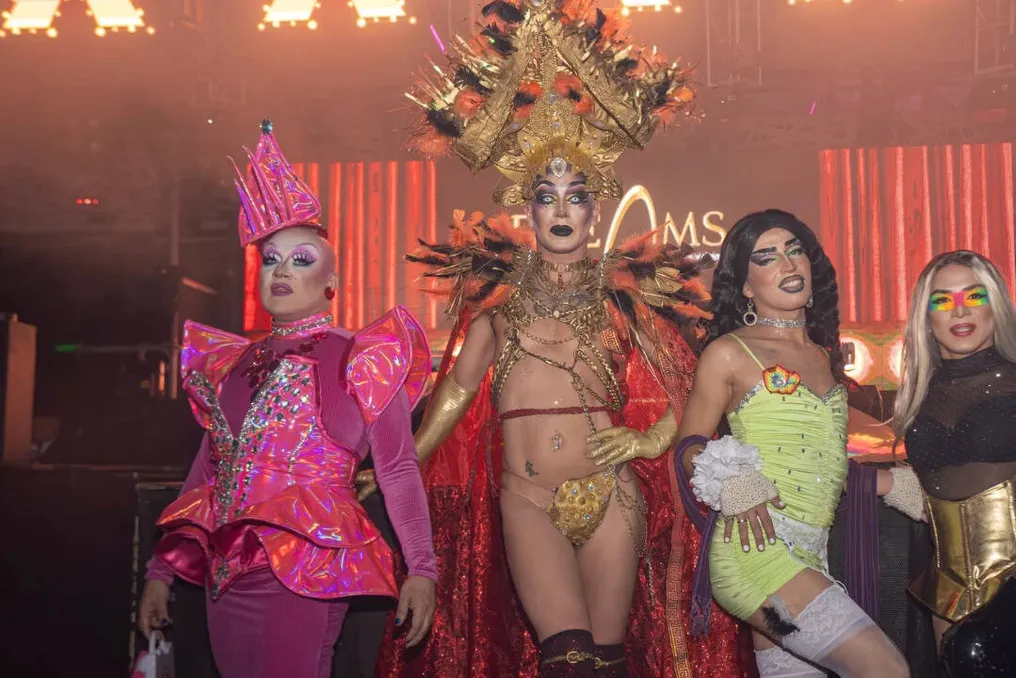
Contemporary drag in India represents the celebration of femininity within a person, and much of what we try to describe was not originally a celebration. In some cases, it was perversion, and in most cases, it was the erasure of women from public space.
A man performing femininity does not automatically become a drag queen. Historical circumstances are important: who performed, why they performed, who watched, who was excluded from the performance, and, crucially, who controlled the meaning of that performance.
Contemporary Drag
For Lash Monsoon, one of the early performers of contemporary drag in Delhi, the link between these historical aspects and modern drag is complicated by the issue of subjectivity. She believes that these art forms are exploitative, even if they are often presented as a celebration of queer history. She points to the gaze surrounding these traditions and to the people who historically hold that gaze.
Lash Monsoon states: 'I always see them as a continuation of what you fear about femininity, so it is more acceptable to you when the masculine projects femininity, and you project your desire onto it.'
According to her, the problem is not only with the audience. Many participants are queer individuals belonging to marginalized segments of society or spaces where queer language is not yet defined but is somehow exploited.
A young drag queen who has been involved in this space for about a year shares this view. She argues that there is a culture of gender mixing in India that can be seen as a rich queer heritage, but contemporary drag is not a direct continuation of it.
She explains: 'The reason I was drawn to this form of drag is that I saw in it a certain degree of subjectivity.'
The point is not to deny India's rich queer heritage, but to make room for its even brighter present. To date, there are only a small number of venues and spaces for drag performers. Most surveyed queens noted that Indian drag still does not have the same status as its Western counterpart, which makes finding venues, building an audience, and turning a performance into a sustainable career difficult.
Places like KittySu and the Lalit hotel chain have pioneered this space, and it is now receiving support from queer collectives, such as the GaySi family, and small creators striving to create safer conditions for queens and their audiences.
Nevertheless, a digital push is necessary to reach a wider audience in the digital age. Every surveyed queen named her first encounter with drag as an art form—RuPaul's 'Drag Race.' The show cemented its place in queer history, but there is a need for an Indian platform that will celebrate queerness and this art on its own terms, instead of reducing it to comedy.
Older queens have long faced accusations of importing Western culture that corrupts Indian heritage. However, this heritage has always had a place for queer stories. It was colonialism that corrupted it, criminalizing the Hijra communities and regulating gender through imported Victorian morality codified in Section 377 in 1861, a law that remained in effect for 157 years until the Supreme Court overturned it in 2018.
Achieving this result took decades of work that the current generation did not have to start from scratch. Earlier queens fought not only for legal recognition but also for the art itself—separating it from the vulgar version of drag that Indian television was accustomed to for a long time.
Noor Singh, a young queen, simply said: this fight mattered because it allowed queens her age to grow up with modern Indian queer icons, not borrowed ones.
Perhaps this is where the history of Indian drag and the essence of Indian drag become more interesting. In a sense, drag has always existed, but for many contemporary queens, there was no opportunity to see themselves in the person performing it.
Queens on stage adopt a form that has so often been used to turn femininity into spectacle, and they make that spectacle controlled. They borrow elements from the West, without necessarily belonging to it, and draw from Indian history, without making a statement that every man who wore a sari was a drag queen. The world is changing, and new queens inherit what their predecessors had to build: language, community, performance spaces, and, most importantly, people like them already standing on stage. But the stage must get bigger, and the language—more universal.
De Beauvoir never wrote about drag. But she wrote a sentence that explains why it matters: one is not born, but becomes. For queens performing in modern India, this becoming is not just about acquiring femininity through makeup and dresses. It is about gaining visibility for themselves, and then for each other, in a form that did not always give them someone to see.