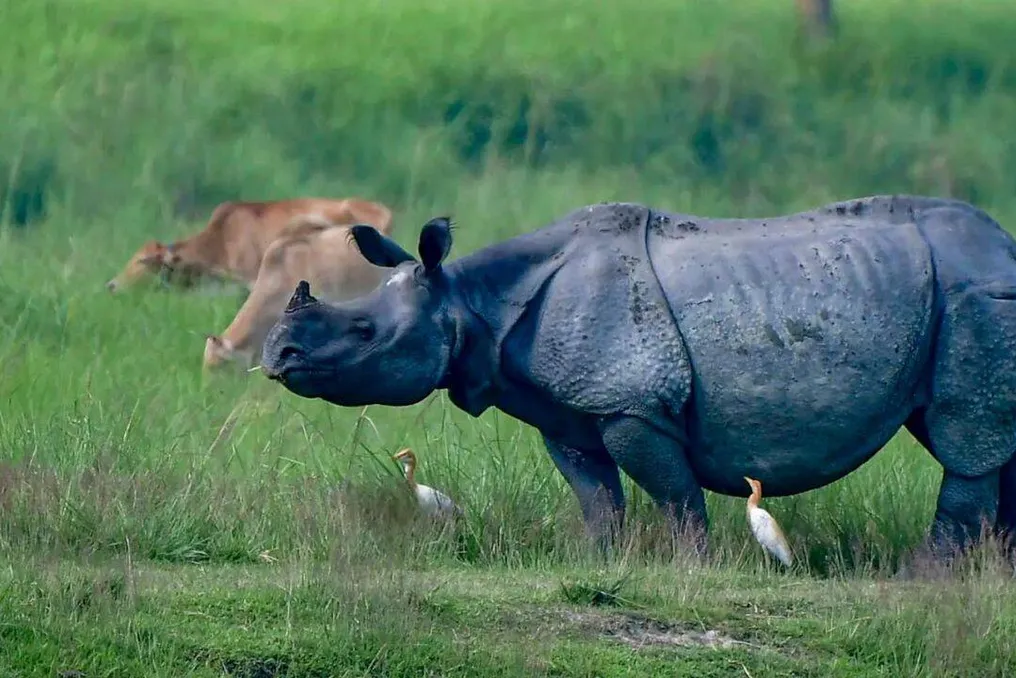
Kaziranga, known for its landscape where fog rises over high meadows at dawn, is home to elephants, wild buffaloes, deer, and rhinos. However, discussions are underway outside the park boundaries regarding what the zone should be between the protected area of Kaziranga and the surrounding settlements, houses, and enterprises.
The Assam government has proposed replacing the existing standard Eco-Sensitive Zone (ESZ) with a 10-kilometer radius around Kaziranga National Park and Tiger Reserve with a zone specifically defined for this territory, ranging from one to three kilometers from the park boundary. This proposal has sparked debate about how far environmental restrictions should extend beyond the protected area and how to balance the needs of local communities with wildlife protection.
The state argues that this change will ease restrictions on housing, healthcare, infrastructure, and local business while maintaining the protection of Kaziranga. It also emphasized that this will not alter the boundaries of the national park or its status as a UNESCO World Heritage site.
What is an Eco-Sensitive Zone?
An Eco-Sensitive Zone represents a regulatory buffer around protected areas such as national parks and wildlife reserves. Its purpose is to provide an additional level of protection to ecologically important areas located outside the boundaries of the protected territory. It is important to note that the presence of an ESZ does not imply an automatic ban on any human activity; activities are classified based on their impact on the environment and may be prohibited, regulated, or permitted according to applicable rules.
Reasons Why Assam Wants a Smaller ESZ
Chief Minister Himanta Biswa Sarma has repeatedly stated that the existing 10 km ESZ is merely a standard provision, not a zone determined by specific local conditions. On August 8, Sarma announced that the state government would present a proposal to the Centre to reduce the ESZ from 10 km to 1 km, citing the need to facilitate development around Kaziranga, including stadium construction.
He clarified that the current 10 km ESZ will remain in effect until the official notification of the state's proposal. Sarma stated: 'The Supreme Court ruled that the eco-sensitive zone around a wildlife sanctuary is usually 1 km, and if necessary, can reach three kilometers. Until the state notifies, the ESZ will remain 10 km. Once the notification is received, it will be reduced to 1 km.'
Sarma argued that maintaining a uniform 10 km buffer would lead to the inclusion of large settlements in the regulatory system and restrict development. He added: 'If we maintain 10 km around Kaziranga, everything in Kaliabor, Dobok, Jakhalabandh will be finished.'
Furthermore, he insisted that residents living near Kaziranga need opportunities to build homes, conduct business, and develop basic infrastructure. Sarma noted: 'Local people must do business to survive. Even the Numaligarh refinery will have to close if the 10 km zone around Kaziranga is declared an ESZ.' He added that if the residents of Kaziranga are displaced, who will protect Kaziranga?
The head of the government also stated that residents must have the ability to earn a livelihood, including business with GI-tagged products, continuing to coexist with wildlife. Sarma pointed out the geographical spread of Kaziranga and adjacent areas, noting that the park extends beyond the Kohora mountain range towards Bishwanat Ghat. A uniform 10 km zone from the park boundary, he said, could affect areas towards Gohpur and Bishwanat Chariali.
The government also cited development needs in Bokakhat, including the proposed modern stadium and other civil infrastructure, as projects that might face restrictions under the existing framework. According to local news reports, Sarma concluded: 'Since Kaziranga has not been finally notified, the standard ESZ is 10 km. After the notification is complete, we will propose a scientifically determined ESZ of 1 km. This will eliminate unnecessary restrictions and allow us to carry out development work in Bokakhat while continuing to protect wildlife.'
What Did the Supreme Court Say?
In June 2022, the Supreme Court ruled that an ESZ of at least 1 km should be declared around protected forests, national parks, and wildlife sanctuaries. The court later amended this directive after states and the Centre stated that a uniform approach was impractical in all areas. It also acknowledged that a rigid approach could create difficulties for people living near protected areas and potentially increase human-wildlife conflict. Thus, the one-kilometer figure should not be interpreted as an automatic mandate that every protected area must have exactly a 1-km ESZ. The extent of the ESZ can vary depending on local conditions, which is the basis upon which the Assam government is pushing for a site-specific approach for Kaziranga. Nevertheless, according to the state government's statement, the existing standard provision of 10 km remains in force until the official notification of the proposed ESZ.
Assam Government's Stance
The Assam government insists that the Eco-Sensitive Zone (ESZ) is not a complete ban on construction or tourism. While activities considered harmful to the environment, including mining and certain polluting operations, are subject to restrictions, other development may be permitted provided established rules are followed. The government also asserts that ESZs do not necessarily have to be uniform and can differ based on the ecological and developmental conditions of a specific area. To support its argument, it cites existing ESZs in Assam. For example, around the Amchango Wildlife Sanctuary, the notified ESZ varies from 170 meters to 8.1 km from the sanctuary boundary. Around the Hollongapar Gibbon Sanctuary, the ESZ ranges from zero kilometers along the inter-state border with Nagaland to 22.54 km in other areas. The state claims that Kaziranga should also have an ESZ specific to its territory, based on its ecological characteristics and the needs of surrounding communities.
Debates over the ESZ have also intertwined with a separate dispute over tourist infrastructure near Kaziranga. Minister Himanta Biswa Sarma rejected accusations that the proposed reduction aims to facilitate a five-star hotel project near the park. He stated: 'There is no connection between the hotel project and the ESZ debates. The ESZ structure primarily restricts mining and certain environmentally polluting and harmful activities, not banning hotels or tourist facilities. If someone protests against a hotel on the grounds that it falls within the ESZ, they do not understand what an ESZ is.'
Sarma argued that tourism is vital for the economy of Kaziranga, citing Jim Corbett as an example of tourist infrastructure around protected areas. However, regulations do impose limitations on some tourism projects. In a 2025 High Court of Gauhati recording concerning tourist infrastructure, it was noted that new commercial hotels and resorts are prohibited within one kilometer of the protected area boundary or the applicable ESZ limit, whichever is closer. Tourist projects outside this distance but within the ESZ remain subject to applicable rules and plans.
Balance Between Wildlife and People
At the heart of the Assam government's argument is the question of how environmental regulations affect people living around Kaziranga. Thousands of residents live in the vicinity of the park, and their livelihoods depend on agriculture, tourism, local business, and other economic activities. The state government argued that the existing 10 km scheme could hinder communities from building housing and developing basic infrastructure. This argument found support among some residents. On August 18, hundreds of people from areas like Bagori and Kutori marched from Kutori to Haldibari in support of the proposed reduction. Residents stated that the restrictions associated with the 10 km zone negatively affected their daily lives and supported a site-specific approach.
They asserted that communities living near Kaziranga should have the ability to build homes, earn a living, and improve basic infrastructure while continuing to coexist with wildlife. The march took place one day after Congress Assam workers held a demonstration near Kaziranga opposing the proposal, highlighting a broader debate about where to draw the line between protecting a fragile ecosystem and allowing surrounding communities to grow.
Congress Raises Concerns Over Mining
The Assam Congress strongly opposed the proposed reduction. State President and Deputy Opposition Leader in Lok Sabha, Gaurav Gogoi, led the protest in the Kohora mountain range and demanded the withdrawal of the proposal. Gogoi argued that this step could provide 'legal cover' for mining and weaken wildlife conservation. He stated: 'Uncontrolled illegal mining of coal, stone, and sand, encouraged by the ruling party, caused catastrophic floods across upper Assam, destroying more than 4000 homes and claiming over 100 lives.'
He also contended that deforestation and mountain mining pushed tigers and elephants into human settlements, exacerbating human-animal conflict. These allegations were dismissed by the state government. Sarma accused the opposition of politicizing the issue and stated that criticism should be based on an assessment of the likely environmental impact of the proposed ESZ. Mining is particularly relevant in the debate as it is one of the activities strictly regulated under the ESZ. A March 2026 High Court of Gauhati order noted that mining is prohibited within the applicable 10 km ESZ under the current regime. Thus, reducing the ESZ could change the regulatory framework applicable to areas currently within the 10 km zone.
Why Are Environmental Activists Concerned?
The wildlife of Kaziranga does not always remain within the legal boundaries of the park. Every year when floodwaters rise, animals migrate to higher ground outside the park. For environmental activists, this makes the landscape around Kaziranga an important part of a larger ecosystem. Wildlife conservationist Jadhav Paieng stated: 'Kaziranga National Park is not only the pride of Assam but also a World Heritage Site. The proposal, if implemented, will have a sharp impact on the wildlife in the national park.'
He noted that rhinos, deer, and elephants leave Kaziranga during annual floods and move to nearby higher areas for safety. In Paieng's view, reducing the ESZ could restrict these movements and leave animals vulnerable. He also questioned the necessity of reducing the ESZ to facilitate construction activities near the national park. Ecologist Kavita Ashok also expressed concern about the proposed reduction. Kavita said: 'Calling this an intrusion into animal territory would be fair, as reducing the eco-sensitive zone from 10 km to 1 km causes distress to wildlife and local communities.'
She added: 'Routes will be disrupted, and animals will be displaced from their habitat. Transport, development, and possibly even any construction will create an imbalance in the otherwise peaceful zone of Kaziranga.'
} , 3.