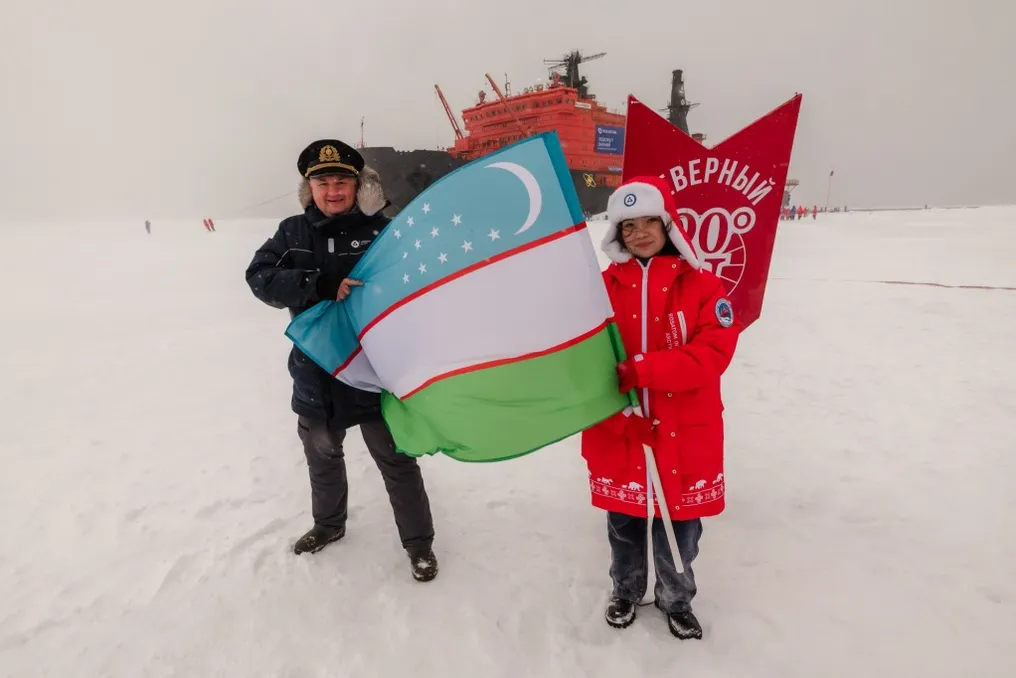
This summer, schoolgirl Ezosa Beshimjanova from Tashkent traded hot weather for Arctic cold. She became one of 22 international winners of the 'Icebreaker of Knowledge' international project and traveled on a nuclear icebreaker towards the North Pole. In two weeks, Ezosa gained experience that showed how science extends beyond the school curriculum, met peers from different countries, and reevaluated her personal capabilities.
Upon arrival at the location, when the guide mentioned Uzbekistan, Ezosa began descending from the icebreaker onto the ice while holding the national flag. Despite the strong wind and vast snowy expanse, before the trip, the schoolgirl had imagined the North Pole and her feelings at the intersection of meridians many times. She felt intense excitement before disembarking.
Ezosa recalls: 'I was afraid something would go wrong, and at the same time, I felt responsible for representing my country. I waited for this moment for so long that when it came, there was a strong excitement inside. When I put my foot on the snow, I finally realized: I am really here! It was cold around, everything was white, the wind blew in my face, and I was standing at the North Pole. Then it seemed to me: if I could reach this place, then perhaps I can achieve much else that I set my mind to.'
The journey within the 'Icebreaker of Knowledge' project is not an ordinary excursion or the end of a competition. This project is conceived as an educational mission for students, where the Arctic serves as a platform for studying natural sciences, nuclear technologies, modern professions, and international interaction.
Competition Selection and Participation
The international selection process for the 'Icebreaker of Knowledge - 2026' project consisted of three stages. Initially, participants had to answer 30 questions from a scientific quiz covering natural sciences, nuclear energy, modern technologies, and the Arctic. This was followed by listening to webinars from experts and completing assignments. Based on the results of the first two stages, ten finalists were selected from each country, who were asked to create a creative video presentation on the impact of nuclear technologies on the modern world. The international jury evaluated argumentation, knowledge of the topic, originality of thought, and the ability to clearly articulate complex technical concepts.
About five thousand teenagers aged fourteen to sixteen participated in the selection round. In the end, 22 students from 22 different countries became winners, including Ezosa Beshimjanova from Uzbekistan. The expedition took place on the nuclear icebreaker '50 Years of Victory', organized by the state corporation 'Rosatom.'
For Ezosa, winning the competition was not accidental; she began showing interest in youth projects and Olympiads as early as the seventh or eighth grade. She admitted that the first attempts were not always successful, but every subsequent application became stronger, and the desire to win transformed into a clear plan for self-improvement.
'At first, I applied to about ten small competitions held in Tashkent, but even there I often didn't pass. After every rejection, I tried to understand what I did wrong: where I wrote the text poorly, where I presented myself badly in the video. When preparing the video introduction for 'Icebreaker of Knowledge', my previous experience helped a lot. I wondered if I had built the story interestingly enough, if I had chosen the phrases correctly, and if I could show myself,' she shares.
Ezosa's story demonstrates that the path to success in such a large-scale selection does not always begin with a perfect resume. Often, it includes a series of failures during which the teenager learns to analyze mistakes, work with information, express their thoughts, and continue trying.
Educational Program Aboard the Icebreaker
The expedition served as a vivid educational stage of the project. An intensive program was planned for the participants on board, including lectures, practical seminars, scientific experiments, and meetings with experts from both Russian and foreign specialists. The students studied the Arctic, modern nuclear technologies, and the functioning of the nuclear ice fleet.
Initially, Ezosa expected that most classes would focus on physics and the study of the Arctic. However, the actual program turned out to be much broader. Participants attended lectures on astronomy, nuclear physics, and the history of the exploration of the Arctic Ocean, as well as studied Chinese language, video recording skills, and interviewing.
The lecture conducted near Franz Josef Land made the biggest impression on Ezosa. The ship was located near the archipelago and an abandoned settlement where researchers had previously worked. The expert talked about the history of this archipelago while simultaneously showing participants places they saw from the ship.
'It was completely different from a regular lecture. They told us about the history of these places and immediately said, 'Look to the left, there is such and such an object.' You are listening to the explanation and seeing everything with your own eyes at the same time. Perhaps that is why the information was remembered differently,' notes Ezosa.
Some planned activities did not proceed according to the original plan. For example, the experiment to launch a device in a helium-filled sphere could not be carried out at the North Pole due to strong winds. Later, the participants repeated this launch near Franz Josef Land. Even this unplanned failure became part of the learning process, as it emphasized that science does not always follow a script, and external circumstances can change the plan, and the first failure does not require giving up on the idea.
Professional Self-Determination Through Expert Interaction
A significant component of 'Icebreaker of Knowledge' was the meetings with mentors and experts. Participants were told not only about the principles of technology operation but also about how people enter specific fields of activity: where they studied, what projects they participated in, and what career prospects the chosen specialty offers.
'I am interested in international relations and plan to choose this field after high school. On the icebreaker, there was a mentor who works in this field. She told me how international relations became her profession, what projects she participated in, and where she was able to go thanks to her work. I wanted to ask her more and more questions because her experience was very close to what interests me. After this meeting, I felt even more motivated to develop in this direction. I saw not just a job title, but a real person and a possible professional path,' explains Ezosa.
Other participants discussed their career plans with physicists, engineers, doctors, and specialists in the nuclear industry. For instance, one of Ezosa's new friends, who dreamed of medicine, gained a clearer idea of a suitable direction after talking to an expert with a medical background. Thus, during the trip, participants do not receive ready-made answers about the future, but gain the opportunity to interact with specialists and align their interests with real professional activity.
Science Overcoming Language Barriers
Students from Europe, Africa, Asia, and Latin America participated in the international part of the project. Teenagers with diverse cultural backgrounds, speaking different languages, gathered on board, united by a common interest in science and technology. English became the working language of communication. For Ezosa, this was one of the first serious tests of the expedition.
'On the first day, I was shy about approaching the guys and starting a conversation. I thought I might misunderstand something or say something wrong in English. But then they started coming to me, and I quickly realized I was worrying too much. After some time, I spoke so fluently that I almost felt like a native speaker,' she recalls.
Ezosa particularly bonded with participants from Kazakhstan, Egypt, Armenia, and Indonesia. They exchanged stories about their countries, jointly prepared presentations, and gave each other souvenirs. From Uzbekistan, Ezosa brought a тюбетейка (tubeleyka cap), halva, kurt, coins, and magnets featuring pilaf, bread, and samsa. Unexpectedly, the most requested gift was a small clay whistle shaped like a bird, which participants asked to hear.
For Ezosa herself, the significance of the project goes beyond the Arctic. 'First of all, I would talk about the opportunities that open up after the project and the knowledge we gained. Participating in the 'Icebreaker of Knowledge' can provide additional opportunities for other programs and university admission. But the most important thing for me were the acquaintances. Now I know that if I come to another part of the world, there might be someone there to meet me, because in different parts of the Earth, I have found close people and first international friends,' she concludes.
Meeting an Arctic Dweller
One of the most memorable moments of the expedition was the encounter with polar bears. Ezosa recalls that for the first two days, the vessel sailed through a severe storm, and many participants struggled to adapt to the rocking and difficult conditions. One late evening, she woke up due to noise in the corridor. A few minutes later, the mentor informed her: 'Get dressed quickly, there's a bear!'. Several participants went to the bow of the ship, where the master of the Arctic was indeed located, almost right next to the hull.
'At first, I didn't even understand that I was seeing a bear. It felt like I was seeing everything in a dream. Then it started walking, and the snow crunched under its paws. That's when I heard that sound and understood that everything was real. We sat very quietly, so we could hear it breathing and walking,' recounts Ezosa.
Later, the participants attended a lecture on polar bears, their habitat, and lifestyle. Scientific information was perceived completely differently after personally observing the animal in its natural environment. Ezosa realized that the Arctic is primarily home to living creatures, and humans are merely temporary guests here.