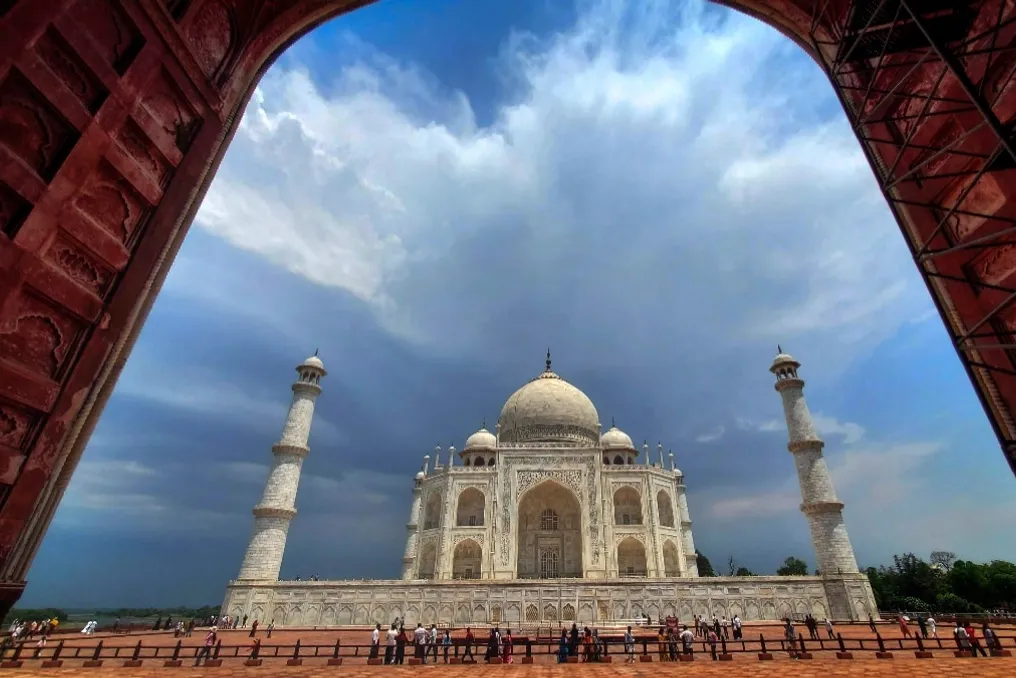
Many people consider the pointed shape located at the top of the Taj Mahal's dome to be a 'trident,' which they use as proof that it is a temple. Upon closer inspection, this shape does indeed resemble a vessel (kalash). However, an expert revealed the true nature of this element.
Professor Syed Ali Nadim Rizvi, a specialist in medieval history, gave a direct answer to this question on the show 'Padhaku Nitin' on Aajtak Radio. He debunked many myths associated with the Taj Mahal, including the question about the shape on the dome.
According to the professor, there is a connection between temples, mosques, and vessels (kalash). When domes began to be built in India, a new element was added, borrowed from the traditions of temple architecture—the kalash. This happened because the dome builders were local Indian craftsmen who already knew the tradition of creating kalashes on temple tops. Therefore, pointed peaks similar to the kalash began to be erected on the domes.
In contrast, when Babur built his first mosque—the Kabul Bagh Mosque in Panipat, his architects Mirak Ghiyas came from Central Asia and were unfamiliar with Indian building traditions. Therefore, the pinnacle they installed on the dome resembled a 'roshan' (window), common in Central Asian buildings, rather than a kalash.
According to Professor Rizvi, the design found on the Taj Mahal and Humayun's Tomb is actually the form of a 'spira' (spear or naj) of that era. A crescent moon is located around it. In that era, the naj was considered a symbol of power and authority. Even during Friday prayers, imams would come with a staff (asa) because carrying weapons was forbidden. The crescent moon in the center is an Islamic symbol, but the presence of three pointed figures in this design can give the impression of a trident from a distance.
Professor Rizvi argues that if the goal were to destroy an Indian symbol, why leave such a conspicuous mark that subsequently caused controversy? He emphasizes that many architectural elements are related more to cultural and artisanal traditions than to religion.
He provides other examples: the pattern is not limited only to the Taj Mahal. Professor Rizvi notes that the motif of a 'inverted lotus' is found on the tomb of a Sufi saint in Sarhind, Punjab. Today, the lotus flower motif is also seen on the domes of many Delhi mosques. This does not mean that all these buildings were temples. The depiction of humans or idols is forbidden in Islam, but the use of plant motifs and geometric patterns (arabesques) is permitted.
Similarly, just as the swastika was once associated with Hitler, linking any design element to a specific identity does not change its original origin. Professor Rizvi also cites the sculpture depicting Rama and Hanuman in Fatehpur Sikri palace, but this does not allow one to claim that Akbar was Hindu. Furthermore, the 'cross arches' of the Shah Jahan era are considered borrowed from Buddhist architecture, and the 'baluster columns' found in the Taj Mahal and Agra-Delhi forts are also linked to Buddhist architecture, despite the fact that almost no traces of Buddhism remained in India at that time.
Professor Rizvi boils down this entire debate to a simple thesis: one should avoid thinking along the lines of 'if dome then Muslim, and if spire then Hindu.' He points out that structures resembling domes are also found in many temples on the banks of the Saryu in Ayodhya. Would those then be considered mosques?
In his opinion, architectural elements evolve as a result of centuries of cultural exchange. Consequently, defining the religious affiliation of a building based on a single design or shape is not an accurate historical interpretation.