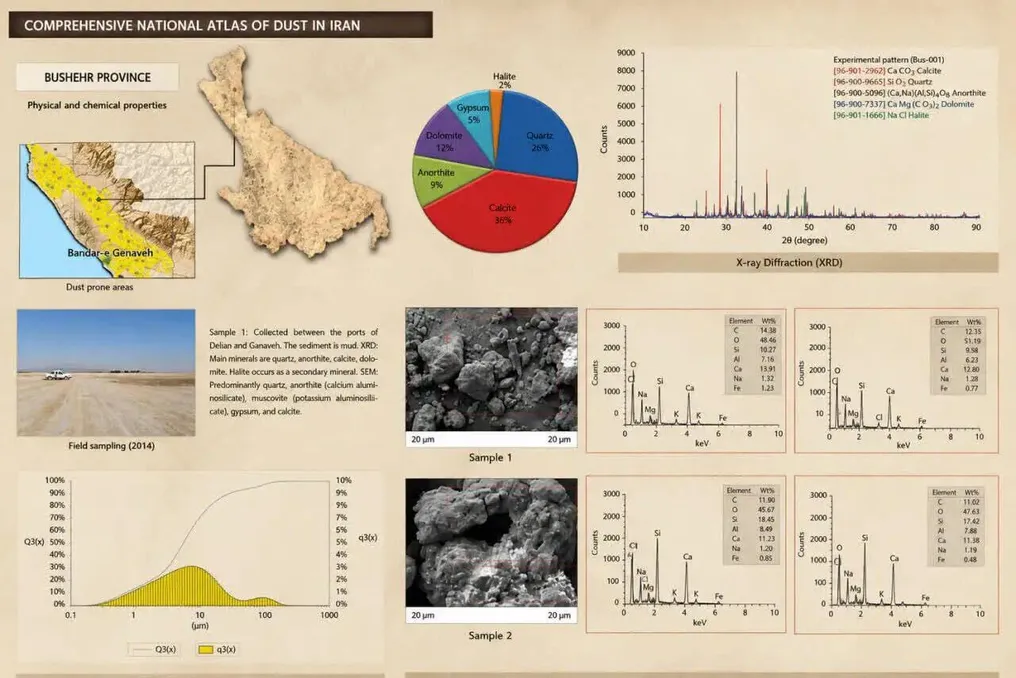
The International Desert Research Center at the University of Tehran, in collaboration with the Geological Survey and Iran's mineral research activities, has released the country's first comprehensive dust atlas after more than ten years of research.
According to an IRNA report, these studies aimed to identify dust sources, monitor bottom and surface sediments, as well as atmospheric dust, including conducting physical, chemical, and mineralogical tests and analyzing the resulting data.
This initiative provides a nationwide overview of dust sources, particle characteristics, geochemical distribution, as well as the environmental and health risks associated with this phenomenon. The information collected in the atlas is presented in two formats: a national map and a provincial map, which can serve as a scientific basis for decision-making, policy development, and planning dust control measures.
Dust storms pose serious environmental problems, negatively affecting food security, human health, and the process of sustainable development at both national and regional levels.
Since Iran is located in a dry and semi-arid zone, the country is negatively affected by climate change. Rising temperatures, decreased precipitation, increased droughts, and frequent dust storms not only threaten the ecosystem and biodiversity but also endanger the country's food security due to exacerbated soil erosion, desertification expansion, and reduced agricultural productivity.
In August 2025, the national specialized working group on sand and dust storms (SDS), in cooperation with other state bodies, approved a comprehensive plan to combat SDS. This plan will be used as a national reference document to increase the country's resilience against one of the most acute environmental threats.
At the 29th meeting of the national specialized working group for SDS management, a 150-page comprehensive plan was developed through intersectoral cooperation among 15 executive agencies and government bodies, including the Ministry of Energy (DOE), ministries of agriculture, health, energy, and transport, as well as the Natural Resources Organization, the Crisis Management Organization, and the Meteorological Organization, according to IRNA.
The plan includes ten key strategies, hundreds of specific actions, performance indicators, implementation schedules, and the distribution of institutional workload among responsible departments.
In July 2025, President Masoud Pezeshkian issued a decree establishing a specialized working group to address the issue of SDS, which has become a significant public health concern in the country.
As part of this work, the DOE presented a risk report regarding SDS as a growing and pervasive threat and listed national plans and strategies for mitigating SDS, according to IRNA.
Emphasizing the importance of environmental preservation as a critical issue for the country, the president ordered the formation of a working group composed of experts, scientists, ministry representatives, and executive agencies to prepare and implement operational plans to counter dust phenomena, drawing on successful international experience.