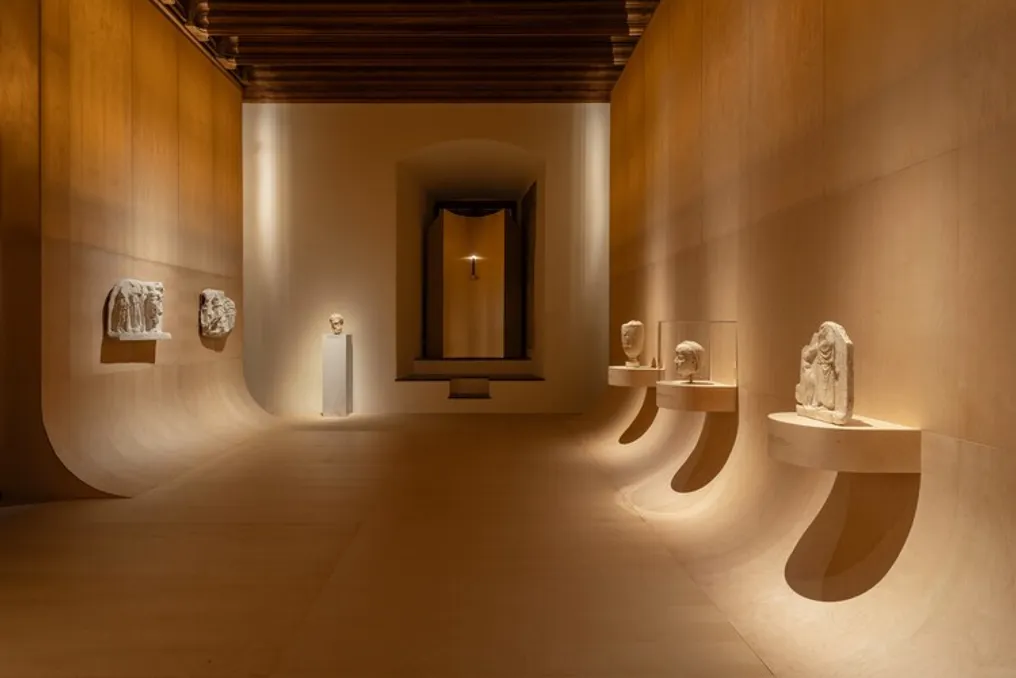
The project for the exhibition titled 'Masterpieces from the Lanckoroński Collection: A Story of Antiquity' aims to implement innovative and non-traditional display methods in the historical architecture of Wawel Fortress. The concept centers on organizing all halls in a stylistically unified manner, maintaining consistency in forms while varying in the choice of colors and materials, which creates a sense of surprise and a gradual progression of perceptions.
The forms used were inspired by both ancient models of details and elements and the principles of classical geometry, such as proportions, symmetry, and divisions. However, these elements were recontextualized through the use of current technologies and materials. Furthermore, the project alludes to specific examples of design and craftsmanship found in Wawel, covering the broader panorama of art and architectural history, including cinematic references.
The curves present in the floor plan drawings and details function to create an environment where the boundaries between floors and walls seem to dissolve. To achieve a feeling of architecture that is warm, tactile, atmospheric, illusory, and soft, the project prioritizes the use of natural materials, such as wood, plywood, and carpet.
The entire set-up represents an architectural intervention that is carefully balanced and appropriate to the historical context of Wawel Royal Fortress. The goal is to establish a notable, though not strictly neutral, backdrop for the artworks, using discreet colors and subtle lighting, along with organic shapes.
The five spaces dedicated to the exhibition symbolize five distinct universes, united by the general theme and the coherent organization of the show. The so-called 'spatial folds' echo the visual effects seen in Christopher Nolan's films, such as 'Inception' and 'Interstellar,' which deal with the distortion of three-dimensional reality and temporal journeys. Thus, the exhibition design proposes to be this very journey through time, linking the past to the present.