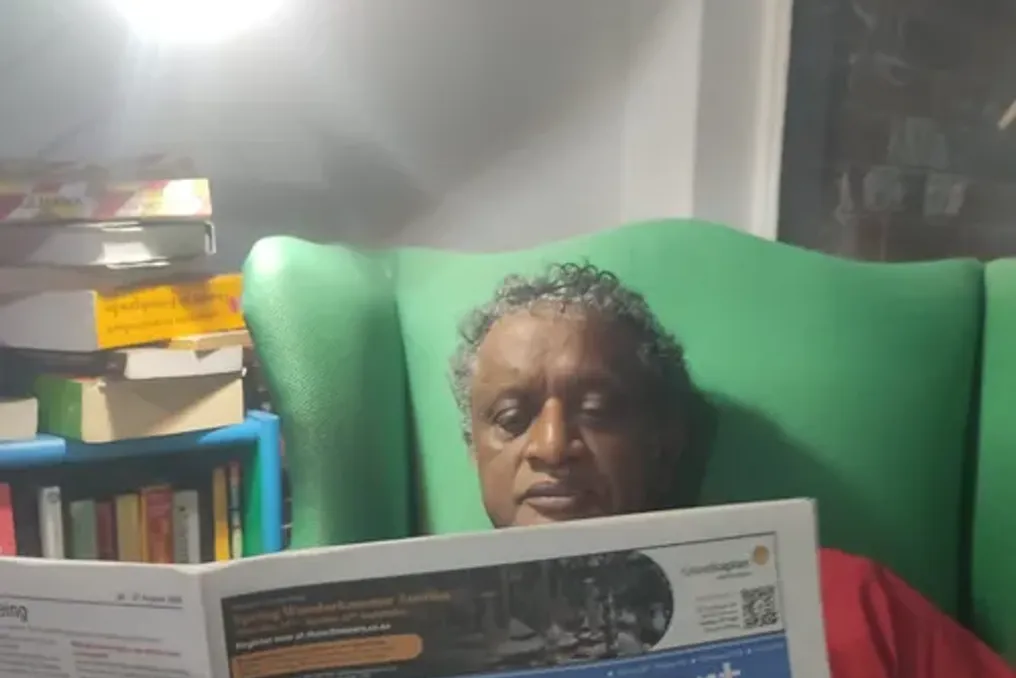
The article raises the question of whether the attack on activist Meghan Khouritz, who is already facing legal proceedings, constitutes journalism. Hassan Lorghat, reading the publication SA Jewish Report, notes that Khouritz is being criticized across various media outlets.
In certain circles, discussion of SAJR can lead to labels such as 'rag doll,' 'yellow press,' or 'Zionist front for Netanyahu,' as well as more offensive designations. The author admits that he has never avoided reading this publication or opinions with which he disagrees. His shelf contains books written by an individual fleeing the ICC and international human rights law, including works by Benjamin Netanyahu and Bibi.
The author emphasizes that despite reading both highly artistic and low-brow literature, he understands that not everyone connects with it. However, he considers it important to know and understand the opposing side's viewpoint, otherwise, it will be a repetition of the Jewish Report mantra. In the author's opinion, the publication demonstrates not only loyalty to the State of Israel but also a close connection to the Likud party and Israeli President Netanyahu.
For alternative information on the situation in Israel, the author recommends the magazines +972 and Haaretz. A broader region includes Palestine, as well as Lebanon and Syria, where Middle East Eye, Mondoweis, Middle East Monitor, Palestine Chronicle, and numerous progressive podcasts are recommended to follow.
A recent article by Tali, who previously argued with Redi Talabi over Talabi's comments on X about 'killing soldiers' in Israel, was noted as an example of criticism. However, in a new article dedicated to Meghan's case, instead of her story, there is a narrative about supporting a professor. The article has once again become an attack on her, as evidenced by the headline: 'Khouritz defends insult against Mendelson,' which, in the author's view, indicates a lack of balanced journalism.
An insult means a derogatory remark, but the decision on its nature must be made by the court. The Mendelson lawsuit is constantly mentioned in the article, and commentators supporting Khouritz are cited. She claims that it is an 'abuse of the judicial process' initiated 'for selfish reasons' to 'prevent her' criticism of a Zionist and supporter of Israel.
Furthermore, Khouritz states in her documents that this is protection against SLAPP (Strategic Lawsuit Against Public Participation), asserting that the Mendelson case has the 'aim of using litigation as a legal war to achieve an improper goal.' A novelty is her hiring of a lawyer who challenges her claims and confirms the legality of Mendelson's lawsuit, which, according to them, is not an abuse of court.
This lawyer, Simon Dippenaar, argues that although Khouritz acknowledges publishing material on TikTok, she denies that her statements carry the defamatory meaning claimed by Mendelson. To succeed in this defense, Khouritz must prove that her statements were recognizable as an opinion concerning a matter of public interest and were based on true, clearly stated, or generally known facts. Dippenaar points to the weakness of Khouritz's case: it will be difficult to argue that her statements—about Mendelson supporting genocide, hatred towards Muslims, racist views, or misconduct—are not defamatory, based on the principle that supporting Israel does not equate to supporting these views.
The author concludes by presenting ideas developed by Palestinian activists and intellectuals regarding Zionism, anti-Zionism, and freedom of speech. Various scholars, including Ilana Pappé, have defined Zionism as a European movement aimed at establishing a Jewish national state in Palestine, which, according to the text, represents a colonial project based on the elimination or displacement of the indigenous population through ethnic cleansing and, recently, genocide. Support for Israel cannot be separated from the violence that spawned and sustains it.
Anti-Zionism is viewed as a consistent political thought. It is a legitimate political and scientific position that sees Zionism as an ideology violating the rights of the indigenous population, while distinguishing between opposing specific state policies and opposing the fundamental ideology itself. It falls within the sphere of ideas opposing the violence of the Israeli state through ideas and non-violent activism.
In contrast, the Zionist state uses laws and ideology to deprive Palestinians of civil rights and keep them from their historical lands. The Nation-State Law of Israel 2018, for instance, defines the country as the exclusive national state of the Jewish people, leaving self-determination only to Jews, thereby marginalizing non-Muslim citizens due to a lack of constitutional equality. Legal maneuvers to dispossess Palestinians in East Jerusalem are evident, as is much else. Settler attacks in the West Bank—seizure of hills and encirclement of Palestinian villages—represent the use of law, police, and army to carry out ethnic cleansing. This violence is supported by the Knesset and is rooted in historical expulsions from villages, the events of 1948, and the ongoing military occupation.
Conversely, the movement to which Khouritz belongs—BDS—is dedicated to working within the framework of democratic and non-violent resistance. Their website contains a resource that everyone should visit, and in context, they write: 'Israel supports a regime of settler colonialism, apartheid, and occupation over the Palestinian people. This is only possible thanks to international support. Governments do not hold Israel accountable, while corporations and institutions worldwide help Israel oppress Palestinians.'
In the US, Europe, and even here, the Boycott, Divestment, and Sanctions (BDS) movement has faced legal pressure, censorship, and violence. The antisemitic label is often used because it attempts to delegitimize criticism of Israel. Another tool—Hasbara and its supporters—argues that they do not want to talk about the genocide committed by Israel in Palestine (Gaza), and this does not stop.
According to UNICEF data, media reports indicate that no fewer than 300 children have died in Gaza over approximately 300 days since the ceasefire announcement in October 2025. Overall, local reports and monitoring groups show that over 1200 Palestinians have died as a result of ongoing violations and shelling during this so-called ceasefire. Many summarize it as: we stop, but the IDF continues to shoot.
In conclusion, freedom of speech comes at a price. It is speaking the truth to power and affirming that anti-Zionist activism—and anti-Zionism itself—is a protected philosophical belief that will liberate even those who oppress, kill, and maim children. The role of journalists is to accurately report events from a human rights-oriented perspective. The Press Council upholds the values and principles of accuracy, verification, context, accountability, and a clear separation of fact and opinion, with the ultimate goal of ensuring the public's right to be informed. This does not mean that SAJR is outside the Press Council; they cannot adhere to the principles of quality journalism.