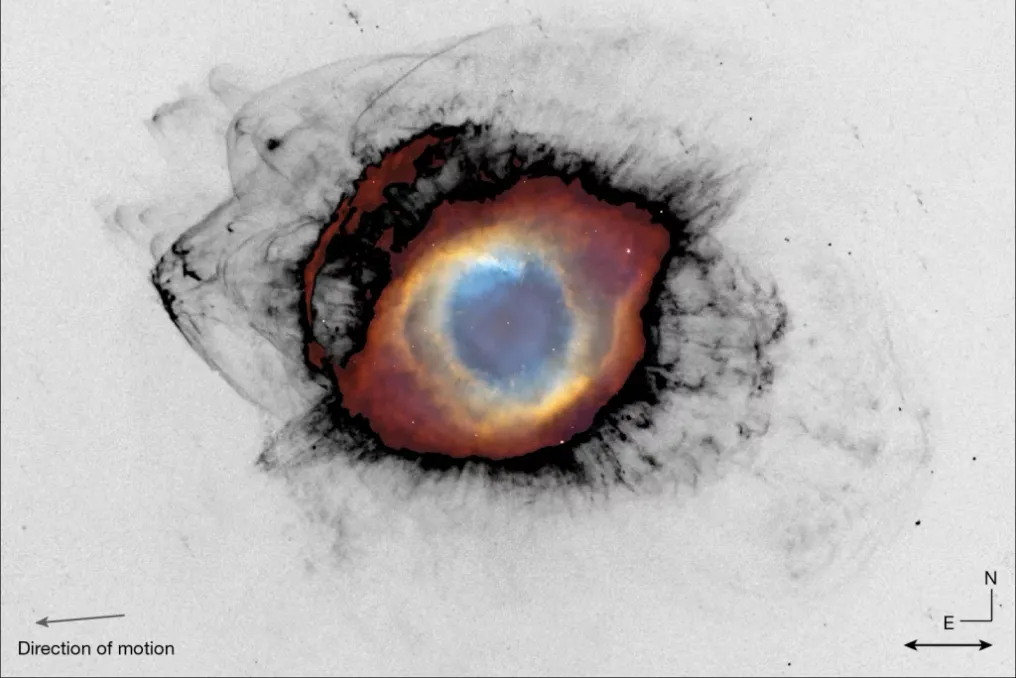
A recent study published in the journal Nature recorded a moment that astronomers have never previously observed directly: the gradual dissolution of Sun-like stellar remnants and their incorporation into interstellar gas.
This phenomenon occurs in the Spiral Nebula, located approximately 650 light-years from Earth, in the constellation Aquarius.
Summary of the discovery
This finding helps to understand the ultimate fate of stars like our Sun. After billions of years, these luminous bodies exhaust the hydrogen in their core, which serves as fuel for nuclear fusion reactions. The core then contracts while the outer layers expand, and the star transitions into a red giant phase.
At the end of this process, the star loses its outer layers, which are ejected into space, forming a planetary nebula. The remaining core turns into a white dwarf—an extremely dense object that no longer undergoes the same fusion reactions that sustained the star during its life.
In the Spiral Nebula, researchers were able to track a later stage of this cycle. Material ejected by an ancient star disperses into the interstellar medium, which contains gas and dust between stars. Gradually, these remnants fragment and integrate into this medium.
The observation was conducted during tests of MOTHRA (Modular Optical High-Spectral Robotic Telephotometry System), installed at the El SoS Observatory in Chile. This equipment is being developed to detect extremely faint gaseous structures in the Milky Way. The team used the Spiral Nebula as a target for calibrating part of the instrument.
However, instead of obtaining a simple reference image, researchers discovered a series of arc-shaped structures in the nebula's outer halo. A total of 22 arc-shaped gaseous clusters, complete or partial, were identified. These structures represent shock waves generated when material ejected by a star moves through the interstellar medium. This process is similar to the waves appearing in front of a boat moving through water.
Peter van Dokkum, the lead researcher from Yale University in the USA, stated in a release: 'We are observing material ejected at the end of a star's life that is fragmenting and returning to the galaxy.' According to him, this transition from stellar remnants to diffuse gas between stars is particularly difficult to observe.
The distribution of these structures demonstrated the transformation mechanism. Closer to the central star, the arcs are larger, thinner, and more clearly defined. As they move further away, they become smaller, more diffuse, and fragmented, indicating the gradual erosion of the material and its mixing with existing gas in space.
According to scientists, the nebula remnants may be in this process about 10 thousand years after entering the interstellar medium. After this period, the material will cease to be recognizable as part of an ancient star and will become part of the galactic environment.
Additional information
This mechanism is important because stars do not arise out of nowhere. They form in vast clouds of gas and dust containing elements produced by previous generations of stars. When a star dies, some of this matter returns to space and can be used to form new stars. Our Solar System is a result of this process: Earth and other planets formed about 4.6 billion years ago from material enriched by preceding Sun-like stars. The same cycle will repeat when our star reaches the end of its life.
However, humanity will not be on Earth to witness the death of the Sun. Long before it becomes a red giant, its gradual increase in brightness will raise the planet's temperature. In about a billion years, this process could cause the oceans to evaporate and render Earth uninhabitable for complex life. If civilization still exists at that time, its survival will depend on finding new habitable environments, possibly in other star systems. Nevertheless, it is unlikely that Homo sapiens will survive in the same form over such a long timescale. Biological evolution or technological progress could profoundly transform our descendants long before the end of the Solar System.
In about five billion years, the Sun will exhaust the hydrogen in its core and go through a sequence analogous to that observed in the Spiral Nebula. Having become a red giant, it will lose its outer layers, forming a planetary nebula, and its core will generate a white dwarf. Thus, the death of the Sun will mean not just its disappearance; its elements will be returned to the Milky Way and may participate in the formation of new stars, planets, and other celestial bodies in the very distant future. Stellar death, therefore, represents the beginning of a new cosmic cycle.