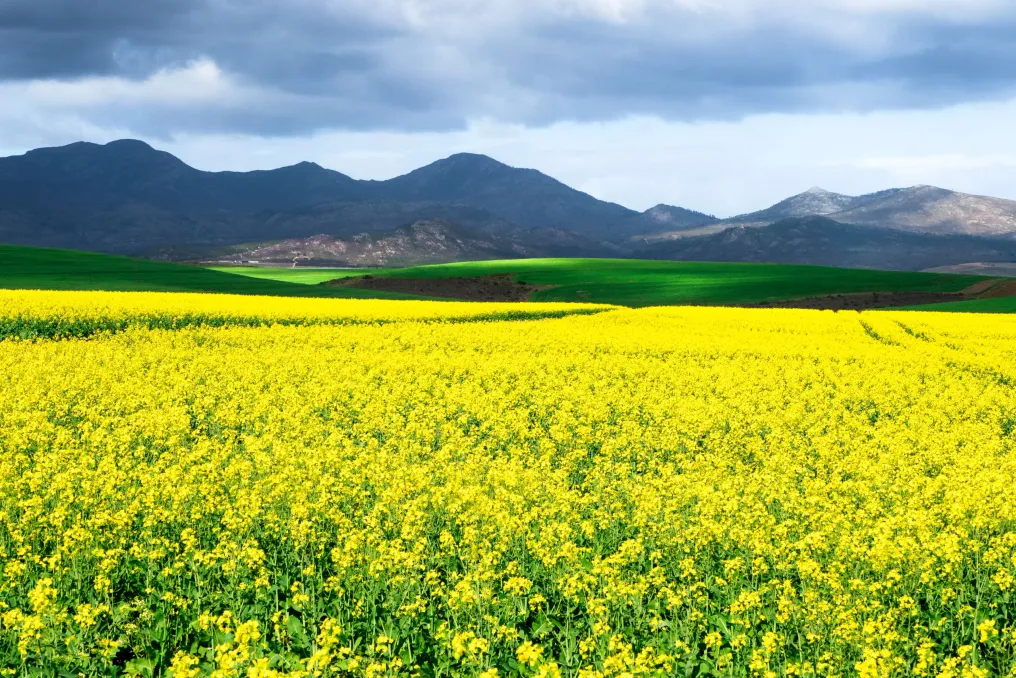
The signs that winter has finally ended are best demonstrated by the spring flowers in South Africa. The arrival of spring transforms many familiar landscapes across the country, from the vast carpets of wildflowers in the Namakwalands to the fynbos-covered slopes of the Western Cape.
The blooming time is not guaranteed, as the appearance and duration of flowering depend on rainfall, temperature, and sunlight. This uncertainty makes the season special; one cannot simply arrive at any time and expect the heather grass to be in full bloom.
However, if the right time is chosen, there are several excellent places to experience the spring bloom.
Best place for a full wildflower experience
For a complete immersion into the world of wildflowers, the Namakwa National Park is hard to beat. As part of the Succulent Karoo, the park is home to an exceptional diversity of vegetation, including over a thousand species found nowhere else on Earth. In August and September, its usually arid landscapes can transform into floral carpets almost overnight.
The flowering is closely linked to winter rainfall, so each season looks slightly different. In 2026, SANParks reported the first flowers appearing in late July, with the peak season expected between mid-August and mid-September, provided the weather is favorable. The park has a long history of recognizing the importance of this landscape and its biodiversity; today it is part of the protected Succulent Karoo, and its cultural heritage also includes connections to the Nama people and ancient San rock art.
Visiting the West Coast National Park
If the Namakwalands feel like a specially planned journey, the West Coast National Park offers a simpler way to experience the South African spring season, especially for travelers based in Cape Town. Every August and September, the park's heather and fynbos burst into color. Postberg, a section of the park open to visitors specifically during the flowering season, attracts particular attention. Here, flowers grow alongside the park's wildlife and coastal scenery, creating a completely different experience than just walking through a botanical garden.
The flowering season has become one of the park's main annual attractions, with its splendor depending on the previous winter's rainfall. SANParks advises visitors to come on weekdays if possible, as sunny weekends can lead to long queues at the gates.
Hantam Botanical Garden in Nieuwoudtville
Nieuwoudtville is a place that rewards travelers willing to delve deeper. Hantam Botanical Garden covers over 6,000 hectares of shell-renosterveld, dolerite renosterveld, and the Nieuwoudtville Succulent Karoo. This area hosts over 1,350 species of flowers, including more than 80 species endemic to the Bokkeveld Plateau. Spring is considered the best season for the garden, typically running from August to October. Segments of the landscape are covered with annual plants, bulbs, and succulents, including species such as the dark blue Nieuwoudtville Pride and the copper-pink Sparaxis elegans.
The garden's history is closely tied to flower tourism. The site was previously part of Glenlion farm, owned by the McGregor family, who began offering flower tours in 1960. In 2007, SANBI acquired the farm, and it became the Hantam Botanical Garden.
Karoo Botanical Garden
It is not necessary to travel far into the Namakwalands to see impressive spring blooms. The Karoo Desert Botanical Garden, located near Worcester, preserves and displays plants from the arid and semi-arid regions of South Africa. The garden was founded in 1921 and moved from Whitehill near Matiesfontein to Worcester in 1945. Spring is its most popular season, when annuals and geophytes bloom throughout the garden. The display is particularly impressive from late July to late September, when red, pink, yellow, purple, and orange hues appear among the rocky landscape.
Kerstenhof
For those who prefer not to turn a flower hunt into a multi-day trip, Kerstenhof offers one of the most accessible spring sights in the country. The garden was officially established in 1913 after a portion of Cecil John Rhodes' estate was transferred to create a national botanical garden. It was initially a neglected, overgrown farm, but early directors and staff gradually transformed the garden into what visitors know today.
Spring is considered Kerstenhof's most colorful season, when many species begin to bloom in August, with the main spring bloom continuing until September and October. Visitors can expect to see Namakwa daisies, geophytes, bulbs, and blooming fynbos, including proteas, cushion flowers, and cone bushes.
Harold Porter Botanical Garden
On the opposite side of the Cape Peninsula, Harold Porter Botanical Garden offers a more intimate way to experience the Overberg's spring flora. The garden was created in Betties Bay after Harold Nixon Porter acquired land in the area and developed it as a garden and private nature reserve. It opened as Shangri-La Nature Reserve in 1955 and later became a national botanical garden.
Spring, from September to October, brings particularly rich blooms of proteas, ericas, daisies, geophytes, and other fynbos species. The garden's wetland promenade, trails, and mountainous landscape provide visitors with many features to explore besides the flowers themselves.
Flowers in South Africa look stunning precisely because they are temporary. A landscape that may look dry and unremarkable one week can transform after winter rain, only to wilt again as temperatures rise. This makes the flowering season less about visiting a specific spot and more about attentiveness. Before traveling, it is advisable to check rainfall and bloom reports, try to choose sunny weather, and allocate enough time for exploration rather than just photography.